Grishneshwar Jyotirlinga: The Final Jyotirlinga And The Power Of Unwavering Devotion
By Pt. Sanjeev Sharma
Maharashtra’s Final Shiva Jyotirlinga Near the Ellora Caves
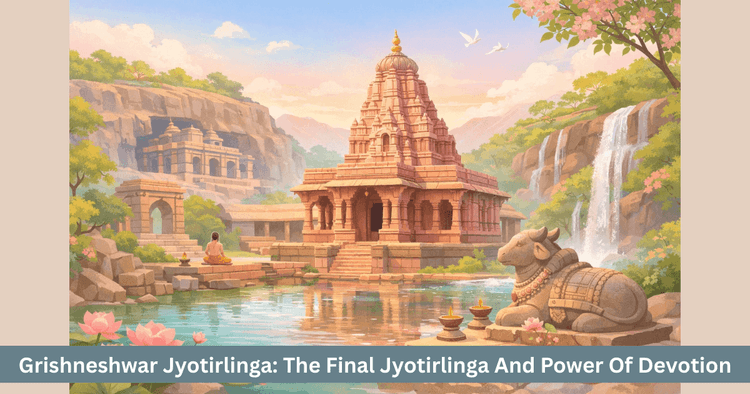
Table of Contents
In the Verul region of Maharashtra, the Grishneshwar Jyotirlinga is revered as the final link in the chain of the twelve Jyotirlingas. Located near the ancient Ellora caves, this sacred shrine is surrounded by an atmosphere that is quiet, humble and naturally turns the mind inward. There is no excessive display of outer grandeur here. Instead, the simple structure, the stone based architecture and the historical surroundings gradually guide the seeker toward an inner journey. Grishneshwar Jyotirlinga becomes a unique center where devotion, sorrow and compassion together take the form of deep trust.
The Ellora caves with their ancient sculptures, temples and spaces for contemplation add to the sanctity of the land around Grishneshwar. While walking in this region one often feels as if the footsteps of countless seekers from earlier times are still present in the memory of the earth. On this very ground stands the Jyotirlinga that reminds the devotee that ultimately the purpose of every outer journey is to come close to the Shiva within.
Sacred Atmosphere Of Grishneshwar Jyotirlinga Near Ellora
Grishneshwar Jyotirlinga stands in the Verul area near Aurangabad in Maharashtra, very close to the Ellora caves. This entire region is regarded as rich in both spiritual and historical terms. On one side there are rock cut monuments and temples. On the other there is this form of Shiva which remains for devotees a center of living grace even today.
Compared with large pilgrimage centers such as Dwarka, Kashi or Rameswaram, the temple of Grishneshwar appears smaller in scale, yet its special power lies in this very simplicity and intimacy. Even when there is a crowd, a person who reaches the sanctum may feel an unusual sense of being very close to Shiva. This nearness transforms worship from mere formality into genuine inner connection.
What Does The Story Of Ghushma And Grishneshwar Teach
The origin of Grishneshwar Jyotirlinga is connected with a woman named Ghushma, remembered as a deeply devoted worshipper of Shiva. Every day she used to prepare one hundred and one Shiva lingas with her own hands. After performing worship with great faith she would immerse these lingas in water. This practice was not just a mechanical ritual or attachment to numbers. It was a complete expression of her total surrender to Shiva.
A very painful event took place in the life of Ghushma. Jealousy and hatred arose within her own household. Because of this her son was killed and his body was thrown into a lake. For any mother this would be among the most severe trials one could face. It is natural in such a situation to be filled with grief, anger, collapse and complaint. Ghushma however chose another path.
According to the story even after this terrible event, Ghushma did not abandon her chanting or worship. She may have wept for her son, yet she also accepted that everything ultimately unfolds within the will and plan of Shiva. She continued her daily discipline of forming Shiva lingas, offering water on them and immersing them. Her devotion did not depend on outer happiness, safety or favourable conditions. It was based on inner surrender.
Manifestation Of Shiva As Grishneshwar Jyotirlinga
The extraordinary steadiness and faith of Ghushma finally moved Shiva to appear before her. The narrative describes that while she was absorbed in her daily practice of worship and immersion of the lingas, Lord Shiva manifested and stood in her presence. He brought her son back to life. This was not only the return of a child. It symbolised the rebirth of hope and trust.
Shiva told Ghushma that her devotion had compelled him to reveal himself. He offered her a boon and asked what she desired. Ghushma did not ask for personal pleasures, luxury or security. She requested only that Shiva remain at that place for the welfare of all devotees and become a constant source of blessing and protection. In response Shiva established himself there as Grishneshwar Jyotirlinga.
This episode reveals that the aim of true devotion is not confined to the fulfilment of private desires. When a seeker is genuinely surrendered, even the pattern of prayer gradually expands from personal need toward wider welfare. Ghushma’s life demonstrates that however deep sorrow may be, if remembrance and surrender stay firm, then a hidden source of grace can arise from within that very sorrow.
Is Grishneshwar Jyotirlinga A Symbol Of Patience And Endurance
The core message of Grishneshwar Jyotirlinga is closely linked with patience, endurance and unwavering faith. Many other Jyotirlingas emphasise themes such as cosmic power, severe asceticism or protection from outer threats. Grishneshwar, by contrast, highlights personal sorrow and tests that arise within family life and the possibility of remaining steady in devotion amid those tests.
The devotion of Ghushma teaches that genuine surrender is not a feeling that lasts only while everything is favourable. The real test of devotion appears when life brings a person to the hardest turning point. If at that time the mind still returns again and again toward the Divine, it can be said that faith has become an integral part of one’s lived experience, not just a concept.
From this perspective Grishneshwar can become a special source of inspiration for those who are facing family tension, emotional breakdown, mistrust in relationships or deep grief. This Jyotirlinga reminds them that when all other supports seem to fall away, the doorway of Shiva’s remembrance does not close.
Temple Structure And Spiritual Ambience Of Grishneshwar
In the present structure of Grishneshwar temple there is a clear imprint of traditional Maharashtrian style. The temple is built of red stone and displays fine carvings on its inner and outer surfaces. On the shikhara, the walls and the pillars, various forms and symbols connected with Shiva, Parvati and other deities can be seen. Together these elements turn the temple into a living cultural record.
The sanctum of the temple is relatively small and intimate. There is not much distance between the devotee and the Jyotirlinga. Because of this closeness, worship at Grishneshwar often carries the feeling of standing directly before Shiva. This sense of proximity reduces formal distance and awakens a direct, heart level communication.
The surrounding environment, the presence of the Ellora caves, the quiet rural landscape and the soft stillness of the temple courtyard together help to draw the mind away from outer noise. Sitting here, even for a short period of meditation, chanting or silent reflection, one can sense the inner clamour starting to settle.
Spiritual And Astrological Importance Of Grishneshwar Jyotirlinga
From a spiritual standpoint Grishneshwar Jyotirlinga can be especially supportive for seekers who are struggling with marital difficulties, tension within family life, emotional instability or long lasting sadness. In the story of Ghushma, jealousy arises within the family itself, a severe blow comes in the form of her son’s death and yet devotion remains firm. This speaks directly to those who are facing harsh conditions in close relationships.
Astrologically Grishneshwar Dham is often connected with the balancing of combinations related to Chandra and Shukra, that is the Moon and Venus. The Moon represents mind, emotions and memory. Venus is linked with love, relationships, marriage and the finer perception of happiness. When these energies become disturbed a person may feel restless, insecure, depressed or dissatisfied in relationships. The worship of Grishneshwar can encourage the seeker to steady the mind and to cultivate patience and compassion within relationships.
Many people come here with prayers for harmony in marriage, blessings related to children or healing of old emotional wounds. It is important to remember that merely visiting any shrine is not a complete solution. The deeper effect appears when the seeker, alongside the story, atmosphere and worship at Grishneshwar, also makes sincere efforts to change personal patterns of behaviour, thought and communication. The inner strength that arises then becomes a real support.
Some key indications associated with Grishneshwar Jyotirlinga can be viewed in this simple table.
| Aspect | Indication |
|---|---|
| Location | Grishneshwar Jyotirlinga at Verul near Ellora caves |
| Core legend | Devotion of Ghushma, killing of her son, Shiva’s appearance and revival of the son |
| Primary spiritual mood | Patience, surrender and steady devotion in the midst of sorrow |
| Astrological tone | Imbalance involving Moon and Venus, emotional pain, marital and family tension |
| Suggested practice | Abhishek of the Shiva linga, chanting, prayer for harmony in marriage and family |
Festivals And Ongoing Practice At Grishneshwar Dham
As in other shrines of Shiva, Maha Shivratri is celebrated with deep devotion at Grishneshwar Jyotirlinga. Pilgrims arrive from various regions. The temple courtyard becomes filled with the sound of Rudrabhisheka, night long vigil, devotional singing and the chanting of Shiva’s name. Yet even amidst the gathering there is a sense of inner quiet as if the grace of Shiva is gently touching each heart.
During the month of Shravan there is continuous abhishek with water, offering of bilva leaves and repetition of Shiva’s name. Many devotees combine a visit to the Ellora caves with pilgrimage to Grishneshwar Dham. In this way art, history and devotion are experienced in a single journey. This combination suggests that in life it is healthy to carry both outer achievement and inner practice together.
Inner Courage Awakened By Grishneshwar Jyotirlinga
The deepest teaching of Grishneshwar Jyotirlinga is that true strength lies in standing within sorrow without abandoning devotion. The event that took place in the life of Ghushma would be nearly unbearable for most people. Yet she did not give up her spiritual discipline. Her tears, pain and anguish did not stop the remembrance of Shiva.
When a seeker reaches a point in life where everything appears to be breaking, the story of Grishneshwar can offer strong support. This Jyotirlinga tells that if one does not let go of the thread of worship, chanting or inner practice, an unseen strength gradually begins to hold the person. Sometimes outer circumstances also change, as in the revival of Ghushma’s son. At other times the inner perspective shifts and provides such balance that the same old sorrow no longer feels crushing.
In the journey through the twelve Jyotirlingas, Grishneshwar stands as the final link and reminds the seeker that among the many forms of Shiva associated with power, knowledge, protection or austerity, there is also a form that directly shares the tears and wounds of the devotee. Grishneshwar Jyotirlinga represents this tender yet strong presence. It conveys that when devotion remains unwavering, grace too finds a way to reveal itself.
Frequently Asked Questions
Question 1. Where is Grishneshwar Jyotirlinga located and why is it regarded as the twelfth Jyotirlinga
Grishneshwar Jyotirlinga is located in the Verul area of Maharashtra near the Ellora caves. It is regarded as the twelfth Jyotirlinga because traditional lists describe it as the final shrine in the sequence of twelve.
Question 2. What is the central message in the story of Ghushma
The story of Ghushma teaches that however intense suffering may be, if the thread of devotion and chanting does not break, that unwavering faith becomes the cause for grace. She did not abandon Shiva worship even after the death of her son.
Question 3. For which situations can Grishneshwar Jyotirlinga be considered helpful from an astrological point of view
Grishneshwar Jyotirlinga can be considered supportive in conditions related to imbalance involving the Moon and Venus, emotional pain, tension in marriage or bitterness within the family, since the practice here encourages stability of mind and balance in relationships.
Question 4. What forms of practice are suitable at Grishneshwar Temple
Abhishek of the Shiva linga with water, milk or other sacred offerings, chanting the name of Shiva and praying especially for the wellbeing of marriage and family are suitable forms of practice here. Sitting quietly while reflecting on the story of Ghushma can also give deep inner strength.
Question 5. What practical lesson can a seeker receive from a visit to Grishneshwar Jyotirlinga
A visit to Grishneshwar teaches that even in situations filled with difficulty and sorrow, if one maintains devotion, patience and surrender, hope can return, relationships can soften and a new beginning can arise from within.
Get your accurate Kundali
Generate KundaliDid you like it?
Author

Pt. Sanjeev Sharma (63)
Experience: 20
Consults About: Family Planning, Career
Clients In: Punjab, Haryana, Delhi
Share this article with friends and family
About ZODIAQ
ZODIAQ is an online Vedic Astrology platform. It connects clients seeking astrological advice to experienced astrologers with deep knowledge. Our users also generate kundali and perform kundali milan for free. ZODIAQ also offers services to the Astrologers. Astrologers utilize various offerings by ZODIAQ to serve their clients effectively.
If you are a User
Consult with experienced astrologers and seek their guidance. You can also order handwritten Janm Patrika report with life prediction prepared by experienced astrologers. Generate accurate Kundali, perform Kundali Matching and check horoscope and muhurat. Utilize our online library for all the necessary astrological and spiritual information.
If you are an Astrologer
Create accurate kundali for your clients and perform Kundali Matching for up to 5 people at a time. Write comprehensive Janm Patrika report for your clients with ZODIAQ. Check client details anytime by saving it in client directory. Become more productive by tracking how many clients you guide every day.
WELCOME TO
ZODIAQ
Right Decisions at the right time with ZODIAQ
