The Story of Guru Purnima and the Birth of Ved Vyasa
By Aparna Patni
Auspicious Day to Honour the Guru and the Importance of Knowledge
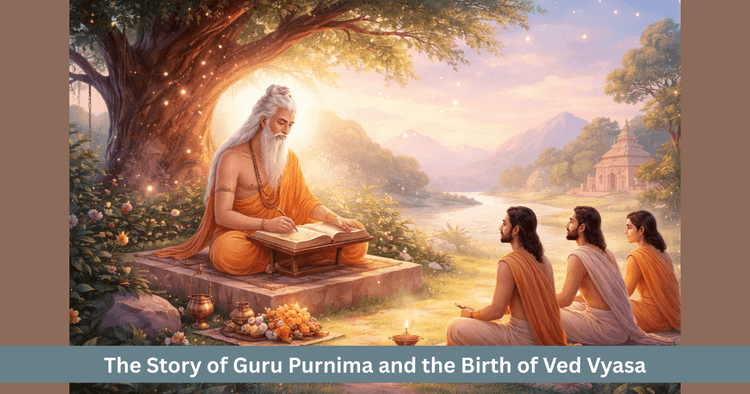
Table of Contents
Guru Purnima is a sacred day dedicated to expressing gratitude towards the guru, the one who brings light into life by removing the darkness of ignorance. On this day, disciples thank their teachers for guiding them on the right path and helping them understand the deeper purpose of human life. Honouring the guru on this full moon is considered a very auspicious act.
In the Hindu tradition, Guru Purnima is also known as Vyasa Purnima, because it is regarded as the birth anniversary of the great sage Veda Vyasa. He divided the Vedas, composed the Mahabharata and authored many Puranas, thereby making higher knowledge accessible to ordinary people. For this reason, on Guru Purnima, Sage Vyasa is revered as the ideal teacher.
Connection between Guru Purnima and Veda Vyasa
Guru Purnima is not just a festival, it is a celebration of the entire guru parampara, the lineage of teachers. On this day, students bow to their academic teachers, seekers honour their spiritual masters and many devotees remember their chosen deity in the form of a guru.
Among all gurus, Veda Vyasa holds a very special place. Through his tapasya and scholarship he organised the Vedas and various scriptures so that they could be remembered and practised by later generations. Because of this contribution, the full moon of this day is lovingly called Vyasa Purnima. The story of his birth beautifully reflects the spirit of Guru Purnima.
How does the birth story of Veda Vyasa begin
The birth story of Veda Vyasa begins with his father, Sage Parashara. Parashara was a renowned rishi, a deep scholar and teacher of Vedic wisdom. His life was devoted to study, contemplation and teaching the Vedas and scriptures to deserving disciples.
Once, Sage Parashara was travelling near the banks of the Yamuna river. He needed to cross the river. There he saw a young woman named Satyavati sitting near a boat. Satyavati was the daughter of a fisherman. Though she came from a simple background, she was known for her kindness, intelligence and noble conduct. She helped her father by ferrying people across the river.
Sage Parashara was impressed by Satyavati’s inner qualities. In his heart he felt that a child born from such a virtuous woman would surely be endowed with great wisdom. He spoke to her respectfully and recognised her goodness. According to the story, with Satyavati’s consent, Sage Parashara entered into marriage relation with her.
In due time, Satyavati gave birth to a son. This child was no ordinary boy. From birth, he showed a natural radiance, calmness and deep spiritual inclination. Sage Parashara named him Krishna Dvaipayana. The name Krishna referred to his dark complexion and Dvaipayana reminded of his birth on a small island like spot.
From Krishna Dvaipayana to Veda Vyasa
As Krishna Dvaipayana grew up, he turned towards study and tapasya, following the path of his father. He mastered the Vedas, Upanishads, Brahmana texts, dharma shastras and many branches of spiritual knowledge. Gradually he himself became a respected guru.
His most famous service to dharma was the careful arrangement of the Vedas. At that time the Vedic mantras were preserved mainly in memory and were vast and difficult for common people to grasp. Krishna Dvaipayana divided them into four sections so that different groups of seekers could learn according to their nature and capacity. These four came to be known as Rigveda, Samaveda, Yajurveda and Atharvaveda. Because of this work, he became known as Veda Vyasa, the one who classified the Vedas.
The Katha further tells that Veda Vyasa not only worked on the Vedas, he also composed the Mahabharata and many Puranas. Through these texts he presented dharma, devotion, ethics and practical wisdom in the form of stories and teachings. Within the Mahabharata, the Bhagavad Gita stands as a clear guide for right living, which adds even more weight to his role as a guru.
Veda Vyasa as a living example of the guru
Veda Vyasa was not just an author. He was a true guru in every sense. He did not keep his knowledge to himself but shared it with disciples and used it to uplift society.
- He structured the Vedas in such a way that people of different tendencies could access spiritual knowledge through different paths.
- Through the Mahabharata, he brought the principles of dharma out of secluded ashramas into the lives of kings, householders, warriors and common people.
- A guru’s duty is not only to teach texts but to refine the mind of the disciple so that the disciple can choose rightly. Veda Vyasa’s life story symbolises this deeper guidance.
That is why on Guru Purnima, people bow not only to visible teachers but also to wisdom, discrimination and inner guidance as forms of the guru. Veda Vyasa is honoured as a meeting point of all these expressions.
What does Guru Purnima teach us
The story of Guru Purnima offers a simple yet powerful teaching. Knowledge becomes complete only when it is shared. Veda Vyasa illumined the path of countless people by distributing what he had realised. Following his example, each person can, in a small way, share clarity, right values and helpful insights in daily life.
Many visit their teachers on this day, some touch the feet of their parents and others silently remember those who have shaped their thinking. For spiritual seekers, the inner guru in the heart is also worshipped, the guiding presence that quietly shows the difference between right and wrong.
If on Guru Purnima a person resolves to reduce at least one weakness and cultivate at least one noble quality in the coming year, this full moon becomes more than a festival. It turns into a starting point for genuine inner growth. In this lies the true significance of this sacred day.
Common questions about Guru Purnima
Is Guru Purnima celebrated only as the birthday of Veda Vyasa?
It is primarily honoured as the birth day of Sage Vyasa, yet the day is also dedicated to all gurus who have given knowledge, direction or inspiration, whether spiritual or worldly.
Are only spiritual gurus worshipped on this day?
Spiritual masters are central to the observance but parents, school teachers and any genuine guide in life are also respected as gurus. People follow their own family and cultural traditions in this regard.
Is there any compulsory fast or ritual on Guru Purnima?
Common practices include bathing, wearing clean clothes, offering flowers at the feet of the guru, chanting mantras, reading sacred texts and expressing gratitude. More than fixed rules, sincerity and reverence are important.
Is Guru Purnima significant only in the Hindu tradition?
Within Hindu dharma it is deeply linked with Vyasa and the guru lineage. Some other Indian spiritual traditions also observe this day to honour their teachers, though details and stories may vary.
What special meaning does Guru Purnima hold for children and students?
For them, it is a gentle reminder to respect their teachers and parents, value learning and approach studies with discipline. Listening with attention and following good advice is also a form of guru bhakti.
Get your accurate Kundali
Generate KundaliDid you like it?
Author

Aparna Patni (63)
Experience: 20
Consults About: Family Planning, Career
Clients In: Punjab, Haryana, Delhi
Share this article with friends and family
About ZODIAQ
ZODIAQ is an online Vedic Astrology platform. It connects clients seeking astrological advice to experienced astrologers with deep knowledge. Our users also generate kundali and perform kundali milan for free. ZODIAQ also offers services to the Astrologers. Astrologers utilize various offerings by ZODIAQ to serve their clients effectively.
If you are a User
Consult with experienced astrologers and seek their guidance. You can also order handwritten Janm Patrika report with life prediction prepared by experienced astrologers. Generate accurate Kundali, perform Kundali Matching and check horoscope and muhurat. Utilize our online library for all the necessary astrological and spiritual information.
If you are an Astrologer
Create accurate kundali for your clients and perform Kundali Matching for up to 5 people at a time. Write comprehensive Janm Patrika report for your clients with ZODIAQ. Check client details anytime by saving it in client directory. Become more productive by tracking how many clients you guide every day.
WELCOME TO
ZODIAQ
Right Decisions at the right time with ZODIAQ
