Why Hanuman Ji’s Marriage Was Kept a Secret
By Pt. Nilesh Sharma
The hidden marriage of Hanuman Ji, symbol of devotion, strength, and discipline
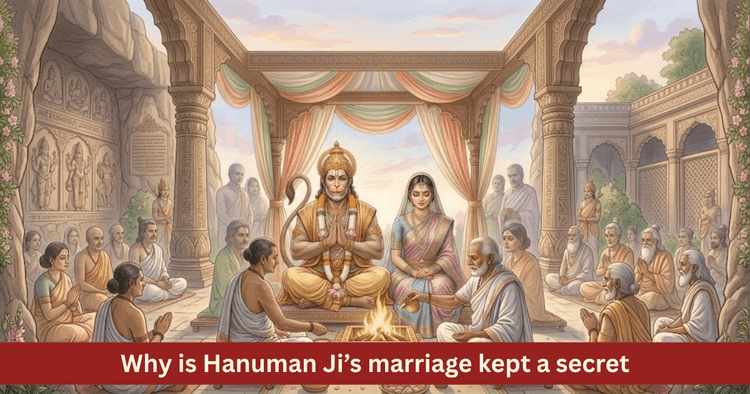
Table of Contents
The moment the name of Hanuman Ji arises, the mind naturally forms the image of a divine being who stands for unshakable devotion, immense strength, perfect discipline and Brahmacharya. For generations, devotees have remembered, worshipped and loved him in this very form. That is why whenever a story connected with Hanuman Ji’s marriage appears, it immediately creates surprise. The question arises naturally. If he was a Brahmachari, where did the idea of marriage come from. And if such a marriage did happen, then why did this episode remain hidden from the larger devotional memory for so long.
This is the point where the story becomes much more than a simple curiosity. It is not only a tale about marriage. It opens deeper layers of dharma, knowledge, discipline, inner restraint, duty and detachment and in doing so, it makes Hanuman Ji’s life feel even more vast. A quiet tradition in Telangana has preserved this account without noise, without debate and without insistence. It does not try to prove anything. It simply continues to exist in faith. And perhaps that is its greatest strength.
The belief we never thought to question
For most devotees, Hanuman Ji is the supreme Brahmachari. From childhood onward, stories present him as the embodiment of self control, unwavering service and absolute dedication to Shri Rama. He kept strength under devotion, intelligence under dharma and his mind fixed only at the feet of the Lord. Because of this, the idea of his Brahmacharya became so deeply rooted that few ever felt the need to imagine any other possibility.
Yet Indian tradition often preserves more than one layer of truth. Regional legends, temple traditions and oral memories sometimes protect aspects of a deity that remain outside the better known public understanding. The story of Hanuman Ji’s marriage belongs to this kind of sacred memory. It does not break his traditional identity. Instead, it reveals another dimension hidden within it.
Why does the question of Hanuman Ji’s marriage arise at all
This question does not appear without context. According to a traditional account, when Hanuman Ji was receiving knowledge from Surya Dev, he sought not ordinary learning but mastery over nine divine disciplines. He was not the kind of disciple who could be content with partial knowledge. He had deep inquiry, discipline and the unwavering desire to complete what he had begun.
Here the story reaches a turning point where dharma and life come into an unusual balance. It is said that among those sacred forms of knowledge, some could be imparted only to a disciple who had entered the state of marriage. This created a rare situation and it is here that Hanuman Ji’s decision takes on deeper meaning.
The condition that changed everything
Surya Dev is not only the deity of light but also a profound source of consciousness and knowledge. To study under him is not merely to receive information but to become worthy through discipline and inner refinement. According to this legend, when Hanuman Ji approached the completion of nine divine vidyas, he was told that some among them could only be transmitted to a married disciple.
This moment is central to the entire story. He stood before two paths. One was to remain content with incomplete learning. The other was to fulfill the condition required for completion. Hanuman Ji chose not from desire but from purpose. He did not choose worldly life. He chose the path through which knowledge could be completed in a dharmic manner.
Main points of this turning moment
- Hanuman Ji was studying under Surya Dev
- He sought completion in nine divine vidyas
- Some forms of sacred knowledge required a married disciple
- The decision became one of knowledge fulfillment, not desire
- This is where the marriage narrative begins
Who was Suvarchala Devi
According to this tradition, Hanuman Ji married Suvarchala Devi, who is regarded as the daughter of Surya Dev. In this story, Suvarchala is not merely a narrative figure. She represents radiance, discipline, sacred purpose and spiritual dignity. Because she is linked with the solar lineage, her presence in the story is also seen as deeply significant.
Her role gives further depth to the account, because this marriage is not presented as emotional attachment or worldly expansion. It appears as a dharmic, purposeful and spiritual union connected with a higher requirement rather than ordinary household life.
Why was this marriage not a conventional household relationship
This tradition makes it clear that the union of Hanuman Ji and Suvarchala Devi was not a conventional married life in the ordinary worldly sense. It was not based on attachment, emotional dependence or domestic companionship. Its foundation was duty, eligibility for knowledge and a higher spiritual purpose. It is believed that after the marriage, Suvarchala Devi entered deep meditation and tapas.
That is why ordinary definitions of marriage are not enough to understand this account. Here, marriage becomes a sacred structure serving a higher purpose, not a bond of worldly attachment. In this way, the story asks us to think of marriage not only as a social arrangement but also as a dharmic form whose meaning may change according to context.
Then why is Hanuman Ji still called a Brahmachari
This is the question that gives the story its greatest depth. If marriage took place, why is Hanuman Ji still worshipped as a Brahmachari. The answer lies in the deeper meaning of Brahmacharya. It is not merely the physical condition of remaining unmarried. Its true meaning lies in complete control over mind, senses, desire and inner energy. It means directing life force toward the highest purpose.
The center of Hanuman Ji’s life never became worldly involvement. His center remained Shri Rama, dharma, service and devotion. Even if this story is accepted, no worldly attachment, no domestic indulgence and no desire based life is attributed to him. That is why his Brahmacharya is not weakened by this account. It is strengthened by it. The story teaches that true Brahmacharya is determined not by outer circumstance but by inner state.
Essential points for understanding Brahmacharya here
- Brahmacharya is not only remaining unmarried
- It is mastery over mind and senses
- Hanuman Ji remained rooted in service and devotion to Shri Rama
- No worldly attachment developed in his life
- Therefore his Brahmachari identity remains intact
Why did this story remain hidden or lesser known
The mainstream devotional image of Hanuman Ji has always emphasized his one pointed Brahmacharya, heroic strength and role as Ramaduta. Devotional communities naturally centered that form in worship and remembrance. Regional traditions that preserved alternative narratives often remained limited to specific sacred spaces and oral memory. This story may also have remained less discussed because it is subtle. If understood only externally, people may rush to simplistic conclusions. To truly understand it, one must reflect on deeper ideas such as Brahmacharya, dharma and purpose based marriage.
Another reason is that many Indian temple traditions remain powerful without seeking wide publicity. They survive through faith, not through debate. They do not impose their memory. They simply preserve it. The marriage tradition of Hanuman Ji seems to belong to this kind of quiet sacred continuity.
The temple in Telangana that keeps this account alive
A special tradition associated with Yelandu in Telangana is often mentioned in connection with this legend, where Hanuman Ji is worshipped alongside Suvarchala Devi. The importance of this temple lies not only in its sacred presence but in the rare tradition it carries. Devotees who visit do not usually treat it as a matter of argument. They approach it as living faith.
There is a local belief that the temple blesses married life with love, harmony and peace. It is also associated with those who seek balance, duty and spiritual alignment in relationships. Through this temple tradition, Hanuman Ji appears not as a symbol of worldly marriage but as a reminder that even a sacred bond can remain free from attachment when rooted in purpose.
What different message does this temple tradition offer
In most Hanuman temples, devotees encounter him as the heroic, solitary and ever alert servant of Shri Rama. But the Yelandu tradition shows another layer. It suggests that dharma can hold multiple dimensions. The very deity we know in one way may, in another context, teach a different truth about life.
In this tradition, Hanuman Ji’s identity does not move against Brahmacharya. Rather, it shows that duty and detachment can coexist. A choice made for knowledge, when free from desire, can still remain within spiritual dignity. This is the subtle message of the story.
Distinct features of this temple tradition
- Worship of Hanuman Ji with Suvarchala Devi
- Blessings for balance in marriage and relationship harmony
- A quiet faith based tradition without argument
- A message joining duty with detachment
- A regional sacred memory preserved in devotion
What does this form of Hanuman Ji teach us
This account first teaches that dharma does not always move in straight and simplistic lines. Sometimes the very characters we think we understand fully carry much deeper dimensions within them. This story shows that purpose determines the true meaning of an action. If a decision arises not from desire but from dharma, knowledge and sacred duty, then its spiritual meaning becomes entirely different.
The second deep lesson is that inner restraint is never determined merely by outer form. Hanuman Ji becomes even greater through this narrative, not smaller. Here he does not appear only as a strong devotee but as a being who remains inwardly unshaken even in unusual circumstances.
Why does this account deepen devotion even more
When we see Hanuman Ji only as the symbol of strength, devotion and service, he is already magnificent. But when this lesser known account is heard, layers of knowledge, dharmic dilemma, purposeful action, detachment and inner discipline begin to appear in his life. Then Hanuman Ji no longer remains only a deity of worship. He also becomes a guide for deep decisions in life.
That is why this story not only creates curiosity but also deepens faith. It reminds us that a character who appears simple on the surface may be inwardly vast beyond imagination. And perhaps for this reason, after hearing this account, Hanuman Ji begins to feel even broader, more profound and yet even more divine.
Is it necessary for everyone to accept this story
Dharma contains many traditions and every devotee may accept or not accept a story based on personal faith, study and inherited understanding. The account of Hanuman Ji’s marriage is also such a tradition. No one is required to adopt it. Yet rejecting it only because it differs from the mainstream understanding may also be unwise. One of the great beauties of Indian spiritual tradition is that it allows more than one sacred layer to coexist.
For this reason, it is best understood as a regional sacred legend, a temple based tradition and a spiritual illustration. It does not diminish Hanuman Ji. It broadens the range of how his life may be contemplated.
The deeper message hidden in this quiet secret
This account of Hanuman Ji’s marriage ultimately gives a profound spiritual teaching. Dharma is not only outer identity. Brahmacharya is not merely a social condition. Marriage is not always about enjoyment. Knowledge is not merely information. Surrender is not merely emotion. When a life integrates all these within dharma, it becomes extraordinary.
This quiet and lesser known episode teaches that duty without attachment, knowledge joined with detachment and a life guided by devotion create true strength. That may be the deepest reason this story remained quiet, yet never disappeared.
Frequently asked questions
Did Hanuman Ji really get married
According to certain regional legends and temple traditions, Hanuman Ji is believed to have married Suvarchala Devi, though this is not equally emphasized in all mainstream narratives.
Why did Hanuman Ji marry
It is believed that he accepted marriage in order to complete divine learning from Surya Dev, because some sacred vidyas could be given only to a married disciple.
Who was Suvarchala Devi
According to traditional belief, Suvarchala Devi was the daughter of Surya Dev and holds an important place in this marriage narrative.
How is Hanuman Ji still considered a Brahmachari if marriage happened
Because Brahmacharya does not mean only remaining unmarried. It also means complete mastery over mind, senses and desire. Hanuman Ji is believed to have remained free from worldly attachment.
Where is this temple believed to be located
According to local belief, this special temple is located in Yelandu, Telangana, where Hanuman Ji is worshipped with Suvarchala Devi.
Get your accurate Kundali
Generate KundaliDid you like it?
Author

Pt. Nilesh Sharma (63)
Experience: 20
Consults About: Family Planning, Career
Clients In: Punjab, Haryana, Delhi
Share this article with friends and family
About ZODIAQ
ZODIAQ is an online Vedic Astrology platform. It connects clients seeking astrological advice to experienced astrologers with deep knowledge. Our users also generate kundali and perform kundali milan for free. ZODIAQ also offers services to the Astrologers. Astrologers utilize various offerings by ZODIAQ to serve their clients effectively.
If you are a User
Consult with experienced astrologers and seek their guidance. You can also order handwritten Janm Patrika report with life prediction prepared by experienced astrologers. Generate accurate Kundali, perform Kundali Matching and check horoscope and muhurat. Utilize our online library for all the necessary astrological and spiritual information.
If you are an Astrologer
Create accurate kundali for your clients and perform Kundali Matching for up to 5 people at a time. Write comprehensive Janm Patrika report for your clients with ZODIAQ. Check client details anytime by saving it in client directory. Become more productive by tracking how many clients you guide every day.
WELCOME TO
ZODIAQ
Right Decisions at the right time with ZODIAQ
