Hariyali Teej Vrat Katha and the Inner Meaning of Devi Parvati’s Tapasya
By Pt. Narendra Sharma
Significance of the Fast for Marital Happiness and Stable Household
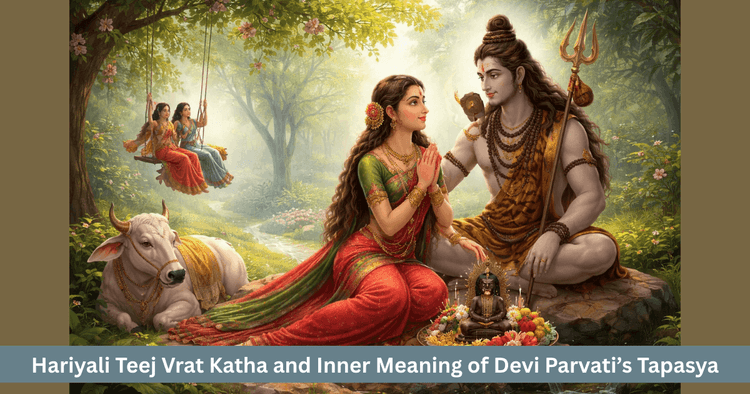
Table of Contents
In the lush greenery of Shravan the mind and nature both soften in their temperament. During this time Hariyali Teej is not seen as just a festival. It is understood as a very sacred fast associated with marital happiness, auspicious fortune and longevity of married life. On this day special worship of Devi Parvati is performed and it is believed that listening to or reading the vrat katha with faith blesses unmarried girls with a suitable life partner and married women with a stable and happy household.
The Bhavishya Purana gives a detailed description of Hariyali Teej. The fast observed on the tithi of Tritiya is said to please Devi Parvati very quickly. Traditionally on the day of Hariyali Teej in the month of Shravan women observe a fast and worship Shiva and Parvati together. Behind this vrat lies not only a ritual practice but also a profound narrative of many births of Devi Parvati and her intense penance to regain Lord Shiva as her husband.
What Is Hariyali Teej and For Whom Is It Auspicious
Hariyali Teej is a major festival of the month of Shravan and is regarded as completely dedicated to Devi Parvati. Teej refers to the lunar date of Tritiya. According to Bhavishya Purana the fast on this tithi is especially effective in pleasing Devi Parvati.
The scriptures mention that the Moon has twenty seven wives and among them Rohini is the most beloved. The story narrates that Rohini observed a special fast on the tithi of Tritiya. As a result the affection of the Moon turned more strongly towards her than towards the others. On this basis the Teej fast is regarded as one that increases love, attachment and auspiciousness in married life.
During the month of Shravan those unmarried girls and married women who listen to the Hariyali Teej katha on Tritiya and worship Devi Parvati along with Lord Shiva are believed to receive blessings of a desired life partner and long lasting marital fortune. It is said that on this very day Shiva and Parvati themselves declared this fast to be especially beneficial for maidens and married women.
Ancient Episode of Devi Sati Linked with the Vrat
To understand the katha of Hariyali Teej it is important first to know the previous birth of Devi Parvati, the story of Devi Sati. According to the Puranas Devi Parvati in her earlier birth was Sati, daughter of Daksha Prajapati. At that time Daksha had a negative attitude towards Lord Shiva. He wished to marry his daughter Sati to Lord Vishnu, whereas Sati had already accepted Shiva in her heart as her husband.
Eventually bowing to circumstances and his daughter’s insistence, Daksha had to perform the marriage of Sati with Lord Shiva. Because his heart did not agree, a feeling of hostility towards Shiva remained with Daksha. After some time Daksha organised a grand sacrifice. For this he invited all the gods, seers, nagas, gandharvas and prominent beings of different realms but did not invite Lord Shiva and Sati.
When the talk of this great sacrifice spread through the three worlds the news reached the ears of Devi Sati. She felt deep sorrow that her father had not considered it necessary to invite her and her husband to the sacrifice. Yet being a daughter her heart became restless to visit her father’s house.
Sati Reaches the Sacrifice Uninvited and the Painful Act of Self Immolation
Devi Sati expressed her wish to attend the sacrifice to Lord Shiva. Mahadev calmly told her that going uninvited to the father’s house leads to loss of honour and that it is not right to visit a place where there is no respect. He tried to stop her and explained that attending this sacrifice might even result in insult.
However Sati’s heart was so firm in affection and insistence that she decided not to follow Shiva’s advice and resolved to go alone to her parental home. She reached the great sacrifice of her father without an invitation.
On arriving at the sacrificial ground she did not receive a welcome of love and respect. Instead she met with insult. Daksha not only criticised Lord Shiva, he also disapproved of Sati’s presence. His harsh words deeply wounded Sati’s heart.
At that moment Sati remembered all the warnings of Mahadev in which he had indicated that entering an uninvited place could bring humiliation. She felt that she herself had invited this insult and that because of her presence her revered husband had to hear words of contempt.
She became overwhelmed with grief and anger. She decided that the body which had endured the insult of Lord Shiva was not worthy of living further. Meditating on Shiva she entered the same sacrificial fire and offered herself in self immolation. In this way Sati gave up her body in her father’s sacrifice and upheld the highest ideal of wifely devotion.
Lord Shiva’s Anger and Withdrawal After Sati’s Death
When news of Devi Sati entering the fire reached Lord Shiva his anger flared fiercely. From his matted hair he manifested a mighty being named Virabhadra and ordered him to destroy the sacrifice of Daksha. Virabhadra reached the ritual ground, destroyed the entire arrangement and reduced Daksha’s pride to dust.
After this Lord Shiva turned towards deep renunciation. Sorrowful in Sati’s separation he withdrew into intense austerity. On the other side, Sati had to bear the result of her own decision. For disobeying the instruction of Lord Shiva she had to wander through many births.
According to the narrative Devi Sati took altogether one hundred and eight births. In the first one hundred and seven births she performed severe penances in many worlds and forms with the sole wish to regain Shiva as her husband.
Birth as Devi Parvati and Connection with Hariyali Teej
In her one hundred and eighth birth Devi Sati was born in the house of Himalaya as Parvati. In this birth her mind naturally inclined towards Lord Shiva from childhood. She desired Him alone as her future husband.
The story describes that in the holy month of Shravan Devi Parvati moulded a Shivling from sacred clay. She remained absorbed in the worship of this Shivling and entered deep tapasya. King Himalaya too was astonished to see his daughter’s intense spiritual practice yet Parvati’s resolve remained firm that even in this birth she would accept only Mahadev as her husband.
After many years of ascetic practice and devotion, during this auspicious time filled with greenery, on the holy day of Hariyali Teej Lord Shiva appeared before Parvati. Pleased with her penance and surrender He granted her the boon that she would become His ardhangini, His inseparable consort. Thus on the day of Hariyali Teej Devi Parvati received her desired husband, Lord Shiva.
This is considered the moment when the Hariyali Teej fast was declared especially fruitful for women. Shiva Himself told Parvati that any maiden who observes the fast of Hariyali Teej with devotion and worships Shiva and Parvati would also obtain a worthy husband.
Fruits of the Vrat and Message for Married Women
The katha of Hariyali Teej is very important not only for unmarried girls but also for married women. It is believed that married women who observe this fast and worship Shiva and Parvati experience lasting love, respect and stability in their married life.
This vrat is a symbol of the resolve, restraint and surrender of a woman. Devi Parvati performed penance through many births and on the day of Hariyali Teej regained Shiva as her husband. Inspired by this ideal women believe that by observing this fast with a sincere heart the bond between husband and wife becomes stronger and obstacles of life gradually lighten.
| Indication of Hariyali Teej Vrat | Inner spiritual meaning |
|---|---|
| Tapasya of Parvati | Patience, surrender and single pointed love |
| Appearance of Shiva | Grace at the right time and fulfilment of wish |
| Boon for maidens | Hope for finding a worthy life partner |
| Message for married women | Love, respect and lasting marital fortune |
Common Questions Related to Hariyali Teej Vrat
For whom is the Hariyali Teej Vrat mainly considered auspicious?
The Hariyali Teej Vrat is regarded as auspicious for both unmarried girls and married women. Maidens observe it for a suitable life partner and married women for stable, happy married life and long lasting marital fortune.
What relationship is described between Devi Sati and Devi Parvati in this katha?
In the story Devi Parvati is described as the later birth of Devi Sati. Sati performed penance across many births and finally, as the daughter of Himalaya, was born again as Parvati and once more obtained Lord Shiva as her husband.
How is Sati’s self immolation at the sacrifice connected with Hariyali Teej?
After Sati’s self immolation began the series of her rebirths. At last she was born as Parvati and on the day of Hariyali Teej she was united again with Shiva. Hence this fast is considered closely connected with the penance and surrender of Sati Parvati.
What inner attitude is regarded as most important in Hariyali Teej Vrat?
In this vrat inner feeling, faith and devotion are more important than external show. Following the example of Parvati, firm resolve, self control and trust in the divine are regarded as the real essence of the fast.
Is the Hariyali Teej Vrat meant only for women?
The fast is mainly observed by women. However men too can worship Shiva and Parvati on this day and pray for family happiness, stability of married life and auspicious fortune.
Get your accurate Kundali
Generate KundaliDid you like it?
Author

Pt. Narendra Sharma (63)
Experience: 20
Consults About: Family Planning, Career
Clients In: Punjab, Haryana, Delhi
Share this article with friends and family
About ZODIAQ
ZODIAQ is an online Vedic Astrology platform. It connects clients seeking astrological advice to experienced astrologers with deep knowledge. Our users also generate kundali and perform kundali milan for free. ZODIAQ also offers services to the Astrologers. Astrologers utilize various offerings by ZODIAQ to serve their clients effectively.
If you are a User
Consult with experienced astrologers and seek their guidance. You can also order handwritten Janm Patrika report with life prediction prepared by experienced astrologers. Generate accurate Kundali, perform Kundali Matching and check horoscope and muhurat. Utilize our online library for all the necessary astrological and spiritual information.
If you are an Astrologer
Create accurate kundali for your clients and perform Kundali Matching for up to 5 people at a time. Write comprehensive Janm Patrika report for your clients with ZODIAQ. Check client details anytime by saving it in client directory. Become more productive by tracking how many clients you guide every day.
WELCOME TO
ZODIAQ
Right Decisions at the right time with ZODIAQ
