Hartalika Teej Vrat Katha and the Blessing of an Ideal Husband
By Pt. Narendra Sharma
Teej Vrat for Finding a Life Partner and Marital Stability
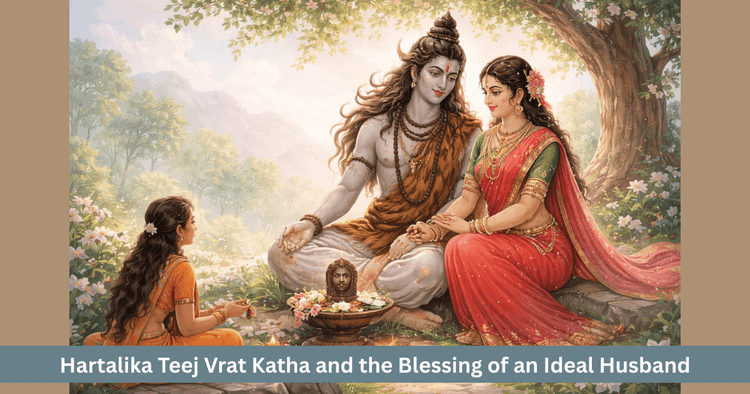
Table of Contents
Hartalika Teej is regarded as a sacred vow that symbolises the divine union of Lord Shiva and Mata Parvati. Observed on the third lunar day of the bright fortnight of Bhadrapada, this Teej is considered highly auspicious for both unmarried girls and married women. The Hartalika Teej vrata is believed to grant a desired life partner, unbroken marital good fortune and stability in married life.
According to the sacred narrative, Lord Shiva himself reminded Mata Parvati of her previous birth and the greatness of the Hartalika Teej vow. He explained that it was through this very vrata that their own marriage became possible. For this reason the observance is especially recommended for unmarried girls who seek an ideal, virtuous and suitable husband.
Date and Significance of Hartalika Teej
Hartalika Teej is celebrated on the shukla tritiya of the month of Bhadrapada. In many traditions this tritiya is considered especially auspicious when it coincides with Hasta nakshatra. On this day women observe a strict fast, often without water or with only fruits and spend the night in vigil, worshipping Lord Shiva and Mata Parvati.
The word Hartalika is formed from two parts. "Har" refers to Hara or Shiva and "talika" conveys the sense of a companion or friend. In the story, Parvati’s friend takes her away from home into the deep forest for her spiritual practice. Because of this, the vow came to be known as Hartalika and is seen as a symbol of friendship, support and single pointed love.
| Aspect of Hartalika Teej | Inner meaning and importance |
|---|---|
| Bhadrapada shukla tritiya | Day of Shiva Parvati worship and deep spiritual practice |
| Observers of the vow | Unmarried girls and married women |
| Main fruits | Desired husband, unbroken marital fortune and stability |
| Deities worshipped | Lord Shiva and Mata Parvati |
How Did Mata Parvati’s Austerity Begin
Lord Shiva told Parvati that in a previous time, on the banks of the Ganga near the abode of King Himavan, she had begun her austerities from early childhood. Her only aim was to obtain Lord Shiva as her husband.
Parvati practised severe tapas for twelve years, remaining with her head bent downward in deep concentration. During this long period she gave up all cooked food and survived only by chewing dried leaves fallen from trees. Behind this tapas stood unwavering love and a firm resolve to accept Shiva alone as her life partner.
Tapasya amid the Challenges of the Seasons
Parvati’s tapas was difficult not only in duration but also in the outer conditions. In the intense cold of the month of Magha she stood immersed in water, continuing her austerity despite shivering limbs and biting winds.
In the burning heat of Vaishakha she performed tapas surrounded by the panchagni, four fires around her and the blazing sun above. In the season of Shravan, under heavy monsoon rains, she remained under the open sky without taking food or water, maintaining her vow with unshaken patience.
Through these harsh shifts of season her observance was a test not just of physical endurance but of inner determination and faith and in each test she remained steadfast.
Concern of Father Himavan and the Visit of Narada
Seeing his daughter’s rigorous penance, King Himavan was deeply troubled. He felt pain witnessing her bodily hardship, yet he was also aware of the strength of her resolve and did not wish to disturb her spiritual path.
At this time, sage Narada arrived at his abode. After being respectfully received, Narada explained the purpose of his visit. He said that he had come at the request of Lord Vishnu, who had been pleased by Parvati’s austerities and wished to marry her.
Himavan was moved with joy on hearing this. He felt that no greater bridegroom could be found for his daughter and that every father would desire such a match, where the daughter becomes the Lakshmi of a noble and prosperous household.
Parvati’s Inner Desire and the Friend’s Wise Counsel
When this proposal reached Parvati’s ears she became deeply distressed. In her heart she had already accepted Lord Shiva as her husband. All her vows and austerities had been directed only towards receiving Shiva as her life partner.
One of her close friends perceived her disturbed state and asked the reason. Parvati confided that her father had agreed to give her in marriage to Vishnu, while she had already chosen Shiva in her heart. She felt trapped and saw no way out other than giving up her life.
The friend, who was wise and insightful, advised her to remain calm. She said that in times of crisis one must not lose courage. A woman’s true fulfilment lies in remaining faithful to the one she has inwardly accepted as her husband. The friend suggested that she would take Parvati away to a dense forest, where they could remain hidden and Parvati could continue her tapas undisturbed, trusting that God would surely help her.
Hartalika Teej Practice and Worship in the Cave
Accepting this plan, Parvati went with her friend to the forest. Meanwhile, when King Himavan realised that his daughter was no longer at home, he was filled with sorrow and anxiety. He also feared the dishonour that might arise if Vishnu came with a wedding party and the bride was missing.
In the forest, Parvati and her friend found a cave on the banks of a river. There Parvati immersed herself in the worship of Lord Shiva. On Bhadrapada shukla tritiya, under the Hasta nakshatra, she formed a Shiva linga from the sand at the riverbank, undertook the vow and spent the entire night in wakefulness, singing hymns in praise of Shiva.
This act of worship, with the sand Shiva linga, the fast and the night vigil, is regarded as the original form of the Hartalika Teej vow, in which Parvati placed her whole life at the feet of Shiva.
Breaking of Shiva’s Samadhi and His Appearance before Parvati
The intense power of Parvati’s tapas caused Lord Shiva’s seat on Kailasa to tremble. His samadhi was interrupted and he became aware that a devotee was worshipping him with great love and single pointed devotion.
He immediately went to the cave where Parvati sat in meditation. Seeing her radiant form, marked by austerity and deep faith, Shiva was greatly pleased and invited her to ask for a boon. This was the direct fruit of her vow, whose sole purpose had been to obtain Shiva as her husband.
Parvati humbly declared that she had already accepted him in her heart as her husband and that if he was truly pleased with her tapas, he should accept her as his consort.
Lord Shiva granted her wish, uttered "tathastu" and returned to Kailasa. Parvati understood that her vow had been fulfilled and that in due course the divine marriage would take place.
Parvati’s Breaking of the Fast and the Father’s Emotion
At dawn, Parvati immersed the articles of worship in the river and, along with her friend, completed the parana or breaking of the fast. At that very time King Himavan, accompanied by his friends and courtiers, reached the spot while searching for her.
Seeing her state and the traces of severe austerity, he was overcome with emotion and sorrow. Tears filled his eyes as he asked why she had left home and undertaken such hardship.
Parvati gently wiped his tears and explained that she had spent most of her life in tapas only to gain Mahadeva as her husband. Her heart and resolve had already been dedicated to him and this was why she had gone to the forest. She said that she would return home only if he agreed to marry her to Mahadeva instead of Vishnu.
Himavan accepted his daughter’s wish and brought her back. After some time, following all the prescribed rites, he solemnised the marriage of Shiva and Parvati. Thus the power of the Hartalika Teej vow paved the way for their divine union.
Fruits of Observing the Hartalika Teej Vow
Lord Shiva told Parvati that the vow she had observed on Bhadrapada shukla tritiya had directly led to their marriage. Therefore this vrata holds special significance. A young unmarried girl who performs it with full faith and one pointedness is blessed with a worthy and desired husband.
For married women the vow is considered a source of unbroken marital fortune, longevity of the husband and stability in married life. Hartalika Teej is thus not only a festival but also a spiritual discipline that expresses a woman’s faith, surrender, patience and steadfastness towards her chosen goal.
Frequently Asked Questions
On which date is Hartalika Teej observed and which divine couple is worshipped?
Hartalika Teej is observed on Bhadrapada shukla tritiya. On this day devotees worship Lord Shiva and Mata Parvati together, remembering Parvati’s tapas and the story of their union.
Why is this Teej called Hartalika?
In the story, Parvati’s friend takes her away from home into the forest for her tapas. "Har" indicates Hara or Shiva and "talika" carries the sense of a friendly companion. Because the friend "carried her away", the vow came to be known as Hartalika Teej.
Is Hartalika Teej only for unmarried girls?
Hartalika Teej is especially recommended for unmarried girls seeking an ideal husband. At the same time married women also observe this vow for the stability of their marriage, the long life of their husbands and the strengthening of their marital fortune.
What special worship did Parvati perform in this vow?
According to the story, on Bhadrapada shukla tritiya under Hasta nakshatra, Parvati created a Shiva linga from river sand, undertook a fast without food or water and spent the entire night in vigil, singing hymns in praise of Shiva. This practice forms the basis of the Hartalika Teej observance.
What is the main spiritual lesson of the Hartalika Teej vow?
The central lesson is that sincere faith, unwavering love and patient perseverance eventually bear fruit. Like Parvati, one who remains firm in a righteous goal and dedicates the heart fully to the Lord can attain the desired blessing at the right time.
Get your accurate Kundali
Generate KundaliDid you like it?
Author

Pt. Narendra Sharma (63)
Experience: 20
Consults About: Family Planning, Career
Clients In: Punjab, Haryana, Delhi
Share this article with friends and family
About ZODIAQ
ZODIAQ is an online Vedic Astrology platform. It connects clients seeking astrological advice to experienced astrologers with deep knowledge. Our users also generate kundali and perform kundali milan for free. ZODIAQ also offers services to the Astrologers. Astrologers utilize various offerings by ZODIAQ to serve their clients effectively.
If you are a User
Consult with experienced astrologers and seek their guidance. You can also order handwritten Janm Patrika report with life prediction prepared by experienced astrologers. Generate accurate Kundali, perform Kundali Matching and check horoscope and muhurat. Utilize our online library for all the necessary astrological and spiritual information.
If you are an Astrologer
Create accurate kundali for your clients and perform Kundali Matching for up to 5 people at a time. Write comprehensive Janm Patrika report for your clients with ZODIAQ. Check client details anytime by saving it in client directory. Become more productive by tracking how many clients you guide every day.
WELCOME TO
ZODIAQ
Right Decisions at the right time with ZODIAQ
