5 Times the Gods Did What Should Not Have Been Possible
By Pt. Narendra Sharma
Extraordinary events in Indian mythology that go beyond logic
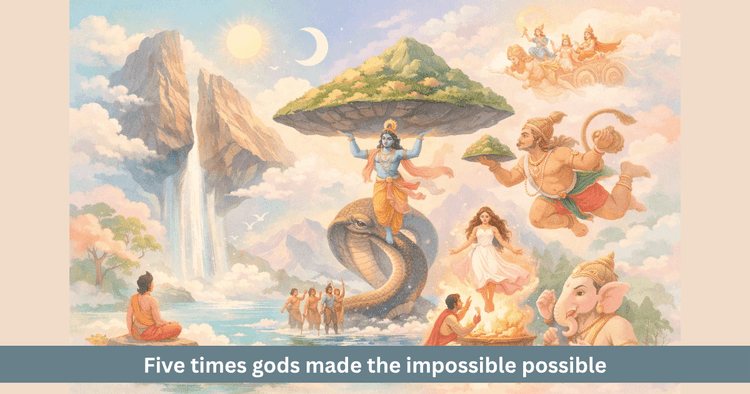
Table of Contents
There are moments in life when logic suddenly becomes too small. Something happens that feels too exact, too strange or too powerful to be dismissed as coincidence. Indian sacred literature is filled with such moments, where the gods act in ways that seem to stand beyond ordinary explanation. These are not merely miracle stories. They are reflections on possibilities that challenge how we understand time, reality, consciousness and the limits of existence itself.
What makes such episodes enduring is that they do not create wonder only outwardly. They also awaken questions inwardly. Is reality as fixed as it appears. Is power limited only to what the senses can measure. Are there dimensions of consciousness that human understanding has not yet fully entered. That is why these divine episodes continue to be read with renewed meaning even today.
When the Infinite Appeared Within the Smallest Space
The childhood episode in which Krishna showed the entire universe inside his mouth to Yashoda is among the most extraordinary in sacred storytelling. It was not simply a miracle. It was a complete shift of perception. A mother looks into the mouth of her child and beholds the very cosmos in which she herself stands. In that instant, the boundaries between great and small, outside and inside, visible and invisible begin to dissolve.
The spiritual significance of this moment is profound. It suggests that the infinite can be experienced through the finite. That which is all pervading may also reveal itself within the smallest point. This reflects a central principle of Indian thought, that ultimate reality is not present only in vastness but also in subtlety.
Even today, this idea appears in symbolic ways in ordinary life. A tiny device can hold memories, conversations, images and connections to distant worlds. A subtle particle may contain immense energy. A single sentence may hold an entire emotional universe. From this perspective, Krishna revealing the universe in his mouth becomes not only a story but also a symbol of the mystery in which the micro and the macro are not truly separate.
Yet the question remains. How can the limitless dwell within the limited. That is what makes the episode not only wondrous but deeply philosophical.
Why Did Shiva Drink the Poison and Keep It From Spreading Within
During the churning of the cosmic ocean, the deadly poison called Halahala emerged and threatened all existence. At that moment, Lord Shiva took the poison into himself, yet did not allow it to spread through his being. He held it in his throat and for this reason came to be known as Nilakantha. This is not merely a story of divine power. It is also a story of containment at its highest form.
The act of Shiva connects to a deeply human truth. In life, poison does not appear only as substance. It also comes as insult, stress, grief, criticism, jealousy and emotional toxicity. Usually a human being either gets consumed by it or begins to spread it further. But Shiva reveals a third possibility. Recognize the poison, contain it but do not allow it to destroy the core of who you are.
That is why this episode remains symbolically meaningful even at the level of modern psychological understanding. To receive negativity, to hold it without becoming reactive and to prevent it from reaching the deepest center of one’s being is itself a great discipline.
Yet taken literally, to contain such destructive poison without being destroyed still lies beyond ordinary logic. That is what makes the act divine. Shiva does not simply consume poison. He shows that the highest form of strength is not only the power to destroy but also the power to stop destruction within oneself.
How Could Hanuman Change His Form According to the Need of the Moment
One of the most astonishing features of Hanuman is his ability to transform his form. He can become vast like a mountain or subtle beyond notice. When he entered Lanka, he made himself small. When he leapt across the ocean, he assumed an immense form. This is not only a description of physical power. It is an expression of supreme self mastery and situational wisdom.
The inner meaning of this episode is very deep. In life too, a person often needs to alter the form of presence. At times one must stand firm and take space. At times one must become quiet, subtle and observant. Sometimes leadership is needed and sometimes silence. The one who behaves in exactly the same way at every moment may fail in the complexity of life. But one who can adjust inwardly and outwardly according to the need of the moment becomes truly capable.
Hanuman’s transformation is therefore not merely about size. It points toward a state in which one can consciously govern ego, energy, presence and force according to dharma and circumstance. In that sense, it is also a deeply yogic symbol.
Yet if read literally, changing size at will lies outside the physical laws we ordinarily know. That is where the story points beyond ordinary explanation toward a deeper dimension of consciousness and power.
Why Was Durga Born Through Collective Divine Energy
The appearance of Goddess Durga is not described as an ordinary birth. She is said to have emerged from the combined radiance of many gods. When the tyranny of Mahishasura grew so great that no single deity alone was sufficient, multiple divine energies united and from that union Durga manifested. This episode carries immense philosophical and spiritual importance.
One profound truth becomes visible here. Sometimes a crisis becomes so vast that it cannot be resolved by a single strength. It requires collective consciousness, combined energy and a unified purpose. Durga becomes the living embodiment of that joined force. She shows that when many strengths come together for one sacred aim, a power may arise greater than any one source alone could offer.
This remains deeply relevant even today. Families, communities, movements and great shared efforts often reveal that collective strength can surpass isolated ability. When diverse qualities align toward one purpose, a new force is born.
Still, the divine wonder of the story lies in the fact that this combined energy does not merely create influence. It takes the form of a living, conscious, divine presence. That is what raises this episode above ordinary cooperation and into the realm of sacred mystery.
How Did Narasimha Transcend Every Rule Without Breaking Any
The boon granted to Hiranyakashipu was extraordinarily intricate. He could not be killed by man or beast. Not by day and not by night. Not inside and not outside. Not by weapon and not by conventional means. At first glance, such a boon made him nearly invincible. Yet the manifestation of Narasimha becomes one of the most intellectually fascinating moments in sacred narrative.
Narasimha is neither fully man nor fully beast. He appears at twilight, which is neither day nor night. He kills on the threshold, which is neither indoors nor outdoors. He uses claws, which are neither ordinary weapons nor standard instruments of war. In this way, every condition is surpassed without being violated.
This story gives a profound lesson in intelligence. Many times, the solution to a difficult problem does not lie in directly breaking the rule. Doing so may destroy the order itself. A higher intelligence works by understanding the structure of the rule so deeply that it finds the space within it where truth may still act.
Narasimha reveals that reality is not always divided into only two rigid extremes. Often the decisive answer lies in the subtle middle state that ordinary thinking fails to perceive. Thus the episode stands not only as miracle but as a revelation of divine intelligence.
Why Do These Stories Still Move Us Today
Across all five episodes, one common thread appears. The gods do not merely display power. They also reveal new ways of seeing reality. Krishna shows that the vast may dwell within the subtle. Shiva shows that poison can be held without letting it spread. Hanuman teaches that transformation is not only of body but of presence. Durga reveals that united energy can take conscious form. Narasimha shows that the deepest solution may lie hidden between the extremes.
This is why such stories do not remain locked in the past. They continue to inspire reflection in the present. When logic collapses, when life becomes tangled and when no immediate answer appears, these episodes quietly remind us that reality may be wider than our first understanding of it.
The Deeper Essence of These Five Episodes
These five divine acts do not merely ask us to stand in wonder before the impossible. They teach that existence may hold depths that ordinary perception cannot immediately grasp. Where logic comes to a halt, symbols often begin to speak. Where rules appear absolute, a new possibility may still be waiting in a subtler layer of reality.
That is the essence of this whole reflection. Not every truth in life is obvious on the surface. Some truths open through experience, some through devotion, some through awakened awareness and some through stories that remind us of the hidden vastness within ourselves.
Frequently Asked Questions
1. What is the meaning of Krishna showing the universe in his mouth
It symbolizes the presence of the infinite within the finite and the revelation of the vast within the subtle.
2. What is the spiritual lesson of Shiva drinking poison
It represents the ability to contain negativity without allowing it to spread into one’s inner core.
3. What does Hanuman changing his form symbolize
It symbolizes self mastery, adaptability and the ability to respond according to the demands of the moment.
4. What is the significance of Durga emerging from collective energy
It represents the power of united strength, shared purpose and collective sacred force.
5. What does the Narasimha episode teach us
It teaches that the deepest solutions are sometimes found in the subtle space between apparent opposites.
Get your accurate Kundali
Generate KundaliDid you like it?
Author

Pt. Narendra Sharma (63)
Experience: 20
Consults About: Family Planning, Career
Clients In: Punjab, Haryana, Delhi
Share this article with friends and family
About ZODIAQ
ZODIAQ is an online Vedic Astrology platform. It connects clients seeking astrological advice to experienced astrologers with deep knowledge. Our users also generate kundali and perform kundali milan for free. ZODIAQ also offers services to the Astrologers. Astrologers utilize various offerings by ZODIAQ to serve their clients effectively.
If you are a User
Consult with experienced astrologers and seek their guidance. You can also order handwritten Janm Patrika report with life prediction prepared by experienced astrologers. Generate accurate Kundali, perform Kundali Matching and check horoscope and muhurat. Utilize our online library for all the necessary astrological and spiritual information.
If you are an Astrologer
Create accurate kundali for your clients and perform Kundali Matching for up to 5 people at a time. Write comprehensive Janm Patrika report for your clients with ZODIAQ. Check client details anytime by saving it in client directory. Become more productive by tracking how many clients you guide every day.
WELCOME TO
ZODIAQ
Right Decisions at the right time with ZODIAQ
