Indira Ekadashi Vrat Katha: Liberation of Ancestors through Sacred Vow
By Pt. Amitabh Sharma
A sacred Ekadashi fast that brings moksha to ancestors and spiritual merit to devotees
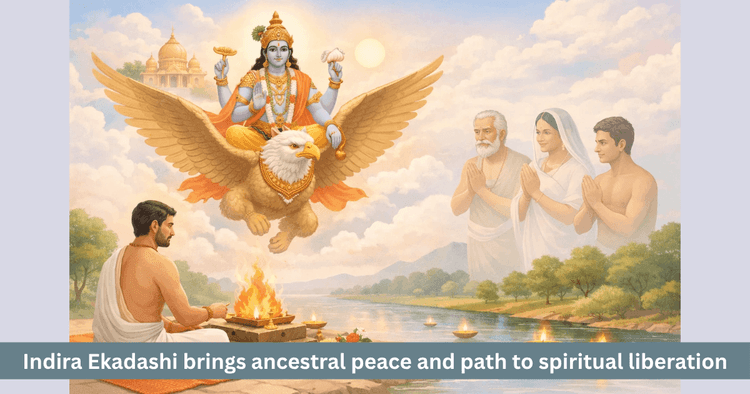
Table of Contents
When the observance of Indira Ekadashi arrives in the Krishna Paksha of the Ashwin month, it is regarded as a deeply sacred occasion connected not only with personal merit but also with the liberation of one’s ancestors. This Ekadashi is especially honored because it is believed to help even those forefathers who may be trapped in lower states of existence attain moksha, meaning spiritual release. For this reason, on the day of Indira Ekadashi, one should not only keep the fast but also perform shraddha karma, worship Lord Vishnu and recite the Indira Ekadashi Vrat Katha described in the Padma Purana.
Scriptural tradition says that the power of this Ekadashi can destroy even great sins. It is also said to uplift ancestors who have not yet attained auspicious movement after death. Therefore this vow is not merely a religious observance. It is an act of gratitude, remembrance, repentance and spiritual duty toward one’s lineage. The one who performs it with sincerity, discipline and devotion receives not only spiritual merit for the self but also becomes an instrument of release for the ancestors.
When does Indira Ekadashi occur and why is it so important
Indira Ekadashi is observed on the Ekadashi tithi of the Krishna Paksha in the month of Ashwin. Since it comes during the spiritually charged atmosphere of the Pitru Paksha period, its importance becomes even greater. During this period, remembrance of ancestors, tarpana, shraddha and prayers for ancestral peace are considered especially fruitful. Indira Ekadashi stands in the middle of this sacred mood as a divine means for ancestral upliftment.
The main significance of this vow is that if any ancestor remains bound because of karmic error, ritual fault or unresolved destiny, the merit of this Ekadashi may help grant that soul higher movement. This is why fasting alone is not considered sufficient on this day. The observance must be joined with shraddha, worship of Lord Vishnu and recitation of the sacred story.
The glory of Indira Ekadashi as described in the Padma Purana
Scriptural narration states that this Ekadashi of the Krishna Paksha is known by the name Indira. It is described as so powerful that it can destroy even major sins. It is further said that even ancestors fallen into lower states can receive auspicious movement through this vow. That is why this observance is not limited to worldly benefit. It becomes a bridge between this world and the next.
The Padma Purana preserves a powerful story connected with this Ekadashi. In it appear a righteous king, his father, Devarshi Narada and the court of Yamaraja. This is not merely a devotional legend. It demonstrates how the merit of a sincere child can help bring peace and elevation to the ancestors. That is why the recitation of this sacred narrative is regarded as essential on the day of Indira Ekadashi.
Where does the story of King Indrasena begin
In ancient times, during the Satya Yuga, there was a renowned and dharmic ruler named Indrasena. He ruled the city of Mahishmatipuri and protected his subjects in accordance with righteousness. His fame had spread in all directions. He was not only a capable king but also deeply devoted to Lord Vishnu. He spent his days chanting the liberating names of Govinda and remained engaged in contemplation of spiritual truth.
One day the king was seated peacefully in his royal assembly when Devarshi Narada descended there through the sky. On seeing the sage, King Indrasena immediately rose with folded hands. He worshipped him properly, offered him a seat and humbly inquired about his welfare. The king said that by the grace of Narada’s arrival, all his sacrificial acts had become fruitful. He then requested the divine sage to kindly reveal the purpose of his visit.
What did Devarshi Narada tell King Indrasena
Narada replied that he had gone from Brahma Loka to Yama Loka. There Yamaraja had welcomed him with great honor and offered him an exalted seat. In the court of Yamaraja, Narada had also seen the father of King Indrasena. The king’s father was present there because of the fault of vow breaking, meaning a failure in the observance of a sacred fast.
Narada then delivered the message that the father had entrusted to him. He said that the king’s father had asked that his son perform the Indira Ekadashi Vrat and offer its merit so that he might be sent to heaven. Thus Narada came as a divine messenger carrying the father’s plea to the son. This moment reveals how deeply the scriptures value the role of a child in supporting the spiritual peace of the ancestors.
Why did King Indrasena ask about the method of the vow
On hearing about the condition of his father, King Indrasena became deeply serious. His feeling was not merely that of filial duty. It carried devotion, compassion and dharma together. He requested Devarshi Narada to explain in detail the full method of observing Indira Ekadashi. He asked in which fortnight, on which tithi and by which procedure the vow should be performed so that his father might attain the heavenly realm.
This was not a casual question. It was the question of a sincere seeker who wanted to perform the vow with full understanding of method, feeling and purpose. For this reason, Narada then explained the complete observance in a very clear and disciplined manner.
What is the proper method of Indira Ekadashi Vrat
Narada instructed that on the Dashami day of the Krishna Paksha, one should bathe in the morning with a mind full of faith. Then at midday, with focused awareness, one should take only a single meal. At night one should sleep on the ground. Then in the final part of the night, when the pure dawn of Ekadashi arrives, one should rise, clean the mouth and prepare for the sacred observance.
After that, with devotion, one should take the vow of fasting before Lord Vishnu. This vow means that one will remain without food, leaving aside all enjoyments, and will eat only on the following day. It is not merely a fast from food. It is also a vow of restraint over mind, speech and senses.
The vow mantra
Adya sthitva niraharah sarvabhogavivarjitah
Shvo bhokshye Pundarikaksha sharanam me bhava Achyuta
The meaning of this mantra is that today one will remain without food and free from all enjoyments, and tomorrow one will eat. O lotus eyed Lord Narayana, O Achyuta, kindly grant refuge.
How should shraddha and ancestral rites be done on Indira Ekadashi
Narada further said that on the day of Ekadashi, at midday, the observer should perform shraddha properly before the sacred Shalagrama Shila for the satisfaction of the ancestors. Brahmanas should be honored with dakshina and respectfully fed. The rice ball offered to the ancestors should be smelled by the performer and then fed to a cow. In this procedure, remembrance of the ancestors, sacred offering and charity all come together.
After this, Lord Hrishikesha should be worshipped with incense, fragrance and other offerings. At night, one should remain awake near the Lord in devotional vigil. This night vigil is not meant merely as staying awake physically. It is meant to be spent in remembrance, chanting, prayer and reflection upon divine narrative. In this way, Ekadashi becomes not just a fast but a complete festival of devotion and ancestral reverence.
Main observances on Ekadashi day
- Taking the vow of fasting
- Performing shraddha before the Shalagrama
- Offering dakshina and feeding Brahmanas
- Feeding the ancestral offering to a cow
- Worshipping Lord Vishnu and keeping night vigil
How should the fast be completed on Dwadashi
Narada explained that on the following day, Dwadashi, Lord Hari should once again be worshipped with devotion. Thereafter Brahmanas should be fed. Then, along with brothers, relatives, grandchildren, sons and other family members, the observer should take food in silence. This silent meal is not merely the formal end of the fast. It is also a continuation of the inner purity and restraint cultivated through the vow.
Dwadashi completes the sacred discipline. If Ekadashi is the day of restraint, then Dwadashi becomes the day of gratitude and quiet fulfillment. It teaches that the fruit of a vow rests not only in observance but also in its proper completion.
How did King Indrasena complete the vow
After hearing the full procedure from Devarshi Narada, King Indrasena observed the Indira Ekadashi Vrat exactly as instructed. Along with his queens, sons and attendants, he performed the sacred vow with great sincerity. He abandoned laziness, followed the proper method and kept the welfare of his father at the center of his devotion. This part of the story also teaches that when a vow is carried out with collective faith, its spiritual force becomes even more powerful.
When the vow was completed, flowers began to fall from the sky. This signified divine approval of the observance. The narrative then describes that the father of King Indrasena ascended upon Garuda and departed for the abode of Lord Vishnu. This was the direct fruit of the merit offered by the king with devotion and discipline.
How did King Indrasena’s father attain liberation
When King Indrasena offered the spiritual merit of the Indira Ekadashi Vrat for his father, the father was released from the condition of Yama Loka and ascended upon Garuda to the divine realm of Lord Vishnu. This is the central glory of the vow. It is not only a source of personal merit. It is also a means of ancestral upliftment and liberation.
The story further says that after enjoying a prosperous and unobstructed reign, King Indrasena handed over the kingdom to his son and later attained higher realms himself. This teaches that the one who performs such sacred observance with devotion for the ancestors also finds grace in one’s own life path.
Why is Indira Ekadashi especially fruitful for the ancestors
The meeting of Pitru related observance and the Ekadashi of the Ashwin Krishna Paksha is considered extremely powerful. This vow becomes an offering of gratitude, remembrance and spiritual support for the ancestors. If any ancestor remains bound because of fault or incomplete karma, this Ekadashi becomes a means of hope. That is why it is regarded as one of the most significant vows for ancestral liberation.
It also teaches that ancestral upliftment is not achieved only through formal offering, but through the union of faith, discipline, fasting, charity, worship and listening to sacred narrative. This is why its value remains alive even today.
Main spiritual fruits of Indira Ekadashi
- Auspicious movement for ancestors
- Destruction of sins
- Grace of Lord Vishnu
- Help in release from ritual or karmic fault
- Growth of devotion and dharma in the observer
Why is recitation and listening to this story considered necessary
Lord Krishna declared the greatness of this vow and said that whoever reads or listens to the Indira Ekadashi Vrat Katha may become free from sin. Here the story is not merely a tale. It teaches dharma, explains the procedure of the vow, reveals the importance of ancestral duty and reminds the listener that life is not lived only for the self. There is also responsibility toward the lineage from which one has come.
Listening to the story makes the heart humble. It helps a person understand that fasting is not merely bodily restraint. It is purification of feeling. And when that purified feeling is offered for the liberation of one’s ancestors, its fruit becomes even more sacred.
What can one learn from Indira Ekadashi today
In modern times many people may see fasting only as ritual, yet Indira Ekadashi offers a far deeper lesson. It teaches that no one stands alone. One is connected to ancestors, lineage, memory and inherited samskara. It also teaches that dharma is not only celebration. It is responsibility. If the remembrance of ancestors has weakened in someone’s life, this Ekadashi can revive that sacred awareness.
It also teaches that liberation is not asked only for oneself. Out of love and gratitude, it may also be sought for one’s forefathers. This is one of the most beautiful features of the vow, that devotion and duty become one.
A sacred union of ancestral grace and Vishnu devotion
The vow of Indira Ekadashi is a divine occasion in which ancestral grace, Vishnu devotion, shraddha, charity, fasting and sacred recitation come together in one thread. For the one who performs it properly, it becomes not merely the observance of a date, but a means of making life more sacred and meaningful.
If this vow is kept with devotion, it becomes a bridge that carries ancestral peace, personal purification and the grace of Lord Vishnu together. That is why Indira Ekadashi remains greatly honored among those who live with faith.
Frequently asked questions
On which tithi is Indira Ekadashi observed
Indira Ekadashi is observed on the Ekadashi tithi of the Krishna Paksha in the month of Ashwin.
What is considered the greatest fruit of this vow
The greatest fruit of this vow is considered to be auspicious movement and liberation of the ancestors, especially those in difficult states.
Is fasting alone enough on Indira Ekadashi
No. Along with fasting, one should also perform shraddha, worship Lord Vishnu, honor Brahmanas and recite the sacred story.
How did King Indrasena’s father attain release
King Indrasena performed the Indira Ekadashi Vrat properly and offered its merit to his father, through which he attained the abode of Vishnu.
Does reading or hearing this story also bring merit
Yes. According to sacred tradition, reciting and listening to the Indira Ekadashi Vrat Katha can help free a person from sin.
Get your accurate Kundali
Generate KundaliDid you like it?
Author
Pt. Amitabh Sharma (56 Years)
Experience: 20
Consults About: Family Planning, Career
Clients In: Punjab, Haryana, Delhi
Share this article with friends and family
About ZODIAQ
ZODIAQ is an online Vedic Astrology platform. It connects clients seeking astrological advice to experienced astrologers with deep knowledge. Our users also generate kundali and perform kundali milan for free. ZODIAQ also offers services to the Astrologers. Astrologers utilize various offerings by ZODIAQ to serve their clients effectively.
If you are a User
Consult with experienced astrologers and seek their guidance. You can also order handwritten Janm Patrika report with life prediction prepared by experienced astrologers. Generate accurate Kundali, perform Kundali Matching and check horoscope and muhurat. Utilize our online library for all the necessary astrological and spiritual information.
If you are an Astrologer
Create accurate kundali for your clients and perform Kundali Matching for up to 5 people at a time. Write comprehensive Janm Patrika report for your clients with ZODIAQ. Check client details anytime by saving it in client directory. Become more productive by tracking how many clients you guide every day.
WELCOME TO
ZODIAQ
Right Decisions at the right time with ZODIAQ
