The Birth Story of Lord Krishna and the Deeper Meaning of Janmashtami
By Pt. Nilesh Sharma
A Celebration of Krishna’s Birth, Divine Intervention, and Devotion
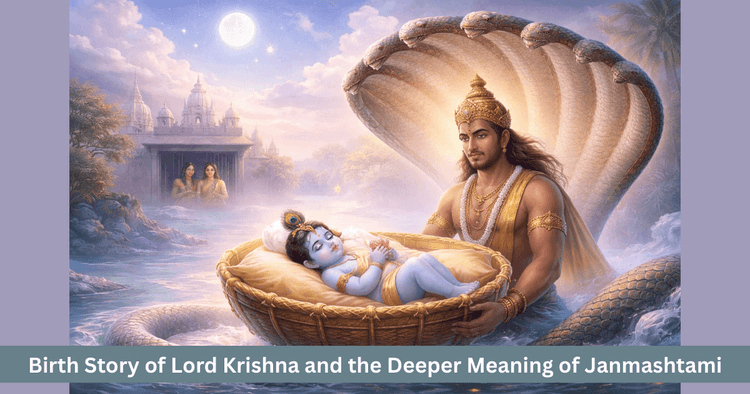
Table of Contents
The festival of Janmashtami is not only a celebration day. It is the remembrance of that sacred moment when Lord Vishnu descended upon earth as Krishna and changed the direction of an entire age. On this night devotees recall the story of Krishna’s birth, observe fasting and try to understand how the Divine enters a world filled with fear and injustice to restore balance.
According to tradition, Krishna’s appearance took place at midnight on the eighth lunar day, under the Rohini constellation, while Devaki and Vasudeva were confined in a prison at Mathura. At that very hour a series of wondrous events showed that when the destined divine time arrives, all forces of nature cooperate with the will of God.
Where Was Krishna Born
From a geographical point of view, the birthplace of Krishna is Mathura, situated in the present state of Uttar Pradesh. In Mathura, the Yadava community had an aged ruler named Ugrasena. His son Kamsa was highly ambitious but lacked a sense of dharma and compassion.
To gain power Kamsa imprisoned his own father and seized the throne. To strengthen his rule he formed an alliance with a ruthless ruler in the East known as Jarasandha. Jarasandha sought to conquer all the known lands and Kamsa believed that standing by him was the only way to become invincible.
| Character | Role |
|---|---|
| Ugrasena | Elderly king of the Yadavas, father of Kamsa |
| Kamsa | Cruel usurper and tyrannical ruler |
| Jarasandha | Ruthless eastern emperor, ally of Kamsa |
| Mathura | Krishna’s birthplace and center of oppression |
How Did Kamsa Receive the Prophecy of His Death
Kamsa’s sister Devaki was married to Vasudeva, a noble leader of the Yadavas. After the wedding, as Devaki was being taken to her new home, Kamsa himself drove the chariot. At that moment, a celestial voice was heard from the sky.
The voice declared that the eighth child to be born from Devaki’s womb would be the cause of Kamsa’s death. Hearing this, Kamsa was filled with fear and rage. He thought that the easiest way to avoid future danger was to kill Devaki immediately.
Drawing his sword, he prepared to strike his own sister. Seeing this, Vasudeva pleaded with folded hands, saying that Devaki was innocent and had committed no offence. If danger lay in her children, he promised to hand over each newborn child to Kamsa but urged that Devaki’s life be spared.
Kamsa accepted this condition, yet fear did not leave him. He placed Devaki and Vasudeva in confinement at Mathura so that their every movement would remain under constant watch.
Why Were Devaki’s First Six Sons Killed
As time passed Devaki’s womb bore children in the prison. When the first child was born, the guards informed Kamsa. Devaki and Vasudeva wept and begged that this was only the first child and the prophecy spoke of the eighth.
Kamsa refused to take any risk regarding his life. He took the infant by the legs and smashed him upon a stone. In the same way the second, third, fourth, fifth and sixth sons were all killed as soon as they were born.
Through these merciless acts Kamsa’s cruelty became a subject of fear and whisper among the people. The subjects lived in terror, yet beneath that fear a silent dissatisfaction with the ruler’s injustice continued to grow. Devaki and Vasudeva bore deep pain in their hearts but they also sensed that some higher plan of the Divine was unfolding through these events.
How Did the Seventh Child Balarama Reach Gokul
When the time of the seventh pregnancy approached, unusual signs were felt even inside the prison. Scriptures narrate that the divine presence in Devaki’s womb was mystically transferred into the womb of Rohini, another wife of Vasudeva who was then living at Gokul.
Outwardly it appeared as if Devaki had experienced a miscarriage. Kamsa concluded that the seventh child had been lost and therefore did not pursue any further enquiry.
In Gokul, however a child was born to Rohini. He later became known as Balarama. From childhood his body and strength were greater than those of ordinary boys. Together with Krishna he played a powerful role in many later episodes of divine play.
Kamsa’s Harsh Confinement during the Eighth Pregnancy
Then came the turn of the eighth child. Since the prophecy referred specifically to this birth, Kamsa’s anxiety and harshness increased further. Devaki and Vasudeva, who had been under a form of house arrest earlier, were now bound in heavy chains and locked in a deep prison cell.
The days leading to the eighth night passed with a tense and mysterious atmosphere. Kamsa ordered that no one was to enter the cell at the time of birth. He appointed his close relative Putana as a midwife, with strict instructions that as soon as the child was born it must be handed to him for immediate killing.
The Wondrous Scene on the Night of Birth
The night of the eighth lunar day arrived. Clouds filled the sky, rain poured down, thunder roared and darkness covered the land. Inside the prison Devaki writhed in labour and Vasudeva, bound in chains, prayed silently to the Lord.
The story relates that at the sacred midnight hour a divine radiance filled the cell. Krishna appeared before Devaki in a four armed form, revealing His identity as Vishnu, the protector of the worlds. He assured His parents that He had incarnated to destroy tyranny and uphold dharma.
At Devaki’s prayer He then assumed the form of a human infant, so that the course of His life would unfold like that of a human being and the guards would suspect nothing unusual.
How Did the Prison Doors Open by Themselves
The moment Krishna took on the form of a child, the heavy chains binding Vasudeva loosened by themselves. The guards fell into deep sleep and the locked doors swung open without effort.
Vasudeva understood clearly that this was divine intervention. An inner prompting arose that the child had to be taken out of the prison immediately to a place of safety.
Outside, the rain and floodwaters presented a frightening scene, yet Vasudeva placed the baby in a basket, lifted it on his head and stepped into the night, trusting the unseen guidance.
How Did Vasudeva Reach Yashoda’s House
Vasudeva walked towards the river Yamuna. Because of the downpour, the river seemed to be in spate but when he reached the bank the water receded just enough to reveal a ford. It was as if the Yamuna wished to touch the child’s feet and then gently clear the way.
Carefully Vasudeva waded through, one hand steadying the basket and the other maintaining balance. Many accounts describe a protecting serpent hood above the child, sheltering Him from the rain. Slowly but surely he crossed the river and approached Gokul.
Soon he arrived at the house of Nanda and Yashoda. There a girl had just been born. Yashoda lay unconscious after the difficult labour. Vasudeva placed Krishna where the newborn had been and took the infant girl into the basket.
He then returned along the same path to the prison at Mathura. The doors were still open, the guards still asleep. Vasudeva laid the girl beside Devaki and at once the chains tightened again and the doors closed, restoring the scene as before.
Yashoda’s Daughter and Kamsa’s Heightened Fear
A short time later the infant girl cried. The guards awoke and informed Kamsa that Devaki’s eighth child had been born. Kamsa rushed to the cell in great agitation.
Seeing that the newborn was a girl, Devaki and Vasudeva pleaded that the prophecy spoke of a male child and this daughter could not be his killer. They begged that her life be spared.
Suspicion troubled Kamsa but his fear was stronger than any reasoning. He declared that he would not take any chances. Seizing the infant by the legs he prepared to dash her against the stone floor.
At that instant, according to the story, the girl slipped from his hands, rose into the sky and manifested a radiant form. She laughed and proclaimed that the one destined to kill Kamsa was already born elsewhere. Hearing this, Kamsa became even more restless, yet the truth was that Krishna was now safely beyond his reach in Gokul.
Krishna’s Upbringing in Gokul
In Gokul, in the home of Nanda and Yashoda, Krishna began His life in the form of a cowherd child. Outwardly He grew as an ordinary village boy, herding cows, playing the flute and roaming freely with His companions, yet an inner light shone through His every action.
Amid the simple life of the cowherds, He revealed the sweetness of service to cows, the joy of music, friendship and shared meals. In these early years devotees see the union of playful innocence with deep spiritual presence.
Later this same child would perform the lilas of Vrindavan, overthrow the tyranny of Kamsa, guide the Pandavas and speak the teachings of the Gita. All of this, however began on that one night when, in the darkness of a prison, a new light was born as Krishna.
Spiritual Message of Krishna’s Birth Story
The story of Krishna’s birth is not just an ancient account. It also carries a profound spiritual message. In Kamsa one sees the mind dominated by ego, fear and cruelty, which will go to any length for its own security.
In Devaki and Vasudeva one sees patience, steadfastness and quiet devotion, which accept hardship yet do not abandon dharma. When a heart like this turns to the Divine, help comes in ways that surpass ordinary logic.
The opening of the prison doors, the calming of the Yamuna and the safe arrival of the child in Gokul symbolise that when the right hour of grace arrives, the forces of nature themselves support truth and righteousness.
Frequently Asked Questions
Where is Krishna’s birthplace considered to be?
Krishna’s birthplace is considered to be Mathura, where Kamsa had imprisoned Devaki and Vasudeva and where, at midnight on the eighth lunar day, Krishna took birth.
Why did Kamsa kill Devaki’s first six sons?
Because a divine voice foretold that Devaki’s eighth son would kill him, Kamsa, blinded by fear, killed all six of her newborn sons, unwilling to take any risk regarding his own life.
How did Balarama reach Gokul?
Scriptural tradition states that the divine presence of Devaki’s seventh child was transferred into the womb of Rohini, another wife of Vasudeva living in Gokul. There the child was born as Balarama, Krishna’s elder brother.
How could Vasudeva carry Krishna out of the prison?
On the night of Janmashtami the chains binding Vasudeva fell away, the guards fell asleep and the prison doors opened on their own. Recognising this as divine intervention, he carried Krishna in a basket across the Yamuna to Nanda and Yashoda’s house in Gokul.
What happened to Yashoda’s daughter and what warning did Kamsa receive?
The girl born in Yashoda’s house was taken to the prison and placed beside Devaki. When Kamsa tried to kill her, she rose into the sky in a radiant form and declared that his slayer had already been born elsewhere, leaving Kamsa fearful yet unable to stop destiny.
Get your accurate Kundali
Generate KundaliDid you like it?
Author

Pt. Nilesh Sharma (63)
Experience: 20
Consults About: Family Planning, Career
Clients In: Punjab, Haryana, Delhi
Share this article with friends and family
About ZODIAQ
ZODIAQ is an online Vedic Astrology platform. It connects clients seeking astrological advice to experienced astrologers with deep knowledge. Our users also generate kundali and perform kundali milan for free. ZODIAQ also offers services to the Astrologers. Astrologers utilize various offerings by ZODIAQ to serve their clients effectively.
If you are a User
Consult with experienced astrologers and seek their guidance. You can also order handwritten Janm Patrika report with life prediction prepared by experienced astrologers. Generate accurate Kundali, perform Kundali Matching and check horoscope and muhurat. Utilize our online library for all the necessary astrological and spiritual information.
If you are an Astrologer
Create accurate kundali for your clients and perform Kundali Matching for up to 5 people at a time. Write comprehensive Janm Patrika report for your clients with ZODIAQ. Check client details anytime by saving it in client directory. Become more productive by tracking how many clients you guide every day.
WELCOME TO
ZODIAQ
Right Decisions at the right time with ZODIAQ
