Jaya Parvati Vrat Katha and the Blessing of Children
By Pt. Sanjeev Sharma
Significance of the Fast for Family Happiness, Children, and Marital Prosperity
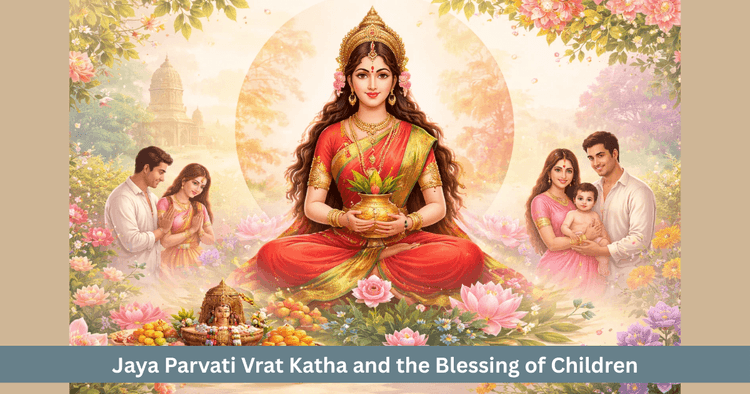
Table of Contents
The Jaya Parvati Vrat is regarded as very sacred for married as well as unmarried women who long for a harmonious marriage, unbroken good fortune and the blessing of children. In this vrata, Goddess Parvati is worshipped with devotion and is remembered as the one who grants stability, protection and completeness to family life. Listening to and reciting the Jaya Parvati Vrat Katha is said to bring inner strength and a sense of reassurance to the devotee.
The Jaya Parvati Vrat is traditionally observed for five days with faith and discipline. In several regions it is kept during specific days of the month of Ashadha, when married women and young girls together worship Goddess Parvati, observe the vrata and hear the sacred story. It is believed that this vrata helps to remove obstacles connected with marriage and gradually clears blockages in the path of receiving children.
What is the Jaya Parvati Vrat Katha
The Jaya Parvati Vrat Katha tells a simple yet deeply moving story of a family whose life is transformed by the grace of Mata Parvati.
Once there was a town called Kaudinya Nagar, where a Brahmin named Vaman lived with his wife Satya. Their house lacked nothing in terms of material comfort. They had wealth, food, clothing, home and honour in society. Yet one absence kept their hearts troubled. They had no children and this weighed heavily on both of them. Despite years of religious observance, the sorrow of childlessness left them inwardly restless.
One day, while travelling, Devarshi Narada arrived at their home. The Brahmin couple welcomed him with great respect, offered him a seat and served him as best as they could. When the moment was right, they folded their hands and opened their hearts before him. They spoke of their sorrow at not having a child and requested guidance. Hearing their sincere pain, Narada gave them a sacred instruction.
Narada’s guidance and the worship of Shiva and Parvati
Narada told the couple that outside their town there was a forest and in the southern part of that forest stood a sacred bilva tree. Under that bilva tree, Lord Shiva resided in linga form along with Goddess Parvati. He instructed them that if both husband and wife would worship that Shivalinga with true devotion and regularity, their desire for a child would surely be fulfilled.
Vaman and Satya felt a new ray of hope. They went to the forest and searched carefully until they found the Shivalinga under the bilva tree. The atmosphere there was quiet, pure and deeply peaceful. At that spot they resolved that from that day onward, they would come regularly and offer worship to Lord Shiva and Goddess Parvati.
The Brahmin couple began their worship according to proper method. Each day they bathed, wore clean clothes and came with bilva leaves, flowers, water and a heart full of reverence. This was not for a few days only. According to the Katha, Vaman and Satya continued this worship without break for a full five years. This long period became a test of their patience, faith and surrender.
Snake bite, death and the cry of the Brahmin’s wife
One day Vaman went to the forest as usual to collect flowers for the daily puja. He intended to return quickly, as always, so that worship could be offered on time. But on that day, while plucking flowers, he was bitten by a snake. The poison was so strong that he died there in the forest.
At home Satya waited for him. Time passed but her husband did not return. Her anxiety grew and she finally set out to search for him in the forest. After some distance she found him lying lifeless on the ground. The sight shattered her heart. She began to weep bitterly, crying out in grief. In her helplessness she remembered Mata Parvati and begged the Goddess to restore her husband’s life.
Her heartfelt call, supported by years of steady worship and an unselfish love, rose upward like a prayer from the depth of the soul. The Katha explains that hearing the anguished cry of this devoted wife, Goddess Parvati appeared there. Seeing the condition of Satya and the lifeless body of Vaman, she was moved by compassion and decided to remove their suffering.
Grace of Goddess Parvati and the boon of a child
Goddess Parvati looked kindly at Satya and then approached her husband’s body. She placed amrita, the nectar of life, into Vaman’s mouth. As the amrita touched him, his body began to move and life slowly returned. In a short time he stood up, restored from death. Satya now wept with tears of gratitude and awe rather than only sorrow.
Seeing her husband alive again, the couple worshipped Goddess Parvati with deep love and offered prayers of thanks. Pleased with their devotion and steadfastness, the Goddess invited them to ask for a boon. With humility they placed before her the same desire that had long rested in their hearts. They prayed for the blessing of a child so that their household could feel complete and their lineage might continue.
Goddess Parvati accepted their request but she also gave them a sacred path. She told them that if they would observe the Jaya Parvati Vrat with sincerity, all their wishes would be fulfilled and the blessing of a child would come into their home. This was not only a boon but also an invitation to walk a path of vrata, faith and discipline.
The couple obeyed the instruction of the Goddess with reverence. When the proper time came, they undertook the Jaya Parvati Vrat with full procedure. Throughout the vrata they embraced restraint, daily worship, listening to the Katha and constant remembrance of Goddess Parvati.
After the successful completion of the vrata, by the grace of Mata Parvati, they were blessed with a son. With the birth of the child, their house filled with joy and completeness. The emptiness that once troubled them was replaced by a sense of fulfilment and peace. Thus, for them, the Jaya Parvati Vrat became the key that opened the door to the happiness of children.
Deeper teachings of the Jaya Parvati Vrat
The Jaya Parvati Vrat Katha offers more than a path to children. It teaches important lessons on devotion and patience.
- The life of Vaman and Satya shows that material comfort alone is not enough. True completeness comes when a home is filled with faith, purpose and connection to the divine.
- Their five years of continuous worship remind that genuine spiritual practice is not driven by impatience. It requires stability, trust and the willingness to continue even when results are not immediately visible.
- The appearance of Goddess Parvati and the revival of the husband symbolise the power of sincere devotion. When the heart’s cry is pure and supported by consistent practice, divine grace can soften even the hardest situations.
Through this story, the Jaya Parvati Vrat emerges not only as a vrata for children but as an inspiration for loyalty, sacrifice and mutual support within married life.
Common questions about Jaya Parvati Vrat
Is the Jaya Parvati Vrat only for those who seek children?
Primarily it is known for the blessing of children and for removing sorrows related to childlessness, yet many women also observe it for marital harmony, the long life of the husband and overall family well being.
Do only married women observe this vrat?
Traditionally married women are more commonly seen keeping this vrata. however in some traditions unmarried girls also observe it seeking a suitable spouse and a blessed married life in the future.
Is it compulsory to observe the Jaya Parvati Vrat for exactly five days?
In popular practice it is usually kept for five days, though local customs may vary slightly. What truly matters is that whatever duration is chosen should be followed sincerely and without carelessness.
Does simply reading the Katha also give benefit?
Yes. Listening to or reading the Katha attentively is considered very important. Even those who cannot keep the full vrata may still receive a share of Goddess Parvati’s grace by reciting or hearing the story with faith. Yet, the combination of vrat, puja and Katha together is regarded as the most complete observance.
Can men also observe the Jaya Parvati Vrat?
The Katha itself shows that instruction for vrata was given to the Brahmin husband as well. In practice women observe it more frequently but a man who follows the rules with devotion and respect can also benefit from this vrata.
Get your accurate Kundali
Generate KundaliDid you like it?
Author

Pt. Sanjeev Sharma (63)
Experience: 20
Consults About: Family Planning, Career
Clients In: Punjab, Haryana, Delhi
Share this article with friends and family
About ZODIAQ
ZODIAQ is an online Vedic Astrology platform. It connects clients seeking astrological advice to experienced astrologers with deep knowledge. Our users also generate kundali and perform kundali milan for free. ZODIAQ also offers services to the Astrologers. Astrologers utilize various offerings by ZODIAQ to serve their clients effectively.
If you are a User
Consult with experienced astrologers and seek their guidance. You can also order handwritten Janm Patrika report with life prediction prepared by experienced astrologers. Generate accurate Kundali, perform Kundali Matching and check horoscope and muhurat. Utilize our online library for all the necessary astrological and spiritual information.
If you are an Astrologer
Create accurate kundali for your clients and perform Kundali Matching for up to 5 people at a time. Write comprehensive Janm Patrika report for your clients with ZODIAQ. Check client details anytime by saving it in client directory. Become more productive by tracking how many clients you guide every day.
WELCOME TO
ZODIAQ
Right Decisions at the right time with ZODIAQ
