Jitiya Vrat Katha: Three Sacred Stories of Jivitputrika Vrat and Their Spiritual Meaning
By Aparna Patni
A spiritual guide to the legends of devotion, sacrifice, and child protection in Jivitputrika Vrat tradition
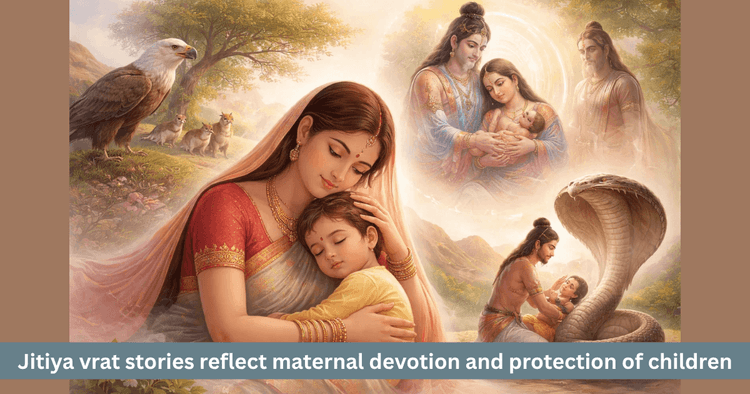
Table of Contents
Jitiya Vrat, also known as Jivitputrika Vrat, is not merely a traditional fast. It is a deeply emotional observance of motherhood, child protection, austerity, devotion and divine grace. On this day, women observe a strict fast for the long life, safety, well being and protection of their children. In tradition, the vrat is not considered complete through fasting alone. Listening to or reading the vrat katha is considered equally important, because the story gives the vow its emotional and spiritual depth.
In the tradition of Jivitputrika Vrat, three major sacred narratives are generally heard. The first is the story of the eagle and the she jackal, which teaches the value of sincerity and the consequences of breaking one’s vow. The second is the story of King Jimutavahana, which presents the highest ideal of sacrifice, compassion and the protection of another mother’s child. The third is connected with Lord Krishna, Uttara, Ashwatthama and the unborn Parikshit, and it explains the deeper feeling behind the name Jivitputrika. Though the outer settings of these stories differ, they are all rooted in the same truth, devotion for the child’s life, purity of resolve, self sacrifice and divine protection.
According to tradition, on this vrat day Lord Ganesha, Mother Parvati and Lord Shiva are worshipped. Worship during Pradosh Kaal, the evening twilight beloved to Shiva, is considered especially significant, and the fast is broken after the end of Ashtami Tithi on the following day. Regional customs may vary slightly, yet the emotional heart of the vrat remains the same everywhere.
What is the first main story of Jitiya Vrat
The first well known story of Jivitputrika Vrat is the narrative of the eagle and the she jackal. It is said that in a dense forest, an eagle lived on a tall semal tree, while a she jackal lived in the nearby bushes. The two shared great affection. Whatever food the eagle brought, she always kept a share for the jackal. The jackal cared for the eagle in the same way. Their lives passed in friendship, warmth and mutual support.
One day, the women of a nearby village were preparing for Jitiya Vrat. The eagle watched carefully as they arranged the worship, fast and prayer for the well being of their children. She then told the jackal about it. Both decided to observe the vrat themselves. They made the vow and spent the entire day without food and water. But as night deepened, the jackal could no longer bear the hunger and thirst.
She went into the forest and secretly ate meat and bones. On returning, the eagle heard the sound of bones being chewed and asked what that sound was. The jackal tried to hide her fault and said that the noise was only the growling of her empty stomach. But the eagle understood that the vrat had already been broken. She rebuked the jackal and said that if she could not keep the vow, she should not have taken it. The jackal was ashamed, but what had happened could not be undone. The eagle remained hungry and thirsty through the night and completed the vrat with full sincerity.
In their next birth, both were born as human sisters. The jackal was born as the elder sister and married a prince. The eagle was born as the younger sister and married the son of a minister. Over time, the elder sister’s children died again and again, while the younger sister’s children remained healthy, safe and strong. This filled the elder sister with jealousy. She made repeated attempts to harm the younger sister’s children and even her husband. At one point she even had the heads of the children cut and placed in a box, but those severed heads turned into sweets and not even a strand of the children’s hair was harmed. Again and again she plotted, yet she never succeeded.
At last, by divine destiny, she realized her mistake. She asked her younger sister for forgiveness. Then, following her guidance, she observed the Jivitputrika Vrat properly and with devotion. Thereafter, her own children too survived. Through this story, the vrat teaches sincerity, the consequences of breaking one’s vow, the destruction caused by jealousy and the possibility of redemption through repentance.
The main teachings of this story
- A vow is completed not only by the body, but by sincerity of mind
- Taking a vow and breaking it can obstruct its blessed fruits
- Jealousy does not bring joy, it only deepens pain
- True repentance and right action can transform destiny
Why is the story of King Jimutavahana so important
The second and deeply revered story of Jivitputrika Vrat is that of King Jimutavahana. This story is regarded as a supreme example of sacrifice, compassion and the willingness to give one’s own life to save another mother’s son. According to the narrative, the prince of the Gandharvas was named Jimutavahana. He was noble, compassionate and devoted to the welfare of others. When his father grew old and prepared to enter the forest stage of life, he wished to place Jimutavahana upon the throne. But Jimutavahana felt no attraction toward royal luxury. He gave the burden of the kingdom to his brothers and went to the forest to serve his father.
In the forest he met a princess named Malayavati, and love arose between them. One day, while wandering in the forest, Jimutavahana went farther than usual and saw an old woman crying in great sorrow. When he asked the reason, she said that she belonged to the serpent race, and that she had only one son named Shankhachuda. She explained that to escape the wrath of Garuda, the king of birds, the serpents had made an arrangement to offer one young serpent to him each day. That day was her son’s turn. She lamented that there could be no greater sorrow for a mother than to lose her child while she still lived.
On hearing this, Jimutavahana was deeply moved. He assured the old mother that her son would not die. He took the red cloth from Shankhachuda and wrapped himself in it, then lay down on the stone of sacrifice, so that Garuda would take him instead. At the appointed hour, Garuda descended with great speed, seized Jimutavahana in his claws and carried him to a mountain peak. There Garuda struck him with his hard beak and tore flesh from his body. In that intense pain, tears flowed from Jimutavahana’s eyes.
Garuda was astonished, because such a thing had never happened before. He asked who he was. Jimutavahana then told the entire story and explained that he had offered himself to save another woman’s son. Garuda was profoundly moved by his courage, sacrifice and compassion. He felt remorse that a human being was ready to give his own life for another mother’s child, while he himself had been living by devouring the children of others.
Garuda released Jimutavahana and offered him a boon. Jimutavahana asked for nothing for himself. He requested that Garuda stop feeding on serpents and restore life to all those lives he had taken. Garuda granted that wish. He gave safety to the serpent race and declared that any woman who listens to the story of Jimutavahana’s sacrifice and observes the vrat properly will see her child protected even from the mouth of death. From that time onward, the worship of Jimutavahana for the protection of children became established. It is also said that Lord Shiva narrated this story to Mother Parvati on Mount Kailasa.
The spiritual significance of the Jimutavahana story
- To make another’s sorrow one’s own is the highest form of compassion
- Sacrifice becomes great only when free from self interest
- Protecting another mother’s child is considered a supreme act of dharma
- True compassion can transform even cruelty
What is the Jivitputrika story connected with Lord Krishna
The third story is linked with the Mahabharata period. After the Mahabharata war, Ashwatthama, burning with grief and revenge after his father’s death, entered the camp of the Pandavas at night. In anger he killed five sleeping figures, thinking them to be the Pandavas, but they were actually the five sons of Draupadi. Because of this grave crime, Arjuna captured Ashwatthama and took away his divine jewel.
Filled with rage and humiliation, Ashwatthama then used the Brahmastra to destroy the unborn child in the womb of Uttara. That unborn child had to survive, because it was the final hope of the lineage. The weapon could not be stopped. At that critical moment, Lord Krishna offered the fruit of all his accumulated merit to that unborn child and restored life to him within the womb itself. That child later became King Parikshit.
The emotional meaning of the story is that this child, who was restored to life after facing death in the womb, became associated with the spirit of Jivitputrika, the child kept alive. In this way, the vrat becomes connected not only with maternal devotion, but also with divine protection, child preservation and God’s grace.
How are these three stories connected with one another
Although the characters and settings of these three stories differ, the spiritual current within them is one. The story of the eagle and the jackal teaches the importance of vow keeping and sincerity. The story of Jimutavahana reveals the greatness of sacrifice, compassion and life protection. The story of Lord Krishna expresses the power of divine grace, child preservation and restoration of life. This is why these three stories are given an honored place together in the tradition of Jivitputrika Vrat.
By listening to these stories together, the observer of the vrat understands that
- A vrat is not only a rule, but also a discipline of feeling and truth
- Sacrifice and compassion are spiritual pillars of the vow
- Child protection is not only worldly concern, but also sacred prayer
- Where devotion is present, the door of grace remains open
Why is Jitiya Vrat Katha still so relevant today
In the present age, many people either follow tradition mechanically or leave it without understanding. In such a time, the stories of Jitiya Vrat remind us that tradition is not merely outer ritual. It holds human experience, pain, compassion, hope and faith within it. These stories contain a mother’s concern, prayer for the child’s life, the power of compassion and deep trust in divine protection.
That is why the katha remains moving even today. A mother’s heart still trembles for her child exactly as it did in earlier times. The prayer for a child’s safety is still as deep as ever. For this reason, the Jitiya Vrat Katha has not become old with time. It continues to feel alive and emotionally powerful.
What should be the right inner attitude while reading this katha
Jitiya Vrat Katha should not be read merely as information. It should be read with devotion, concentration and feeling. While reading it, one should remember that it is a lesson in maternal compassion, sacrifice and protection. The story of the eagle and the jackal teaches discipline. The story of Jimutavahana teaches the widening of the heart. The story of Lord Krishna gives faith that when all worldly paths seem closed, divine grace may still remain possible.
For this reason, these inner attitudes may be especially helpful while reading
- A true prayer for the welfare of children
- Seeing the vrat as an austerity of faith and devotion
- Choosing compassion and service over jealousy
- Awakening inner feeling along with outward ritual
The inner message of Jitiya Vrat Katha
The deepest message of this vrat is that the protection of life is connected not only with effort and strength, but also with resolve, devotion, sacrifice and divine grace. In these stories, danger appears again and again, and the shadow of death also appears. Yet every time, it is met by motherhood, vrata, prayer, sacrifice and divine protection. That is the spiritual beauty of this katha.
Jitiya Vrat Katha does not create fear. It gives assurance. It does not merely prescribe rules. It reveals the living heart of dharma. It teaches that a true vrat is one in which bodily restraint, sincerity of mind and compassion of heart all remain together.
Frequently asked questions
Which main stories are included in Jitiya Vrat Katha
Jitiya Vrat Katha generally includes the story of the eagle and the she jackal, the story of King Jimutavahana and the story connected with Lord Krishna.
What is the main message of the story of King Jimutavahana
The main message of this story is sacrifice, compassion, selfless protection of another mother’s child and the greatness of offering oneself for life.
What does the story of the eagle and the she jackal emphasize
This story emphasizes sincerity in observing the vrat, keeping one’s vow, the consequences of jealousy and the possibility of change through repentance.
How is Lord Krishna’s story connected with Jivitputrika Vrat
In this story, Lord Krishna restores life to Uttara’s unborn child, and that emotional theme becomes connected with the spirit of Jivitputrika.
What is the greatest teaching of this vrat
The greatest teaching of this vrat is that maternal devotion, sincerity, sacrifice, compassion and divine grace together create a sacred foundation for the protection of children.
Get your accurate Kundali
Generate KundaliDid you like it?
Author

Aparna Patni (63)
Experience: 20
Consults About: Family Planning, Career
Clients In: Punjab, Haryana, Delhi
Share this article with friends and family
About ZODIAQ
ZODIAQ is an online Vedic Astrology platform. It connects clients seeking astrological advice to experienced astrologers with deep knowledge. Our users also generate kundali and perform kundali milan for free. ZODIAQ also offers services to the Astrologers. Astrologers utilize various offerings by ZODIAQ to serve their clients effectively.
If you are a User
Consult with experienced astrologers and seek their guidance. You can also order handwritten Janm Patrika report with life prediction prepared by experienced astrologers. Generate accurate Kundali, perform Kundali Matching and check horoscope and muhurat. Utilize our online library for all the necessary astrological and spiritual information.
If you are an Astrologer
Create accurate kundali for your clients and perform Kundali Matching for up to 5 people at a time. Write comprehensive Janm Patrika report for your clients with ZODIAQ. Check client details anytime by saving it in client directory. Become more productive by tracking how many clients you guide every day.
WELCOME TO
ZODIAQ
Right Decisions at the right time with ZODIAQ
