Jyeshtha Gauri Avahana: Spiritual Significance and Family Tradition
By Pt. Suvrat Sharma
Worship of Goddess Gauri and Rituals During Bhadrapada Month
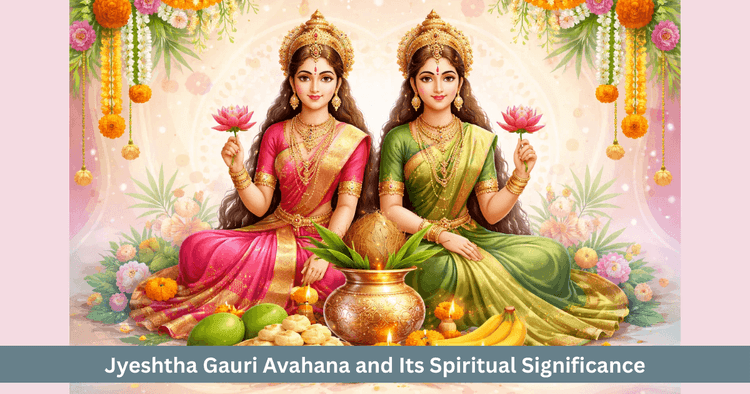
Table of Contents
In the month of Bhadrapada, Jyeshtha Gauri Avahana is cherished in Maharashtra as a profoundly auspicious and family centred vow. In this observance, Goddess Gauri, a form of Mata Parvati, is worshipped with special devotion and her arrival is seen as the entry of good fortune, harmony and prosperity into the home. Because the vrata falls during the Jyeshtha nakshatra, it is known as Jyeshtha Gauri Vrata or Jyeshtha Gauri Puja.
Jyeshtha Gauri Vrata usually begins on the day in the bright half of Bhadrapada when Jyeshtha nakshatra is in effect. The celebration continues for three days, during which Gauri Avahana, the main Gauri Puja and finally Gauri Visarjana are observed in order. Primarily married women undertake this vow but unmarried girls also join the worship of the Goddess with prayers for a suitable life partner.
| Aspect of Jyeshtha Gauri Vrata | Meaning and indication |
|---|---|
| Time | Bhadrapada bright fortnight during Jyeshtha nakshatra |
| Main observers | Married women along with unmarried girls |
| Chief purpose | Marital happiness, prosperity and protection |
| Principal deity | Gauri form of Mata Parvati, often honoured as Mahalakshmi |
What Is Jyeshtha Gauri Vrata and Where Is It Observed
Jyeshtha Gauri Puja is a widely loved vrata in Maharashtra. It is celebrated in the same Bhadrapada period in which the Ganesh Chaturthi festival is observed and both festivals together fill homes and communities with devotional joy.
The vrata extends over three days and includes the sequential observances of Gauri Avahana, Gauri Puja and Gauri Visarjana. Houses are decorated with flowers, lamps and rangoli. A very auspicious atmosphere is created and women gather together to share in the joy of this special time.
Importance of Jyeshtha Gauri for Women
Women perform the Jyeshtha Gauri Vrata to receive the grace of the Divine Mother. Since the Goddess is revered as the highest Shakti, this vow becomes an important form of Shakti upasana. Married women pray for happiness in married life, safety for their husbands, progress for the family and stable prosperity.
Unmarried girls particularly worship Devi Parvati on this day. They request her blessings for the gift of a worthy, noble and dharmic husband. As the consort of Shiva, Gauri is seen as the Goddess who understands the hearts of her devotees and fulfils sincere wishes related to family and relationships.
Story of Jyeshtha Gauri and the Connection with Worship of Mahalakshmi
In several traditions Jyeshtha Gauri Puja is also linked with the worship of Goddess Lakshmi. According to a well known legend, there came a time when the devas were greatly troubled and overpowered by demons. They repeatedly lost battles and suffered deeply.
In their distress the devas prayed to Shrimahalakshmi. Pleased by their devotion, Shrimahalakshmi destroyed the demons on the eighth tithi of the bright half of Bhadrapada, the sacred Ashtami and freed the devas from fear and danger. In remembrance of this event and in gratitude for the protection of their husbands by Mahalakshmi, women observe the Jyeshtha Gauri Vrata on Bhadrapada shukla Ashtami.
Thus Jyeshtha Gauri Puja may be understood as a combined worship of Mata Parvati and Mahalakshmi. On one side it carries the blessings of love and harmony in marriage and on the other side it invokes wealth, protection and enduring prosperity for the household.
How Is Jyeshtha Gauri Avahana Performed
On the day of Jyeshtha Gauri Avahana, two idols of Gauri are welcomed into the home with great honour. In many families these are referred to as Jyeshtha and Kanishtha, indicating the elder and younger forms. Usually the idols are brought into the home about two days after the beginning of Ganesh Chaturthi.
Two married women carry the Gauri idols to the house. One enters from the main door at the front of the home and the other from the rear entrance. This symbolises that Goddess Gauri enters from all directions, bringing auspiciousness and abundance.
From the threshold to the inner altar, footprints of the Goddess are drawn using turmeric and vermilion. At each set of footprints, when the idol is placed, haldi, kumkum and akshata are offered and welcoming mantras are chanted. This entire process is regarded as the sacred Jyeshtha Gauri Avahana.
What Is Offered in Jyeshtha Gauri Puja
On the following day, the main Jyeshtha Gauri Puja is performed. According to tradition, sixteen varieties of vegetable dishes are prepared and offered to the Goddess. Along with these, several sweet preparations, rice based dishes and different fruits are also presented as naivedya.
Special festive items such as puran poli are commonly prepared. The Goddess is worshipped as the patron of marital joy and prosperity, so items of suhag such as bangles, bindi, kumkum, haldi ornaments and a sari or cloth are offered. In the evening the lady of the house invites married women from the neighbourhood and family to participate in a formal haldi kumkum ceremony.
This gathering is more than a religious formality. It becomes a beautiful occasion to exchange affection, blessings and mutual respect among women, under the loving gaze of the Goddess.
Tradition of Jyeshtha Gauri Visarjana
On the third day, Jyeshtha Gauri Visarjana is performed. If the idols are made of clay, they are immersed in water according to tradition. Before immersion, dahi bhat or similar simple offerings are presented and the devotees request Gauri to return again the next year with the same kindness.
In some households the Gauri idols are made of metal or other reusable material. In such cases there is no immersion. Instead, after offering dahi bhat and performing arati, the idols are respectfully removed and kept in a clean, safe place until the next worship.
During these three days the home remains filled with special dishes, devotional activities and a festive mood. In many traditions Jyeshtha Gauri Puja is treated as a form of Lakshmi upasana as well, so prayers are also offered for financial stability and success in occupation and business.
Are the Rituals of Jyeshtha Gauri the Same in Every Home
One striking feature of Jyeshtha Gauri Vrata is that its observance often follows the family tradition or kula parampara, of each household. Certain mantras, offerings and small customs are passed down through generations and maintained with care.
Because of this, even within the same town, the style of worship may appear slightly different from home to home. In some places great emphasis is placed on the sixteen vegetable dishes. Elsewhere, special sweets or particular naivedya items are central. Some families focus more on kirtan and group singing by women. Yet in every home, the core feeling remains the same, which is honouring the Shakti of Gauri and praying for auspiciousness.
Connection between Jyeshtha Gauri and Ganesh Chaturthi
The timing of Jyeshtha Gauri Puja falls within the broader celebration of Ganesh Chaturthi. Generally, after Ganesh installation has taken place, Gauri arrives a few days later and the combined worship of mother and son fills the home with a sense of complete divine grace.
Gauri is honoured as the mother of Ganesha, so many devotees worship her alongside him. Some also address Gauri as Mahalakshmi and feel that the joint presence of Ganesha and Lakshmi symbolises a harmonious balance of wisdom and wealth in the household.
Frequently Asked Questions
During which nakshatra and in which month is the Jyeshtha Gauri Vrata observed?
The vrata is observed in the bright fortnight of Bhadrapada when Jyeshtha nakshatra is present. This alignment gives the observance its name Jyeshtha Gauri Vrata and it is especially popular in Maharashtra.
What do the idols of Jyeshtha and Kanishtha Gauri represent?
The two idols, brought and worshipped as Jyeshtha and Kanishtha, symbolise elder and younger aspects of the Goddess. Together they suggest a double flow of grace, good fortune and prosperity entering the home.
Why is the haldi kumkum ceremony important in Jyeshtha Gauri Puja?
In the haldi kumkum gathering, married women are invited, honoured and offered turmeric and vermilion. This ritual expresses the sharing of marital fortune, mutual blessings and sisterly affection under the blessings of the Goddess.
Why are sixteen kinds of vegetables offered to Jyeshtha Gauri?
The sixteen vegetable dishes symbolise fullness in nourishment and abundance in the household. Since the Goddess is regarded as complete in sixteen kalas, the offering of sixteen varieties expresses a wish for holistic prosperity and completeness.
Why is Jyeshtha Gauri Puja sometimes regarded as worship of Lakshmi?
According to the legend, Shrimahalakshmi destroyed the demons on Bhadrapada shukla Ashtami and protected the devas. In remembrance, women observe the Jyeshtha Gauri Vrata. In many regions Gauri is therefore revered as a form of Mahalakshmi and prayers for wealth, protection and family prosperity naturally become part of the worship.
Get your accurate Kundali
Generate KundaliDid you like it?
Author

Pt. Suvrat Sharma (63)
Experience: 20
Consults About: Family Planning, Career
Clients In: Punjab, Haryana, Delhi
Share this article with friends and family
About ZODIAQ
ZODIAQ is an online Vedic Astrology platform. It connects clients seeking astrological advice to experienced astrologers with deep knowledge. Our users also generate kundali and perform kundali milan for free. ZODIAQ also offers services to the Astrologers. Astrologers utilize various offerings by ZODIAQ to serve their clients effectively.
If you are a User
Consult with experienced astrologers and seek their guidance. You can also order handwritten Janm Patrika report with life prediction prepared by experienced astrologers. Generate accurate Kundali, perform Kundali Matching and check horoscope and muhurat. Utilize our online library for all the necessary astrological and spiritual information.
If you are an Astrologer
Create accurate kundali for your clients and perform Kundali Matching for up to 5 people at a time. Write comprehensive Janm Patrika report for your clients with ZODIAQ. Check client details anytime by saving it in client directory. Become more productive by tracking how many clients you guide every day.
WELCOME TO
ZODIAQ
Right Decisions at the right time with ZODIAQ
