Jyeshtha Purnima Vrat Katha: The Sacred Day of Savitri, Satyavan and Banyan Worship
By Aparna Patni
Importance, Vrat, and Worship of Jyeshtha Purnima
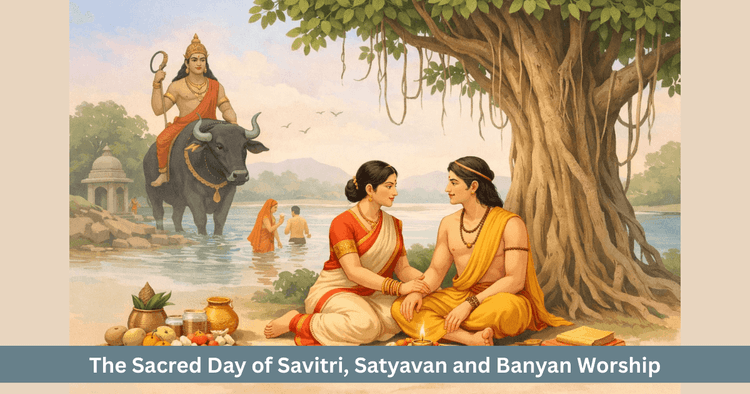
Table of Contents
In the Sanatana tradition Jyeshtha Purnima is regarded as a very auspicious full moon that fulfils heartfelt wishes. According to belief it was on this sacred day that Savitri received back the life of her husband Satyavan from Yama. Because of this, the day came to be considered especially important for marital harmony, long life of the husband and peace within the family.
It is believed that devotees who perform Ganga snan, fasting, japa and charity on Jyeshtha Purnima gradually see many of their wishes being fulfilled. This full moon is also regarded as favourable for pacifying ancestral afflictions and the bath, tarpan and offerings made on this day are considered very beneficial for the peace of departed ancestors.
Importance of Jyeshtha Purnima and basic worship
The Hindu lunar calendar usually has twelve full moon days in a year. Sometimes, due to the presence of an extra month, the number becomes thirteen, yet Jyeshtha Purnima holds a unique status among them. Coming at the height of summer, this full moon gives special importance to charity of water, food and shade.
On this day it is considered good to rise in Brahma muhurta, bathe and remember deities and ancestors with a conscious resolve. If possible devotees bathe in a sacred river, especially the Ganga and perform tarpan for the ancestors along with acts of charity. Those who stay at home may bathe, wear clean clothes and remember Lord Vishnu, Shiva, the Goddess and their ancestors with faith.
From the viewpoint of fasting, Jyeshtha Purnima is observed by many devotees through a day of restraint or simple fruit diet, combined with listening to the story of Savitri and Satyavan and expressing gratitude towards the banyan tree. In several regions married women circumambulate the banyan, tie thread around its trunk and pray for the long life of their husband.
Special beliefs associated with Jyeshtha Purnima
Various traditional beliefs are connected with Jyeshtha Purnima. A few principal ideas can be understood as follows.
- Bathing in the Ganga or any sacred water body and giving charity on this day is believed to remove sins and grant desired results.
- Offering water, food and remembrance for ancestors is considered helpful for reducing pitru dosha and for the peace of the family lineage.
- Married women keep a vrata on this tithi following Savitri’s example and pray for the long life, health and good fortune of their husbands.
- The banyan tree is worshipped as a symbol of unending life and stability by offering water, vermilion, rice, flowers and lamp at its roots.
From where does the story of Jyeshtha Purnima begin
The vrat katha of Jyeshtha Purnima is directly connected with King Ashvapati, his daughter Savitri and her future husband Satyavan. This episode is narrated in the setting of ancient times.
According to the story, after a very long period without children a radiant and virtuous daughter was born to King Ashvapati. She was named Savitri. As she grew up, her intellect, beauty and character became remarkable. When she reached the age of marriage the king started searching for a worthy husband but none of the princes seemed fully suitable in his eyes.
Seeing her father’s worry, Savitri decided to help and lessen his burden. She chose to travel herself to search for a suitable husband and thus a new chapter of the story began.
How did Savitri choose Satyavan as her life partner
During her search for a worthy husband Savitri’s eyes one day fell upon Satyavan, a noble young man living in the forest. He was calm, truthful and devoted and spent his time serving his blind parents with great care.
Impressed by Satyavan’s humility, service and inner strength, Savitri accepted him within her heart as her life partner. When she returned to her father she clearly stated that her mind had chosen Satyavan as her husband.
Although King Ashvapati trusted his daughter’s judgment, he still wished to follow tradition and requested the divine sage Narada to reveal the destiny and qualities of Satyavan in detail.
Warning of Narada and Savitri’s firm resolve
When Narada learned of Savitri’s choice he meditated and saw the span of Satyavan’s life. He informed the king and Savitri that although Satyavan was noble, virtuous and ideal in every way, his life would be very short. Because of this brief lifespan Narada advised Savitri to select another husband.
He explained that choosing a husband of short life could bring sorrow and hardship in the future. Savitri however replied calmly yet firmly that she had already accepted Satyavan as her husband in her heart. Once a man is accepted as husband, she said, it is not right to abandon him and choose another.
In this way Savitri placed her pativrata dharma, fidelity and inner conviction above fear of the future and the warning of short life. Finally the king accepted her decision and the marriage of Savitri and Satyavan was celebrated.
Life of Savitri and Satyavan after marriage
After the marriage Savitri went with Satyavan to live in the forest and serve his parents. Satyavan’s father had lost both his kingdom and his eyesight and now lived a simple life in the hermitage. Savitri took the service of her in laws as her foremost duty and soon won their hearts through respect and dedication.
The couple led a modest yet contented life. Savitri never complained, although she remembered Narada’s warning in the depths of her heart. As the predicted time of Satyavan’s death drew near, she quietly increased her inner disciplines of fasting, prayer and meditation, preparing herself for a great test.
The day of Jyeshtha Purnima approached. Savitri resolved to observe a special vrata on that day with fasting and worship since she had a subtle intuition that this full moon would bring a decisive turning point in her life.
The hour of Satyavan’s death and Savitri’s determination
On that day Satyavan went to the forest to cut wood according to his daily routine. Sensing something, Savitri requested to accompany him. Satyavan agreed and the couple went together into the forest.
After some time Satyavan felt a sudden and intense pain in his head. Weak and exhausted he lay down with his head in Savitri’s lap. She gently stroked his head, praying inwardly to the Lord for protection. Then Yama, the lord of death, appeared and separated Satyavan’s subtle body from the physical body, beginning to depart with his soul.
Seeing this, Savitri rose and quietly followed Yama. He told her several times to return, explaining that she should not walk with the dead. Savitri, with humility yet firmness, answered that where her husband resides her path must also lead. So she continued to walk behind Yama.
Yama’s test and the three boons granted to Savitri
Yama was deeply moved by Savitri’s unwavering fidelity, courage and calm behaviour. He saw that she was not protesting or demanding in anger but was following him only out of pure devotion to her dharma. He decided to honour rather than test her.
Yama told Savitri that he was pleased and would grant her three boons, with the condition that she could not ask directly for Satyavan’s life. In the first boon she requested that her blind parents in law regain their eyesight. In the second she asked that her father in law receive back his lost kingdom and royal authority.
In the third boon Savitri prayed that she might become the mother of sons born from Satyavan. Yama agreed to all three boons. however when he reflected on the third boon it became clear that for Savitri to become the mother of Satyavan’s sons, Satyavan himself had to be alive.
Why Yama had to return the life of Satyavan
Yama realised that to keep the boons true and meaningful Satyavan must live again. By the power of her intelligence Savitri had not asked directly for her husband’s life yet had made it logically necessary through her third boon.
Yama recognised the depth of Savitri’s devotion and wisdom and decided to return Satyavan’s soul. He praised her fidelity and integrity and granted that Satyavan would live.
Savitri bowed to Yama and returned to the banyan tree where Satyavan’s body lay. As the power of the boon unfolded, Satyavan slowly opened his eyes and rose, fully alive once more.
How the worship of the banyan tree began
With Satyavan’s return to life, the eyesight of his parents also came back. Their memory and strength were restored. Through the effect of the boons Satyavan’s father regained his lost kingdom and royal status. Thus the family came out of sorrow and once again enjoyed prosperity and peace.
The entire turn of fate had taken place under the shade of the banyan tree, where Satyavan had lain with his head in Savitri’s lap and where she had awaited the result of Yama’s promises. The banyan, with its deep roots, wide shade and long life, naturally became a symbol of stability and unending fortune.
From that time the custom arose of worshipping the banyan tree on Jyeshtha Purnima. Married women circumambulate the tree, tie threads around its trunk and following Savitri’s example pray for unbroken marital bliss and the long life of their husbands.
Main benefits associated with Jyeshtha Purnima
The vrat and story of Jyeshtha Purnima are believed to grant auspicious results on many levels.
- It strengthens marital stability, trust and mutual dedication between husband and wife.
- The tithi is regarded as helpful for reducing ancestral afflictions and for the prosperity of the family line.
- Worship of the banyan, charity of food and water and remembrance of Savitri and Satyavan are believed to support health, longevity and respect in society.
- Hearing and reciting the story inspires patience, courage and steadfast adherence to dharma in difficult times.
Frequently asked questions about Jyeshtha Purnima
What is considered the primary religious importance of Jyeshtha Purnima
The main religious significance of Jyeshtha Purnima comes from the story of Savitri and Satyavan. On this day Savitri, through her fidelity, wisdom and determination, obtained the return of Satyavan’s life from Yama. Therefore this date is honoured for marital good fortune, long life of the husband and fulfilment of sincere wishes.
Which actions are especially recommended on Jyeshtha Purnima
On this day early morning bathing, preferably in the Ganga if possible, along with tarpan for ancestors, offering of food and water in charity are considered auspicious. Married women worship the banyan tree, circumambulate it and tie threads on its trunk while praying for their husband’s long life. Listening to and reciting the story of Savitri and Satyavan is also regarded as highly beneficial.
How is the worship of the banyan tree connected with the story of Savitri and Satyavan
According to the story, both the death and revival of Satyavan took place under a banyan tree. Savitri held his head in her lap there and later returned to the same spot with Yama’s promise. Because the turning point of the story unfolded under this tree, the banyan came to symbolise everlasting fortune and long life and is worshipped on Jyeshtha Purnima.
Is Jyeshtha Purnima also important for relief from ancestral afflictions
Yes, Jyeshtha Purnima is regarded as favourable for pacifying pitru dosha. Devotees who bathe, offer tarpan and perform charity of food and water on this day pray for the peace of their ancestors and for the upliftment of their family line.
What practical lessons does the story of Savitri and Satyavan offer for daily life
The story teaches that true love, fidelity, patience and wise firmness in dharma can transform situations that appear impossible. Savitri did not give in to fear or despair but remained respectful even while speaking to Yama and thus secured the wellbeing and prosperity of her entire family. It encourages living with integrity, restraint and unwavering commitment to righteous decisions.
Get your accurate Kundali
Generate KundaliDid you like it?
Author

Aparna Patni (63)
Experience: 20
Consults About: Family Planning, Career
Clients In: Punjab, Haryana, Delhi
Share this article with friends and family
About ZODIAQ
ZODIAQ is an online Vedic Astrology platform. It connects clients seeking astrological advice to experienced astrologers with deep knowledge. Our users also generate kundali and perform kundali milan for free. ZODIAQ also offers services to the Astrologers. Astrologers utilize various offerings by ZODIAQ to serve their clients effectively.
If you are a User
Consult with experienced astrologers and seek their guidance. You can also order handwritten Janm Patrika report with life prediction prepared by experienced astrologers. Generate accurate Kundali, perform Kundali Matching and check horoscope and muhurat. Utilize our online library for all the necessary astrological and spiritual information.
If you are an Astrologer
Create accurate kundali for your clients and perform Kundali Matching for up to 5 people at a time. Write comprehensive Janm Patrika report for your clients with ZODIAQ. Check client details anytime by saving it in client directory. Become more productive by tracking how many clients you guide every day.
WELCOME TO
ZODIAQ
Right Decisions at the right time with ZODIAQ
