Kajali Teej Vrat Katha and the Blessings of Teej Mata
By Pt. Narendra Sharma
A Devotional Vow for Marital Happiness, Prosperity, and Good Fortune
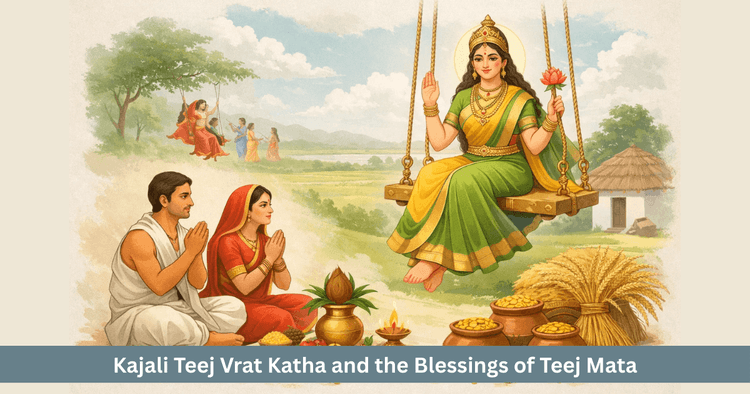
Table of Contents
The Kajali Teej of the month of Bhadrapada is regarded as a deeply devotional vow linked with marital happiness, prosperity and good fortune. On this day women observe the vow of Teej Mata, praying for the long life of their husbands and for an increase of wealth and well being in the family. Kajali Teej is especially observed in several regions of North India with worship, faith and listening to the sacred story.
According to belief, when the Kajali Teej vrat katha is heard with sincerity and Teej Mata is worshipped properly, even difficult circumstances begin to change. Just as the life of a poor Brahmin and his wife turned around by the grace of Kajali Mata, in the same way this vow is considered capable of opening new doors of good fortune for those who keep it with devotion.
What Is the Inner Meaning of Kajali Teej Vrat
The Kajali Teej vow is observed in the month of Bhadrapada. On this day married women and young girls worship Teej Mata. Married women pray for the protection and growth of their married life, while unmarried girls observe the fast with the wish for a suitable life partner.
In the Kajali Teej vow sattu made from chickpeas holds special importance. According to the story, the vow is not regarded as complete without this offering. That is why in many homes chickpea sattu is prepared and offered before Teej Mata as the main sacred food of the day.
| Aspect of Kajali Teej | Meaning and feeling |
|---|---|
| Vrat of Teej Mata | Protection of marital bond and family |
| Chickpea sattu | Central offering of the story and the vow |
| Listening to the katha | Sign of changing destiny and removing hardship |
Where Does the Story of the Poor Brahmin and His Wife Begin
The traditional Kajali Teej vrat katha tells of a very poor Brahmin who lived with his wife in a village. Their circumstances were difficult, yet both husband and wife tried to maintain their link with dharma and devotional observances.
The day of Kajali Teej in the month of Bhadrapada arrived. The Brahmin’s wife, who was herself devoted to fasting and religious vows, decided that she would certainly observe the vow of Teej Mata, whatever the circumstances might be. She took the vow of Kajali Teej and followed its rules throughout the day.
The Wife’s Insistence and the Demand for Sattu
By evening, the Brahmin’s wife told her husband that this day was her Teej Mata vow and that for the completion of the vow she needed sattu prepared from chickpeas. She requested him to bring the sattu by some means so that the worship of Teej Mata might be performed properly.
The Brahmin replied helplessly that he was very poor and had no money to purchase sattu. In a moment of intense feeling the wife said that he should procure the chickpea sattu even if it meant stealing or robbing, for the vow of Teej Mata must not remain incomplete.
Hearing this, the Brahmin became troubled. On one side stood dharma and on the other the unshaken faith of his wife. After much inner conflict he left the house in the night, with only one thought in his heart, that somehow his wife’s vow should not be broken.
The Merchant’s Shop and the Making of Sattu
It was night. In the shop of the village merchant, everyone had gone to sleep. The Brahmin quietly entered the shop. There he saw gram lentils, ghee and sugar. Using these ingredients he measured out one and a quarter seers and prepared sattu so that his wife could complete the vow of Teej Mata.
As he was about to leave with the sattu, a small sound occurred. The servants of the shop woke up and started shouting “thief, thief.”
The merchant came running and caught hold of the Brahmin. Everyone thought that a serious thief had been caught but the reality was very different.
The Brahmin’s Pain and His Truth
The merchant sternly asked the Brahmin what he had stolen by entering the shop at night. The Brahmin, frightened, replied that he was not a thief but a poor Brahmin. With humility he explained that his wife had taken the vow of Teej Mata that day and had insisted on sattu made of chickpeas for its completion.
He admitted that only because of this request he had entered the shop, taken some gram lentils, ghee and sugar and prepared one and a quarter seers of sattu so that his wife’s vow would not remain incomplete. He added that he possessed nothing other than that sattu, no gold, no silver and no other goods.
When the merchant searched him he found only the sattu. It became clear that the man had not come out of greed but solely for the sake of his wife’s vow.
Rising of the Moon and the Wife’s Waiting
Meanwhile at home, the Brahmin’s wife waited for the rising of the moon. In the observance of Teej, it is after moonrise that the sattu is taken and the formal worship is considered complete.
The moon rose in the sky but the Brahmin had still not returned. The wife continued to pray in her heart to Teej Mata that her vow might be successful, that her husband would return safely and that she might receive sattu for the offering.
Change of Heart of the Merchant and the Bond of Sacred Sisterhood
When the merchant saw the truthfulness and poverty of the Brahmin, his heart softened. He realised that this man had entered the shop not for selfish gain but to uphold the sanctity of a vow.
The merchant then told the Brahmin that from that day he would regard the Brahmin’s wife as his sister in dharma. He not only gave the sattu to the Brahmin but also presented ornaments, money, henna, ceremonial thread and a considerable amount of wealth, so that the Teej of his new sister would be celebrated with honour and joy.
Thus the Brahmin was sent away not as a criminal but as an honoured guest. The one who had entered the shop in shame and fear now returned home with respect and gifts.
Grace of Kajali Mata and Fruit of the Vow
When the Brahmin reached home, he found his wife still waiting with the vow of Teej Mata. He placed before her the one and a quarter seers of sattu, along with the ornaments, henna, thread and money.
The wife, filled with gratitude, worshipped Teej Mata with devotion. She offered the sattu, performed the rituals and the whole family joined in the worship of Kajali Mata.
According to the story, from that very day the misfortune of the Brahmin began to fade and the doors of prosperity opened in his life. The closing blessing of the katha is that just as the Brahmin’s destiny changed, in the same way whoever observes Kajali Teej with faith and listens to the story of Kajali Mata will find the days turning in their favour, with increased happiness, good fortune and prosperity in the home.
Frequently Asked Questions
In which month is the Kajali Teej vow observed?
This vow is kept in the month of Bhadrapada on the day of Kajali Teej. On this day special worship of Teej Mata and recitation of the Kajali Teej vrat katha are considered very important.
Why does chickpea sattu hold such importance in Kajali Teej?
According to the story, the Brahmin’s wife desired chickpea sattu for the completion of her vow and the Brahmin went to the merchant’s shop solely for this. Hence sattu made from gram is regarded as the principal sacred offering of this vow.
Why did the merchant accept the Brahmin’s wife as his sister in dharma?
After realising the Brahmin’s intention and poverty, the merchant’s heart changed. He accepted the Brahmin’s wife as his sacred sister and, besides the sattu, gave ornaments, henna, thread and money so that her vow of Teej Mata might be fulfilled with beauty and honour.
For what results is the Kajali Teej vow observed?
This vow is kept for marital happiness, good fortune, family prosperity and for the transformation of difficult circumstances. The story clearly shows that just as the Brahmin’s fate changed, so the devotees’ lives may also be uplifted by the grace of Kajali Mata.
If sattu is not available, does the vow of Kajali Teej remain incomplete?
The feeling of the story suggests that sattu is the central offering of the vow, so every effort should be made to prepare chickpea sattu in some form. Even so, the most important aspect is devotion, sincerity and focused worship of Teej Mata.
Get your accurate Kundali
Generate KundaliDid you like it?
Author

Pt. Narendra Sharma (63)
Experience: 20
Consults About: Family Planning, Career
Clients In: Punjab, Haryana, Delhi
Share this article with friends and family
About ZODIAQ
ZODIAQ is an online Vedic Astrology platform. It connects clients seeking astrological advice to experienced astrologers with deep knowledge. Our users also generate kundali and perform kundali milan for free. ZODIAQ also offers services to the Astrologers. Astrologers utilize various offerings by ZODIAQ to serve their clients effectively.
If you are a User
Consult with experienced astrologers and seek their guidance. You can also order handwritten Janm Patrika report with life prediction prepared by experienced astrologers. Generate accurate Kundali, perform Kundali Matching and check horoscope and muhurat. Utilize our online library for all the necessary astrological and spiritual information.
If you are an Astrologer
Create accurate kundali for your clients and perform Kundali Matching for up to 5 people at a time. Write comprehensive Janm Patrika report for your clients with ZODIAQ. Check client details anytime by saving it in client directory. Become more productive by tracking how many clients you guide every day.
WELCOME TO
ZODIAQ
Right Decisions at the right time with ZODIAQ
