Kamika Ekadashi Vrat Katha and the Deep Meaning of Purification
By Pt. Sanjeev Sharma
Devotion to Lord Vishnu and the Significance of Liberation from Sins
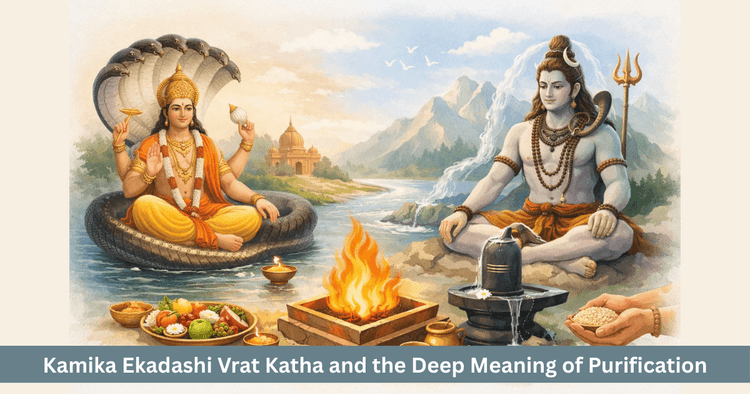
Table of Contents
The Kamika Ekadashi that falls in the Krishna Paksha of the month of Shravan is regarded as a highly powerful and meritorious Ekadashi dedicated to Lord Vishnu. It is believed that by observing this fast with devotion one attains merit equal to bathing in the Ganga, performing sacrifices and giving gifts. For the devotee who follows the Kamika Ekadashi vrata, sins begin to fade and the path of liberation becomes smoother.
The month of Shravan itself is considered very sacred for combined devotion to Lord Shiva and Lord Vishnu. During the rainy season, when the environment supports inner reflection and spiritual practice, this Ekadashi offers a rare opportunity to purify both mind and actions.
When and Why Is Kamika Ekadashi Observed
Kamika Ekadashi occurs on the eleventh lunar day of the Krishna Paksha of Shravan. On this day the devotee bathes in the morning, takes a vow to fast and observes self control till night. Some keep a complete fast or take only fruits, while others follow a simple sattvic diet in the discipline of Ekadashi.
The very name of this Ekadashi indicates its importance. Kamika means that which fulfils heartfelt desires. Thus this Ekadashi is regarded as beneficial not only for destruction of sins but also for the fulfilment of auspicious wishes.
| Tithi and phase | Related understanding |
|---|---|
| Month | Shravan, within the rainy season |
| Lunar phase | Eleventh day of the waning fortnight |
| Deity worshipped | Lord Vishnu, remembrance of Hari’s names |
| Main practices | Fasting, worship, Tulsi offering and vigil |
What Does the Kamika Ekadashi Story Teach
In ancient times there lived a warrior of the Kshatriya class in a certain town. He was brave and powerful, yet by nature quick tempered. Due to anger his decisions often became harsh.
One day he became entangled in a dispute with a Brahmin. The argument grew so intense that in a fit of rage the Kshatriya killed the Brahmin. As soon as this terrible sin of Brahma hatya was committed, unrest spread through his life.
People began to avoid him, his social honour fell and a deep sense of fear and guilt settled within his heart. He constantly felt as if an unseen burden accompanied him due to this sin.
The Kshatriya’s Search for Atonement in the Forest
Time passed but his mind did not find peace. One day, encircled by his own thoughts, he left the town and wandered away, finally reaching a forest. In a quiet part of that forest there was an ashram where a great sage engaged in austerities.
The Kshatriya reached the ashram and fell at the feet of the sage with a weary heart. With tears he narrated the entire story of his offence. He admitted that in anger he had killed a Brahmin and now could see no way to free himself from the sin.
He asked the sage to show a path by which he might atone for this terrible act and bring his life back towards dharma and inner peace.
The Sage’s Guidance to Observe Kamika Ekadashi
The sage, understanding his situation, spoke calmly and said that no matter how grave the sin may be, if repentance is genuine and effort is sincere, then shelter in God can bring a solution.
He told the Kshatriya that the coming Ekadashi in the Krishna Paksha of Shravan would be Kamika Ekadashi. On that day he should observe a fast with faith. After bathing in the morning he should worship Lord Vishnu, maintain purity of thought, word and deed throughout the day and stay awake at night, chanting the names of Hari.
The sage especially instructed him to offer Tulsi leaves during worship. He should place Tulsi before Lord Vishnu, pray with a truthful heart and ask forgiveness for his misdeed. On the following day, Dvadashi, he should break the fast at the proper time to complete the vow.
How the Kshatriya Observed the Kamika Ekadashi Vrat
The sage’s words touched the Kshatriya deeply. When the day of Kamika Ekadashi arrived, he rose early, bathed and took the vow of fasting. While making the resolve he remembered his crime and sincerely prayed that the rest of his life would be dedicated to dharma and truth.
He fasted for the entire day. Before an image of Lord Vishnu he lit a lamp, offered flowers, fruits and Tulsi leaves. He recited the names of Vishnu again and again and repeatedly asked forgiveness for the sin of killing a Brahmin.
During the night he kept vigil. He sang hymns, meditated on prayers and remembered the name of Hari. Compared to earlier days his mind had become more serious and calm because he was no longer running away from his sin but standing in the refuge of the Lord.
On the next day, Dvadashi, he broke his fast according to the rules, partook of simple food and once again bowed before Lord Vishnu, renewing his determination to lead a transformed life.
What Result Did Kamika Ekadashi Bring to Him
According to the sacred narration, Lord Vishnu became very pleased with the Kshatriya’s sincere repentance and devotion filled fast. Seeing the pain in his heart and his longing for change, the Lord bestowed special grace upon him.
The story declares that by the power of Kamika Ekadashi he was freed even from the terrible sin of Brahma hatya. The heavy burden of fear, unrest and guilt gradually lifted from his mind and he moved towards inner peace.
Thus this vow shows that when a person accepts responsibility for actions and comes honestly into the refuge of God, sacred observances like Kamika Ekadashi become channels for the destruction of sin and purification of the self.
What Is the Spiritual Importance of Kamika Ekadashi
The meaning of Kamika Ekadashi is not limited to an outer observance. It points to that inner state in which a person redirects desires towards a pure and righteous path and abandons sinful tendencies.
Scriptural teaching says that worship of Lord Vishnu on this day destroys sins from many births. Worship of Tulsi holds special prominence because it is believed that the Lord is quickly pleased by offerings made with Tulsi leaves.
Staying awake at night and chanting the names of Hari is said to bring the fruits of many sacrifices. Acts of charity performed on this day are believed to grant inexhaustible merit and deepen the feeling of compassion and sharing.
| Spiritual practice | Inner meaning and fruits |
|---|---|
| Worship of Lord Vishnu | Destruction of sin and attainment of peace |
| Offering of Tulsi leaves | Symbol of purity, humility and intimate devotion |
| Night vigil and kirtan | Effect equal to many sacrifices in scriptures |
| Charity and service | Inexhaustible merit and growth of compassion |
Step by Step Method of Kamika Ekadashi Vrat
When the Kamika Ekadashi vow is performed properly, its influence is said to reach both mind and life.
Resolve of the Fast and Practices of the Day
On Ekadashi morning, during the auspicious early hours or after sunrise, the devotee bathes and wears clean clothes. Then, remembering the Lord, a vow is made to observe the Kamika Ekadashi fast with remembrance of Vishnu, self control and purity for the entire day.
After this, an image or picture of Lord Vishnu is respectfully placed facing east or north. If the picture shows the Lord with conch and discus, it is considered especially auspicious.
How to Worship Lord Vishnu on This Day
In the worship, a lamp and incense are lit first. Then the image of the Lord is ceremonially bathed with clean water or with a mixture known as panchamrita. After the ablution, the Lord is adorned with yellow cloth, yellow flowers, fruits and especially Tulsi leaves.
The devotee may then recite the Vishnu Sahasranama, listen to or read the Kamika Ekadashi katha or repeat a chosen name of the Lord continuously. Whatever mantra or name feels natural to the heart, repeating it with attention is regarded as the essence of the vow.
At night, as far as possible, a vigil is kept with singing, remembrance and quiet meditation on the Lord’s name. Even those who cannot stay awake the whole night are encouraged to spend at least some time in focused prayer.
On Dvadashi, at an appropriate time, the fast is broken with water, fruits or light sattvic food. While doing this, it is important to maintain a feeling of gratitude for the strength and grace received during the vow.
Inner Message of Kamika Ekadashi
The story and observance of Kamika Ekadashi teach that sincere repentance can give a new direction to life. Any person can rise above past mistakes if those mistakes are acknowledged, the resolve for change is taken and shelter is sought at the feet of the Lord.
This vrata is not merely an outward ritual. It is a means for inner purification. Leaving aside anger, pride, violence and tendencies to blame others and embracing the path of truth, self discipline, compassion and devotion, is the true message of this Ekadashi.
The devotee who on this day also purifies personal desires and turns them towards dharma, noble conduct and spiritual welfare gradually begins to experience deeper peace, contentment and the gentle presence of divine grace.
Frequently Asked Questions
When is Kamika Ekadashi observed and to which deity is it dedicated?
Kamika Ekadashi is observed in the Krishna Paksha of the month of Shravan on the eleventh lunar day. It is dedicated to Lord Vishnu and is observed with remembrance of His names and worship accompanied by Tulsi offerings.
Which kinds of sins are said to be destroyed by the Kamika Ekadashi vow?
According to the story, when this fast is observed with true repentance and devotion, even grave sins such as the killing of a Brahmin may be absolved. The essential conditions are inner purification, acceptance of responsibility and sincere refuge in Lord Vishnu.
Is it necessary to offer Tulsi leaves on Kamika Ekadashi?
Offering Tulsi leaves holds special importance on this Ekadashi. It is believed that when worship of Lord Vishnu is performed with Tulsi, the fruits of the vow increase manifold and the Lord becomes quickly pleased.
Why is a night vigil performed on Kamika Ekadashi?
Keeping vigil at night while chanting the names of Hari is described as giving results comparable to many great sacrifices. The vigil allows the mind to remain longer in devotion and lets the purifying influence of Ekadashi fill both day and night.
Can everyone observe this fast in the same way?
The heart of the vow is devotion and self control. Those who cannot keep a complete fast may observe it with fruits or light sattvic food. however it is very important on this day to refrain from anger, quarrels, criticism and negative thoughts and to remain inwardly turned towards the Lord.
Get your accurate Kundali
Generate KundaliDid you like it?
Author
Pt. Sanjeev Sharma (63)
Experience: 20
Consults About: Family Planning, Career
Clients In: Punjab, Haryana, Delhi
Share this article with friends and family
About ZODIAQ
ZODIAQ is an online Vedic Astrology platform. It connects clients seeking astrological advice to experienced astrologers with deep knowledge. Our users also generate kundali and perform kundali milan for free. ZODIAQ also offers services to the Astrologers. Astrologers utilize various offerings by ZODIAQ to serve their clients effectively.
If you are a User
Consult with experienced astrologers and seek their guidance. You can also order handwritten Janm Patrika report with life prediction prepared by experienced astrologers. Generate accurate Kundali, perform Kundali Matching and check horoscope and muhurat. Utilize our online library for all the necessary astrological and spiritual information.
If you are an Astrologer
Create accurate kundali for your clients and perform Kundali Matching for up to 5 people at a time. Write comprehensive Janm Patrika report for your clients with ZODIAQ. Check client details anytime by saving it in client directory. Become more productive by tracking how many clients you guide every day.
WELCOME TO
ZODIAQ
Right Decisions at the right time with ZODIAQ
