Spiritual Significance of Karka Sankranti
By Pt. Amitabh Sharma
Auspicious Time for Devas and Devotees
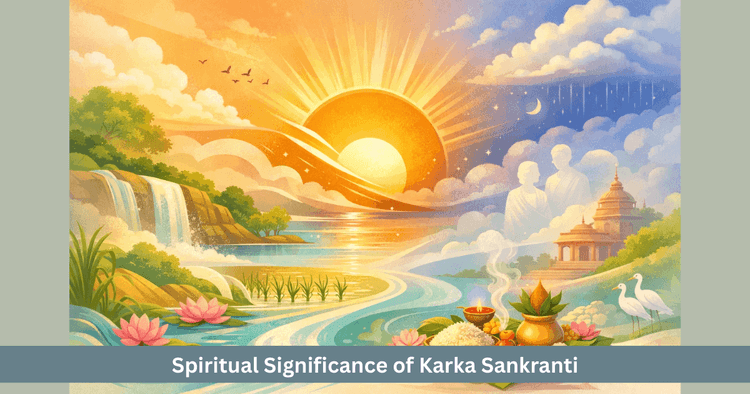
Table of Contents
When the Sun enters Karka Rashi it is called Karka Sankranti. From this moment the phase of Dakshinayana begins, which is regarded as night time for the devas and a special inward time for spiritual seekers. On this day Lord Vishnu is especially worshipped and donating food and clothes is considered very auspicious.
Karka Sankranti also marks the clear onset of the monsoon season. From here the six month southern journey continues until Makar Sankranti, when Dakshinayana ends and Uttarayana begins. Within these months the four holy months of Chaturmas fall between Shravana and Karthika, a period dedicated to focused worship of Lord Vishnu. This entire Dakshinayana phase is also seen as favourable for Pitru Tarpan, since the departed souls are believed to draw closer to the earthly plane to receive offerings.
What is Karka Sankranti
In Vedic astrology, a Sankranti is the moment when the Sun shifts from one sign to another.
- When the Sun moves from Gemini into Karka Rashi, that moment is called Karka Sankranti.
- This change is not only astronomical. It marks an energetic turning point where the upward, outer movement of Uttarayana gives way to the inward movement of Dakshinayana.
- Because of this shift, worship, fasting, chanting and charity dedicated to Lord Vishnu on this day are regarded as especially meaningful.
After Karka Sankranti, days gradually become shorter and nights longer. Nature itself suggests that this is a good time to slow down outward activity and give more space to inner stability and reflection.
Karka Sankranti and Dakshinayana
With Karka Sankranti, the Sun’s Dakshinayana phase begins.
| Phase | Span and meaning |
|---|---|
| Uttarayana | From Makara to Karka, day for devas, outer growth |
| Dakshinayana | From Karka to Makara, night for devas, inwardness |
- It is said that one year for humans equals one day in the life of the devas. From this view, Uttarayana is their day and Dakshinayana their night.
- These six months of Dakshinayana are the time when energy turns inward. For this reason, meditation, vows, Pitru Tarpan and Vishnu worship are considered especially fruitful.
- Karka Sankranti is therefore a starting signal for a period in which seekers are encouraged to focus more on inner cleansing than on outward display.
Dakshinayana ends on Makar Sankranti, when the Sun begins its journey northward again and the devas’ day resumes.
Religious and spiritual meaning of Karka Sankranti
The vows, prayers and charity performed on Karka Sankranti are believed to carry deep influence.
- The main intent behind puja and fasting on this day is to seek relief from negative patterns, misfortunes and inner heaviness.
- In many Vishnu temples, Lord Varaha Swamy, the third avatar of Lord Vishnu, is specially worshipped on Karka Sankranti. Varaha symbolises the lifting of Earth from lower states, pointing to upliftment from spiritual darkness.
- During Dakshinayana, the period of Chaturmas, from Shravana to Karthika, is observed as a four month discipline. Devotees adopt extra vows and deepen their worship of Lord Vishnu during this time.
Since Dakshinayana is understood as the night of the devas, it is seen as a season for withdrawal from excessive outward indulgence and turning toward introspection and correction of one’s actions.
Why is this period important for Pitru Tarpan
With Karka Sankranti begins the part of the year that is especially suitable for Pitru Tarpan.
- Traditional belief holds that during Dakshinayana the Sun’s movement towards the south is connected with the realm of the ancestors.
- It is said that in this phase the Pitru approach the earthly plane and await the Shradh and Tarpan performed by their descendants.
- Karka Sankranti, as the opening of this phase, serves as a reminder to prepare mentally and practically for offerings, remembrance and gratitude toward one’s lineage.
Seeing Shradh and Tarpan not as dry ritual but as an expression of responsibility and thankfulness makes this period far more meaningful. It is a time to remember the roots through which one has received life.
Vrat, puja and key observances on Karka Sankranti
Certain practices are traditionally followed on Karka Sankranti and can be adopted according to individual capacity.
Morning bath and sankalpa
- At Karka Sankranti it is auspicious to take a holy bath at sunrise or just before. Bathing in a river or lake is ideal but clean water at home is also acceptable with the right intent.
- After the bath, devotees remember Surya and Lord Vishnu and take a sankalpa to maintain restraint in speech, behaviour and food for the day.
- During bathing one silently prays that in the months of Dakshinayana, laziness, negativity and ego may reduce and awareness may increase.
Worship of Lord Vishnu and the Sun
- Special worship of Lord Vishnu is recommended on this day. At home or in a temple, devotees offer a lamp, incense, flowers, Tulsi leaves and simple naivedya before his image.
- Many recite the Vishnu Sahasranama Stotram, which is known for calming the mind and supporting steadiness in life.
- Along with this, Surya Dev is also worshipped. Water is offered as arghya to the Sun with prayers for health, vitality and clear vision. Gratitude in the heart is considered essential during this offering.
Charity, conduct and other guidelines
- Donation of grains, clothes, oil or other necessities is considered very auspicious on Karka Sankranti. The spirit behind giving should be compassion rather than expectation of reward.
- It is generally advised not to begin major new ventures on this day, as the focus is more on introspection and alignment than on outward expansion.
- Performing Pitru Tarpan, offering water and setting intentions for the upcoming Shradh period are all seen as very favourable acts on this day.
A sattvic and light diet, regular chanting and a disciplined daily routine throughout Dakshinayana help to deepen the subtle benefits of Karka Sankranti.
Inner guidance from Karka Sankranti
Karka Sankranti is not only an astronomical event. It is also an inner turning point.
- It reminds that every year has a phase for outer achievements and a phase for inner refinement and rest.
- As the Sun changes direction, seekers are invited to re examine their own direction in thoughts, emotions and actions.
- Through Pitru Tarpan, Vishnu worship, Surya puja and charity, a person can relate more responsibly to past, present and future all at once.
When Karka Sankranti is lived as an opportunity rather than just a date, it can become a gentle beginning of greater restraint, gratitude and steadiness in life.
Common questions about Karka Sankranti
Is it necessary to observe a strict fast on Karka Sankranti?
Fasting is beneficial but not compulsory. One may follow a lighter fast or eat simple sattvic food according to health, while keeping the mind focused and disciplined.
Should new projects always be avoided on this day?
Traditionally this day is seen as more suitable for reflection than for launching major plans. If possible, important new ventures are better started on other auspicious dates.
Should one worship only Lord Vishnu on Karka Sankranti?
The central focus is on Lord Vishnu and Surya Dev. Devotees may also worship their family deities but keeping Vishnu and Surya at the heart of the day’s puja is considered ideal.
Is Pitru Tarpan compulsory on this day?
It is not compulsory but Karka Sankranti is considered a very favourable time for it. If a full rite is not possible, at least a simple remembrance and prayer for ancestors is recommended.
What simple practices can an ordinary person follow during Dakshinayana and Chaturmas?
Daily repetition of a few names of Lord Vishnu, offering water to the Sun, eating sattvic food on some days, controlling anger and harsh speech and keeping regular sleep and waking habits are all simple yet powerful disciplines for this period.
Get your accurate Kundali
Generate KundaliDid you like it?
Author
Pt. Amitabh Sharma (56 Years)
Experience: 20
Consults About: Family Planning, Career
Clients In: Punjab, Haryana, Delhi
Share this article with friends and family
About ZODIAQ
ZODIAQ is an online Vedic Astrology platform. It connects clients seeking astrological advice to experienced astrologers with deep knowledge. Our users also generate kundali and perform kundali milan for free. ZODIAQ also offers services to the Astrologers. Astrologers utilize various offerings by ZODIAQ to serve their clients effectively.
If you are a User
Consult with experienced astrologers and seek their guidance. You can also order handwritten Janm Patrika report with life prediction prepared by experienced astrologers. Generate accurate Kundali, perform Kundali Matching and check horoscope and muhurat. Utilize our online library for all the necessary astrological and spiritual information.
If you are an Astrologer
Create accurate kundali for your clients and perform Kundali Matching for up to 5 people at a time. Write comprehensive Janm Patrika report for your clients with ZODIAQ. Check client details anytime by saving it in client directory. Become more productive by tracking how many clients you guide every day.
WELCOME TO
ZODIAQ
Right Decisions at the right time with ZODIAQ
