Kokila Vrat Katha and the Blessing of a Worthy Husband
By Pt. Suvrat Sharma
Significance of the Fast for Marital Happiness and a Suitable Life Partner
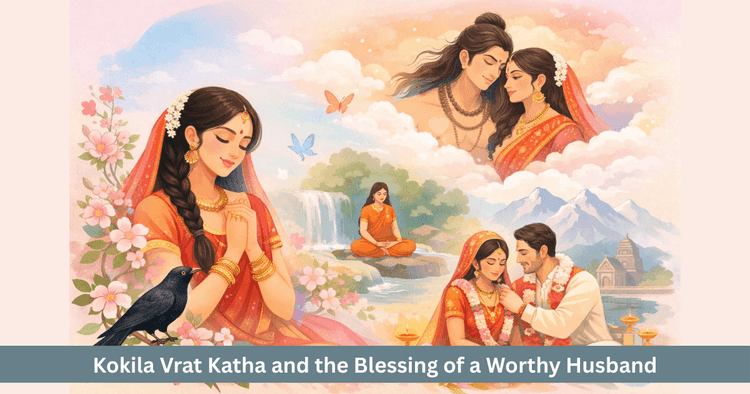
Table of Contents
The Kokila Vrat is regarded as highly auspicious for young girls and women who desire a worthy life partner, a steady married life and sincere devotion. The story of this vrata is intimately connected with Lord Shiva and Mata Sati and is described in the Shiva Purana. It is said that the origin of this vow goes back to the previous birth of Goddess Parvati, when she appeared as Devi Sati.
The Kokila Vrat is observed during specific dates in the month of Ashadha and in many traditions the symbol of the kokila, the cuckoo bird, is given special importance. It is believed that a maiden or woman who observes this vrata with devotion finds obstacles in marriage slowly removed and receives a life partner who matches her nature and supports her inner growth. Behind this vrata lies a long spiritual journey from Sati to Parvati, filled with tapasya, renunciation and rebirth.
Where does the Kokila Vrat Katha begin
The story of Kokila Vrat begins with the birth of Devi Sati and the atmosphere of her parental home.
Devi Sati was born as the daughter of King Daksha. Daksha was a Prajapati, well versed in Vedic sacrifices and rituals. Yet he carried a serious inner flaw. He had strong dislike, even contempt, for Lord Shiva. In contrast, Sati’s heart was filled with deep love and devotion toward Shiva. This sharp difference between daughter and father later gave rise to the event famously known as the Daksha Yajna.
At one time, King Daksha organised a grand yajna. He invited the gods, sages and all prominent celestial beings. Brahma, Vishnu and many other deities were respectfully called. The arrangements were splendid and the sacrificial arena was filled with Vedic chants. however one name was deliberately left out of the invitation list. That was the name of Lord Shiva.
When Sati came to know that her father had performed a great yajna, invited everyone, yet neither invited Lord Shiva nor even sent a word to his own daughter, she felt deep hurt and confusion. She believed that as his daughter she had a natural right to be present in her father’s sacrifice.
Sati’s decision and the insult at Daksha Yajna
Devi Sati requested Lord Shiva to allow her to attend the yajna at her father’s house.
- Lord Shiva, with calm wisdom, explained that going uninvited to someone’s sacrifice is not considered proper in dharma, even if that person is one’s own father.
- He indicated that where there is no respect or honour, merely having a relationship does not make one’s presence auspicious.
For Sati this reasoning was intellectually sound, yet her emotions stood elsewhere. The pull of her father’s home, childhood memories and a sense of filial right were very strong. She did not accept Shiva’s counsel and, in a mood of insistence, decided to go alone to Daksha’s yajna.
On reaching the yajna site, Sati saw that there was no sign of welcome or honour for her or for her husband. No one showed joy at her arrival. According to the Katha, Daksha not only ignored Sati, he also spoke disrespectfully about Lord Shiva, using harsh words and revealing his arrogance.
Sati could not tolerate this insult of her beloved husband. She felt that to remain alive in a place where her Lord was being dishonoured would itself be a kind of support to that insult. therefore in intense grief, she entered the sacrificial fire and gave up her body. Externally she left her physical form but inwardly her love and devotion did not die.
Anger of Lord Shiva, Daksha’s pride and Sati’s curse
When news of Sati’s self immolation reached Lord Shiva, deep sorrow and righteous anger arose within him. The Katha describes how Shiva, in this state, destroyed Daksha’s sacrifice and crushed his pride. This event symbolises not only the breaking of one yajna but the shattering of a mindset that clings to outer ritual while forgetting humility and devotion.
In this context a severe consequence for Sati herself is also mentioned. Sati had gone to the sacrifice against Shiva’s advice, driven by emotional insistence and this led to great disaster. Shiva felt profound pain at the outcome. It is said that because of this disobedience and insistence, Sati was destined to wander for thousands of years as a kokila, a cuckoo bird.
Here lies the root of the Kokila Vrat. The kokila, known for its sweet voice, becomes in this story a symbol of long tapasya, waiting and purification. As a cuckoo, Sati’s journey is one of reflecting upon past choices and moving toward deeper maturity.
Kokila Vrat and Sati in the form of a cuckoo
Under the influence of this destiny, Sati moved in the form of a cuckoo in the Nandana Vana, the divine forest.
- In this form she maintained the inner flame of remembrance and repentance for a very long period.
- Her tapasya was not only a waiting for rebirth but also a journey of inner refinement, where previous decisions were re examined and purified.
Because of this long penance performed as a kokila, the vow came to be known as the Kokila Vrat. The cuckoo here is not just a bird. It is Sati herself, who continues her devotion beyond the limits of one body and one lifetime.
After this long phase of tapasya, Sati was reborn as Parvati, the daughter of Parvata Raja Himavan. From childhood, Parvati felt deep attraction and devotion for Lord Shiva, as if the unfinished spiritual current from the previous life had resurfaced.
With the guidance of the sages, Parvati came to understand that if she would undertake serious vrata and tapasya in this life, Shiva would accept her once again. The Katha mentions that she observed special vows from the month of Ashadha into the following month, worshipping Lord Shiva with full dedication. Through this long period of restraint and worship, she gradually won Lord Shiva’s heart and he agreed to marry her.
From tapasya as a cuckoo to marriage as Parvati, the entire journey shows that true love, when joined with discipline and self improvement, can eventually reach fulfilment, even if it requires time and rebirth.
Spiritual meaning and observance of Kokila Vrat
Kokila Vrat is particularly known as a vrata for unmarried girls seeking a good husband, yet its meaning extends beyond marriage alone.
- Through this vrata, girls and women inwardly resolve to choose their paths with care, patience and balance.
- The life of Sati teaches that decisions taken purely in emotion can have serious consequences, while Parvati’s path shows that through tapasya and steady devotion the same love can mature and bring lasting blessing.
- The symbol of the kokila reminds that sweet speech, patience and restrained behaviour are also forms of spiritual practice.
While observing Kokila Vrat, remembering both Sati and Parvati helps devotees draw strength from their journey. It encourages them to combine deep feeling with wise choices in their own relationships.
Common questions about Kokila Vrat
Is Kokila Vrat meant only for unmarried girls?
Traditionally it is especially recommended for maidens seeking a worthy husband. however married women may also observe it to support harmony, respect and steadiness in their married life.
Is feeding cuckoos or birds necessary during this vrata?
The Katha does not prescribe it as a rule, yet many devotees offer grains or water to birds in honour of Sati’s kokila form. This act expresses compassion and aligns nicely with the spirit of the vow.
Does this vrata require fasting for a whole month?
The reference to observing vows from Ashadha into the next month in Parvati’s life is symbolic of sustained effort. In practice, the duration and strictness of Kokila Vrat may vary by region and family tradition. Whatever period one chooses should be followed sincerely.
Can one gain benefit by only listening to the Kokila Vrat Katha?
Yes. Those unable to keep a full fast can still benefit by reading or hearing the Katha with faith. The story itself awakens devotion, patience and clarity of decision, which are important fruits of the vrata.
Should Kokila Vrat be kept every year or is once enough?
If circumstances allow, observing it regularly can be helpful. Yet even a single Kokila Vrat, done with a focused intention such as finding a suitable spouse or healing a relationship pattern, can bring meaningful change over time.
Get your accurate Kundali
Generate KundaliDid you like it?
Author

Pt. Suvrat Sharma (63)
Experience: 20
Consults About: Family Planning, Career
Clients In: Punjab, Haryana, Delhi
Share this article with friends and family
About ZODIAQ
ZODIAQ is an online Vedic Astrology platform. It connects clients seeking astrological advice to experienced astrologers with deep knowledge. Our users also generate kundali and perform kundali milan for free. ZODIAQ also offers services to the Astrologers. Astrologers utilize various offerings by ZODIAQ to serve their clients effectively.
If you are a User
Consult with experienced astrologers and seek their guidance. You can also order handwritten Janm Patrika report with life prediction prepared by experienced astrologers. Generate accurate Kundali, perform Kundali Matching and check horoscope and muhurat. Utilize our online library for all the necessary astrological and spiritual information.
If you are an Astrologer
Create accurate kundali for your clients and perform Kundali Matching for up to 5 people at a time. Write comprehensive Janm Patrika report for your clients with ZODIAQ. Check client details anytime by saving it in client directory. Become more productive by tracking how many clients you guide every day.
WELCOME TO
ZODIAQ
Right Decisions at the right time with ZODIAQ
