Sri Krishna Warns Against Hustle Culture
By Pt. Nilesh Sharma
Discover how the ancient wisdom of the Bhagavad Gita cures modern mental exhaustion and burnout.
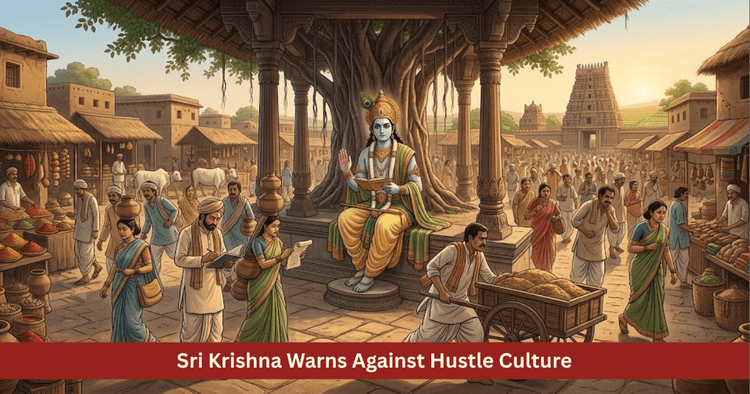
Table of Contents
The modern world considers constant movement to be the ultimate synonym for success. Working for excessively long hours, relentlessly chasing endless ambitions and believing that rest must be earned only through total exhaustion have become the core principles of contemporary society. In this current mindset, slowing down feels like an absolute failure and taking a brief pause appears to be a massive risk. This culture of relentless striving, which modern society views as a byproduct of corporate competition, social media influence and productivity metrics, is actually a deep psychological affliction. The timeless solution to this condition was provided thousands of years ago within the sacred pages of the Bhagavad Gita.
The profound teachings that Sri Krishna imparted to Arjuna on the battlefield of Kurukshetra were not merely meant for warfare; rather, they were infallible principles designed to quiet the inner turmoil of humanity. The Gita delivers a silent yet incredibly firm warning against the psychological toll of this endless race. Sri Krishna provides a vivid depiction of how a life that appears immensely successful on the outside can remain thoroughly hollow and troubled within. He does not reject action, sincere effort or personal responsibility but he fundamentally questions the blind race to prove personal worth through continuous activity.
Instead of urging individuals to withdraw completely from the world, Sri Krishna offers an exceptionally wise path of worldly engagement that preserves inner equilibrium. His words subtly yet powerfully dismantle the very foundations of this modern hustle.
Action Without Attachment and the Illusion of Identity
One of the most revolutionary teachings of the Bhagavad Gita is that humanity has the right to perform action alone, never to its fruits. This single philosophical truth is entirely sufficient to dismantle the blind culture of hustle at its absolute core. Modern lifestyle systematically ties human identity to external outcomes, rewards, social recognition and material successes. Within this structured setup, the value of an individual is judged solely by productivity, forcing people to believe that rest is a luxury to be claimed only after driving oneself to complete exhaustion.
Sri Krishna warns against this deceptive mindset by completely separating the actions of a human being from their true spiritual existence. He instructs Arjuna to execute duties with total dedication, sincerity and responsibility but with the strict condition that results must never become the metric of self-worth.
| Perspective on Work | Hustle Culture | Vedic Astrology and Gita Perspective |
|---|---|---|
| Core Motivation | External praise, outcomes and constant productivity | Sense of duty, self-purification and dedication to the Divine |
| Mental State | Continuous anxiety, fear and fluctuations of ego | Inner peace, stability and equanimity of mind |
| Basis of Identity | Status, wealth, success and material achievements | Eternal soul, pure consciousness and sanctity of action |
| Energy Consumption | Rapid burnout and depression due to mental stress | Continuous flow of vital energy due to absolute clarity |
When work itself becomes the sole identity of an individual, natural effort transforms into a deep-seated anxiety. Every single task begins to carry the heavy burden of self-validation and every unfavorable outcome directly threatens the ego. This is precisely why the modern lifestyle leaves people mentally depleted even after achieving monumental success, simply because the mind never enters a state of true repose.
The message of Sri Krishna is not an opposition to ambition; rather, it is a direct opposition to obsession. He does not command Arjuna to abandon his supreme duty as a warrior but he explicitly instructs him to release the internal craving for control and rewards. Translating this into a modern context, Sri Krishna warns that when self-worth depends entirely on product output, mental and physical burnout becomes absolutely inevitable. Action executed with complete clarity sustains human energy, whereas action performed solely for validation thoroughly consumes it.
The Restless Mind Is the Real Enemy, Not Laziness
Contemporary society routinely frames rest as a sign of weakness and stillness as a form of laziness. Sri Krishna directly challenges this widespread illusion by clarifying that the true cause of human suffering is not a lack of action but a restless mind. According to the Gita, the downfall of an individual does not occur due to a shortage of effort but rather because of uncontrolled desires and mental agitation.
Sri Krishna explains that when the mind remains continuously obsessed with obtaining one thing or another, it can never experience true contentment. Even the grandest achievement fails to pacify it, because the moment one desire is fulfilled, the mind immediately sprints toward the next target. This endless inner restlessness is a perfect mirror image of modern hustle culture. People are not exhausted because they are working hard physically; they are exhausted because their minds never actually stop chasing.
- The volatility of the mind cannot be quieted by simply increasing workload
- True mental mastery emerges from deep self-awareness, not from suppression
- A balanced mind can remain completely serene even amidst intense physical activity
- An undisciplined individual fights an internal war even while sleeping physically
In this manner, Sri Krishna demonstrates that modern society is misdiagnosing the core issue. The problem is not the lack of sufficient effort but the complete absence of self-analysis regarding desires. Without strict mental discipline and profound inner stillness, no amount of external productivity can ever guide an individual toward peace. In the teachings of Sri Krishna, rest does not mean inactivity or sloth; it is, in essence, absolute freedom from the compulsive urge to keep striving.
Detachment Is True Strength, Not An Escape
Perhaps the most frequently misunderstood concept in the entire Bhagavad Gita is detachment or Ananasakti. The modern world erroneously assumes that detachment implies indifference, laziness or a complete withdrawal from personal responsibilities. Sri Krishna teaches the exact opposite. He explains that genuine detachment is the ultimate power that enables an individual to act with absolute clarity while enduring the least amount of suffering.
He encourages Arjuna to engage fully with life, yet remain inwardly untouched by the final outcomes. This internal detachment is what effectively prevents emotional burnout. When success does not inflate the human ego and failure does not shatter the spirit, the energy levels of an individual remain perfectly steady. In contrast, the blind race of today traps people in a volatile cycle of emotional highs and lows, offering extreme euphoria when work goes well and deep despair when it fails. This emotional rollercoaster is the single greatest cause of mental exhaustion.
The detachment presented by Sri Krishna is not fleeing from duties but remaining entirely free within those duties. It permits effort without any internal conflict. It inspires excellence without self-destruction. By warning against excessive emotional investment in results, Sri Krishna reveals that peace does not come from abandoning work but from loosening the rigid grip of expectations. In modern life, this teaching completely refutes the notion that higher pressure yields better results. Sri Krishna suggests that the best results come solely from clarity and clarity originates exclusively from detachment.
A New and Timeless Definition of Success
The insights of Sri Krishna stand in stark opposition to this endless hustle culture. He does not advise Arjuna to slow down merely for comfort or luxury, nor does he support passivity. Instead, he introduces a profound correction, stating that life must be lived with absolute intensity and vitality but entirely without internal strain or friction.
Through action performed without obsession, complete mastery over a restless mind and detachment without withdrawal, Sri Krishna outlines a path where human effort does not destroy inner peace. Today, society measures success exclusively by output, turnover and endurance. In complete contrast, Sri Krishna measures success by inner steadiness and equanimity of mind.
In a modern world that glorifies exhaustion as a badge of honor, the Bhagavad Gita serves as a radical reminder that rest is not something to be earned after experiencing burnout. Rather, it is something to be preserved throughout life through wisdom and self-knowledge. True strength does not lie in running endlessly but in the rare ability to perform actions with total dedication without losing oneself in the process.
FAQ
Is being ambitious considered wrong according to the Bhagavad Gita?
No, the Bhagavad Gita does not oppose ambition but it condemns excessive attachment to actions and an obsession with results. Sri Krishna inspires Arjuna to perform his duty with absolute excellence but advises him to remain free from the anxiety of outcomes to preserve mental peace.
What is the primary cause of mental exhaustion in modern hustle culture?
The primary cause of this mental exhaustion is not physical labor but a restless mind filled with unexamined desires. When individuals link their personal identity to external successes and productivity, the mind constantly runs with anxiety regarding outcomes, leading to deep exhaustion.
What is the real meaning of detachment and how does it help in professional work?
Detachment does not mean abandoning actions or becoming indifferent; it means performing duties while remaining inwardly unaffected by success or failure. This brings immense mental clarity, allowing an individual to work at their full potential without the fear of failure or stress.
How can one maintain inner peace while working according to Sri Krishna?
To maintain inner peace, one must avoid turning work into their entire identity. When an individual relinquishes the rigid demand for specific outcomes and understands that their human worth is not defined solely by productivity, mental stability remains completely secure even during intense activity.
Is rest considered a form of laziness in the Bhagavad Gita?
Absolutely not, the Gita views true rest as the liberation of the mind from the endless race of uncontrolled desires. Laziness is a negative state of inaction, whereas the rest that Sri Krishna speaks of is a pure state arising from awareness, self-discipline and inner equanimity.
Get your accurate Kundali
Generate KundaliDid you like it?
Author

Pt. Nilesh Sharma (63)
Experience: 20
Consults About: Family Planning, Career
Clients In: Punjab, Haryana, Delhi
Share this article with friends and family
About ZODIAQ
ZODIAQ is an online Vedic Astrology platform. It connects clients seeking astrological advice to experienced astrologers with deep knowledge. Our users also generate kundali and perform kundali milan for free. ZODIAQ also offers services to the Astrologers. Astrologers utilize various offerings by ZODIAQ to serve their clients effectively.
If you are a User
Consult with experienced astrologers and seek their guidance. You can also order handwritten Janm Patrika report with life prediction prepared by experienced astrologers. Generate accurate Kundali, perform Kundali Matching and check horoscope and muhurat. Utilize our online library for all the necessary astrological and spiritual information.
If you are an Astrologer
Create accurate kundali for your clients and perform Kundali Matching for up to 5 people at a time. Write comprehensive Janm Patrika report for your clients with ZODIAQ. Check client details anytime by saving it in client directory. Become more productive by tracking how many clients you guide every day.
WELCOME TO
ZODIAQ
Right Decisions at the right time with ZODIAQ
