The Paradox Of Karma And Sri Krishna
By Aparna Patni
Discover why karma feels unjust until you understand the deep psychological and spiritual secrets of the Gita.
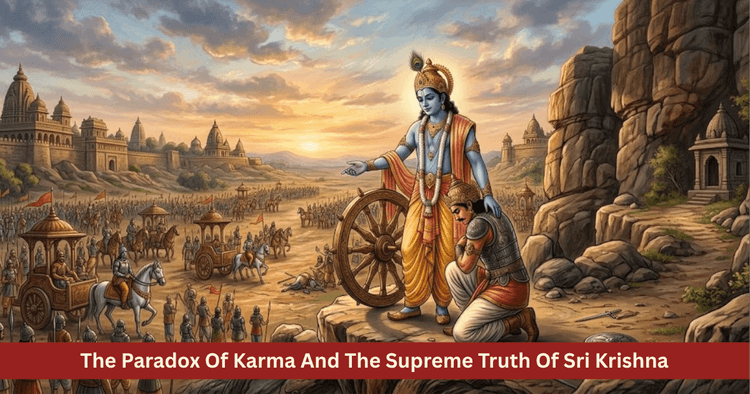
Table of Contents
While wandering through the world, a question inevitably arises in the mind of every living being at some point or another: if the universe is just and fair, why do bad things happen to good people and good things happen to bad people? In the worldly realm, karma is often mistaken for an immediate system of punishment or revenge, where people wait for life to take vengeance on those who once caused them pain. This belief may provide temporary solace to an aggrieved mind but authentic Vedic spirituality and Sanatan philosophy reveal a completely different and far deeper reality. On the battlefield of Kurukshetra, making Arjuna the medium, Yogeshwar Sri Krishna shattered his doubts and unveiled the supreme truth of karma, which does not function like an external court of law. Karma is actually that subtle internal law through which the thoughts, consciousness and character of a human being take a definite shape. According to Vedic astrology, the irrefutable principles of the Upanishads and the dialogue of Kurukshetra, karma does not chase anyone; rather, it constructs a specific destiny and aura within the soul that operates their love, success, struggle and worldly justice. When a human being assimilates this core truth expounded by Sri Krishna, the agitation of their life vanishes spontaneously and a celestial peace dawns upon the mind.
Special Astrological Rules Of Time Wheel And Karma Impressions
According to Sanatan scriptures and metaphysical science, karma is not merely a physical action; it is an imperishable vibration inscribed in the space element and the subtle body that travels with the soul across births. In astrology, Lord Shani possesses the lordship over justice and fruits of actions in the horoscope of the cosmic being, whereas Rahu represents the illusion of accumulated desires. According to Sri Krishna, the movement of karma is exceptionally subtle and difficult to comprehend and it cannot be understood merely through worldly intellect. To comprehend the anomalies of life and this mysterious cycle of karma, specific rules and planetary combinations have been described in the scriptures, which prove that justice never stops; only its time and plane of manifestation are different.
| Type of Karma | Mental and Spiritual Plane | Astrological Significator Planet | Vedic Rule of Gita | Long-term Impact on Life |
|---|---|---|---|---|
| Anger and Revenge | Tamasic consciousness and unrest | Polluted influence of Mars and Rahu | Abandonment of reaction | Decay of nervous system and mental delusion |
| Greed and Unrighteousness | Rajasic energy and external attraction | Polluted Venus and absence of Jupiter | Refuge in desireless state | Disappearance of inner peace and deep fear |
| Service and Compassion | Sattvic intellect and equanimity | Strong Moon and Jupiter | Intellect offered to God | Purification of aura and self-confidence |
| Awareness and Meditation | State beyond attributes and witness | Sattvic combination of Ketu and Sun | Karma Yoga and self-realization | Eradication of accumulated karma and moksha |
Karma Is Merely Action, Not Divine Punishment
It has been clearly explained in the Mimamsa branch of Indian philosophy and the Samkhya Yoga of the Bhagavad Gita that the literal meaning of karma is simply action or work. Every single thought of a human being, each word emanating from their speech and every choice selected by them generates an exceptionally subtle movement within their inner conscience. Over time, this continuous movement determines the nature, habits and ultimately the direction of life of a human being. This law of karma does not make any decision to reward a person or cause them physical pain. It merely strengthens that arrangement which a human being continuously practices in their daily life.
- If an individual repeats the feelings of anger, jealousy and malice within themselves daily, their brain shapes itself accordingly.
- In contrast, if a living being continuously practices compassion, forgiveness and generosity, sattvic consciousness develops within them.
- Vedic astrology also confirms this fact that our thoughts construct our aura, which attracts favorable or adverse planets.
- The modern scientific principle of neuroplasticity also accepts this truth that our thoughts alter the neural pathways of the brain.
therefore Sri Krishna says that karma is not an external punishment but the gradual evolution of one's own character through self-awareness. When we become completely aware of our actions, we do not remain the slaves of destiny but become the creators of our own future.
The Illusion Of Revenge And The Internal Diplomacy Of Karma
When we witness a deceitful, dishonest and unrighteous person becoming immensely successful, wealthy and powerful in the material world, the mind of an ordinary human being becomes deeply disturbed. From the perspective of ethics, this situation appears exceptionally unjust and then the anxious mind of a human being begins to wish that some divine power would arrive and punish that unrighteous person immediately. Due to this very agitation, people consider karma a tool of revenge but Sri Krishna rises above this superficial thinking to reveal a highly profound truth.
Karmany evadhikaras te ma phalesu kadacana Ma karmaphalahetur bhur ma te sango stv akarmani (Bhagavad Gita 2.47)
Through this immortal verse, Sri Krishna clarifies that the right of a human being is over action alone, never over its fruits. When a person acquires wealth or position by walking on the path of unrighteousness, the world witnesses only their external prosperity but the true diplomacy of karma operates within them. Success earned through wrong deeds completely destroys the internal self-confidence of a human being. It gives birth to such an unknown fear, insecurity and mental unrest within them that it does not allow them to sleep at night. Their trust in their own soul and in society disappears completely. They live life like a prisoner despite residing in a golden palace. Authentic spiritual insight teaches us that the true result of karma does not demonstrate justice on any public stage; rather, it completes its task by remaining exceptionally silent within the character and consciousness of a human being. What is termed success in the external world might be a terrible poverty in the internal world.
Inscription Of Karma On Subtle Body And Nervous System
According to Sanatan Ayurveda and yoga science, every mental reaction executed by a human being leaves an imperishable impression upon their physical body and subtle body. When a person remains continuously drowned in the thoughts of fear, hatred, revenge and lust, the nervous system of their body begins to become excessively constricted and toxic. In contrast, when the feeling of compassion, prayer and equanimity awakens in the heart, the energy cells of the body become exceptionally tender and vibrant.
- Repeating the same type of mental reaction for years constructs a default internal state within a human being.
- This is the reason why two individuals can experience completely different states from within while living amidst identical comforts.
- One individual remains calm and blissful even in adverse circumstances, whereas the other lives in stress and anxiety despite acquiring everything.
- This internal difference is not an accidental coincidence or partiality of the Creator; rather, it is the ledger of their past emotional actions.
The ancient Upanishads state that as the contemplation of a human being is, so their intellect becomes and as the intellect is, so their destiny is determined. This unseen method of karma operates our mental health, our internal peace and the overall quality of our life with extreme subtlety.
The Slow Movement Of Karma And The Time Interval
The greatest reason for mistrust towards karma in worldly life is the long time interval between the execution of an action and the manifestation of its fruit. Many times, individuals performing destructive and immoral deeds obtain immense benefits immediately, whereas an individual walking on the path of honesty and righteousness has to face extreme struggle, humiliation and sufferings initially. According to behavioral science and Vedic astrology, this very interval of time gives birth to confusion and atheism within a human being.
The limited ego of a human being always demands immediate justice but the law of the universe is exceptionally comprehensive and patient. The principle of karma is constructed not to destroy anyone immediately but to make the soul realize its true nature. Just as it takes a definite time for the seed of a huge tree to be sown and to bear fruit, exactly in the same manner, the impressions of our actions mature gradually in the deep layers of the inner conscience. Sri Krishna teaches Arjuna in the Gita that the fruit of a sattvic action may appear like poison initially but in the end, it satisfies life like nectar. In contrast, tamasic and rajasic actions appear pleasant like nectar initially but their ultimate result manifests in the form of a highly terrible poison. therefore the movement of karma can be slow but it is never unjust.
Awakening Of Consciousness And Freedom From Karma Bondage
The greatest and most optimistic message of the Holy Bhagavad Gita is that karma is not such an unalterable destiny before which a human being stands helpless. Every present moment of a human being is endowed with the immense power of constructing a new future. Sri Krishna never delivers the education of kneeling before determinism or fate. He tells Arjuna to awaken the divine consciousness within himself and choose a conscious alternative at this very moment.
- When a human being operates their actions with complete clarity and wisdom instead of fear or lust, the bondages of their accumulated karma begin to loosen.
- Even a tiny ray of awareness is completely capable of destroying the conceptual darkness of births altogether.
- When actions are executed purely out of a sense of duty without any personal selfishness, they do not construct new karma impressions but cut down old bondages.
- This has been termed in the Gita as 'Karmani Akarme', that is, the art of remaining completely free from bondage while executing actions.
When this truth enters the understanding of a human being, they completely stop blaming circumstances. They realize that whatever unrest or happiness exists in their life is merely the echo of their own mind. Along with this divine realization, such a resilience develops within a human being that does not allow them to waver in any storm of the world.
The Path Of Equanimity And Supreme Bliss
This supreme truth of karma expounded by Sri Krishna teaches us to view every circumstance of life in a comprehensive and spiritual perspective. Success and failure, victory and defeat are merely waves coming and going at the level of the mind, which can never touch the core bliss of the soul. When we consider karma a sacred school of self-elevation instead of a punishment, the entire burden of the world lifts away from us.
Work then no longer remains a compulsion or a tiring process; rather, it becomes a supreme medium for the purification of the inner conscience. Becoming established in this sattvic consciousness, when a human being executes their role, their every conduct becomes a living sermon for the world. This is the true message of Sri Krishna: do not run away from action but achieve your highest consciousness while remaining within action, because true liberation is secured not in burnout or escape but in self-knowledge and internal equanimity.
FAQ
If the law of karma is perfectly just, why do innocent children and animals have to suffer in the world?
According to Vedic philosophy, the existence of the jivatma is not limited merely to this single birth. The living beings who appear innocent in the present are consuming the impressions of the accumulated karma of their past births. This cycle of karma is exceptionally long-term, which is not bound within the boundaries of a single birth.
Can our bad actions be completely destroyed by the grace of a perfected guru or the devotion of God?
Yes, according to the Holy Bhagavad Gita, when a human being achieves complete surrender, the fire of knowledge burns down all the bondages of their accumulated karma. The decree of God is above the law of karma; devotion elevates the consciousness within a human being so high that the fruits of actions cannot touch them.
According to astrology, which house of the horoscope determines karma and how can it be improved?
In astrology, the tenth house of the horoscope is considered the house of karma and Lord Shani is regarded as its significator planet. To improve karma, executing one's duties with complete honesty, serving helpless people and working with a desireless state are the best remedies, through which the auspicious influence of Shani is obtained.
Does desireless action mean that we should not set any target or goal in our career or business?
Absolutely not. Setting targets and planning is a part of action itself. Desireless action means that while working, the entire energy should be on the present effort, rather than the mind wandering in the worry of the future result. Put full effort into achieving the goal but do not lose mental equilibrium if the result is not favorable.
What is the difference between 'Karma Yoga' and 'Inaction' according to Sri Krishna?
Inaction means running away from one's essential duties being subservient to laziness, which Sri Krishna has termed tamasic and improper. In contrast, Karma Yoga means fulfilling all your responsibilities with complete efficiency and awareness while residing in the world, yet remaining inwardly detached from their fruits.
Get your accurate Kundali
Generate KundaliDid you like it?
Author

Aparna Patni (63)
Experience: 20
Consults About: Family Planning, Career
Clients In: Punjab, Haryana, Delhi
Share this article with friends and family
About ZODIAQ
ZODIAQ is an online Vedic Astrology platform. It connects clients seeking astrological advice to experienced astrologers with deep knowledge. Our users also generate kundali and perform kundali milan for free. ZODIAQ also offers services to the Astrologers. Astrologers utilize various offerings by ZODIAQ to serve their clients effectively.
If you are a User
Consult with experienced astrologers and seek their guidance. You can also order handwritten Janm Patrika report with life prediction prepared by experienced astrologers. Generate accurate Kundali, perform Kundali Matching and check horoscope and muhurat. Utilize our online library for all the necessary astrological and spiritual information.
If you are an Astrologer
Create accurate kundali for your clients and perform Kundali Matching for up to 5 people at a time. Write comprehensive Janm Patrika report for your clients with ZODIAQ. Check client details anytime by saving it in client directory. Become more productive by tracking how many clients you guide every day.
WELCOME TO
ZODIAQ
Right Decisions at the right time with ZODIAQ
