Maha Bharani and the Inner Meaning of Karthigai Deepam
By Aparna Patni
Festival of Light in South India: Celebration of Light, Harmony, and Positive Energy
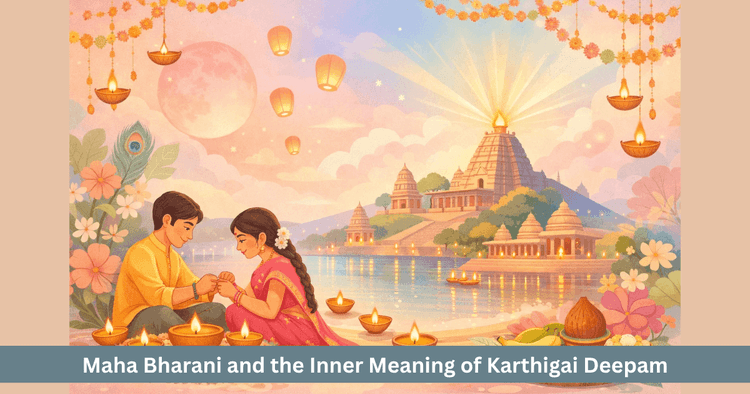
Table of Contents
Among the festivals of light celebrated in South India, Maha Bharani and Karthigai Deepam hold a very special place. In Tamil Nadu, Kerala and parts of Andhra Pradesh, this festival is regarded as a time when families and communities fill their surroundings with light, harmony and positive energy.
According to tradition, Maha Bharani is observed in the month of Kartika, around the full moon, under the influence of the Karthigai nakshatra. During this period, lamps are lit as a living symbol of the victory of light over darkness. In many South Indian homes it is also seen as an occasion when sisters pray for the long life, health and welfare of their brothers.
When and Why Maha Bharani Is Celebrated
Maha Bharani is closely connected with the month of Kartika, the Karthigai star and the customs of offering lamps. In many parts of South India it is known by the name Karthigai Deepam.
On this day, countless lamps are lit in homes, temples and streets. The light of the lamp is believed to remove physical, mental and spiritual darkness and to awaken hope and clarity within the mind. Sisters also offer special prayers for the wellbeing and protection of their brothers, which gives the festival a gentle family dimension.
| Aspect | Indication linked with Maha Bharani |
|---|---|
| Region | Tamil Nadu, Kerala and some parts of Andhra Pradesh |
| Timing | Month of Kartika, near full moon with Karthigai nakshatra |
| Main symbols | Oil lamps, sacred flame, Karthigai Deepam, Maha Deepam |
| Core mood | Triumph of light, positive energy, family welfare |
What Is the Legend behind Maha Bharani
A well known legend behind Maha Bharani speaks of a dispute between Brahma and Vishnu over supremacy. It is said that at one time Lord Brahma and Lord Vishnu began to argue over who was greater. Each considered himself superior and the conflict intensified.
At that moment Lord Shiva appeared between them in the form of a column of fire, revealing his infinite nature. The fiery pillar rose so high and extended so deep that its beginning and end could not be seen. Lord Shiva challenged both of them to find the top or the bottom of this flame.
Vishnu went downwards in search, while Brahma went upwards. Vishnu searched as far as he could with sincerity but finally admitted that he could not reach the base. Brahma, however encountered a flower that had been descending from the top of the flame for a very long time. He took the flower as a witness and falsely claimed that he had reached the summit of Shiva’s light.
The legend says that Shiva saw through this falsehood and rejected Brahma’s claim, declaring that temples for Brahma would be rare upon the earth. The story points to the truth that the light of the Supreme is infinite and cannot be measured or surpassed by individual intelligence. The lamps of Maha Bharani and Karthigai Deepam are lit in remembrance of this endless flame form of Shiva.
Main Rituals of Maha Bharani and Karthigai Deepam
On the day of Maha Bharani, both homes and temples in South India take on a festive yet devotional appearance. From early morning, people clean their houses thoroughly and draw beautiful kolam designs in the courtyard using rice flour paste. These kolams are seen as symbols of prosperity, purity and a respectful welcome to the deities.
At dusk, small clay lamps called agal deepam are lit and placed at the entrance, in the courtyard, on windowsills and before the household deities. In many families, people observe a fast until sunset and then prepare special dishes to complete the celebration after the lamps have been lit and the worship has been offered.
Connection between Karthigai Deepam and Bharani Deepam
In the Tamil tradition of Karthigai Deepam, two special lights are especially remembered. One is the Bharani Deepam and the other is the Maha Deepam. Bharani Deepam is kindled in the early morning, often inside the sanctum of the temple, as a sacred seed flame. From this sacred light, the later lighting of the Maha Deepam is spiritually linked.
At dusk, on a hilltop or on the main temple tower, the great Karthigai Maha Deepam is lit. This huge flame can be seen from a great distance and is honoured as a symbol of Shiva’s infinite fiery form. Devotees regard the sight of this flame as a sign of divine shelter, protection and blessing.
In some regions of Andhra Pradesh, on the night of Kartika Purnima, a large lamp with 365 wicks is lit. This lamp is taken to represent all the days of the year and to gather in one act the light, worship and protection sought for the entire year. Many devotees see this as a way to ward off negativity and to invite good fortune into the home.
Main Vows and Practices during Maha Bharani
On Maha Bharani, devotees usually bathe early in the morning, wear clean clothes and inwardly resolve to fill their home with auspicious light. Many families keep a light fast or eat only simple food until sunset in order to maintain a quiet and devotional mood.
After sunset, lamps are lit one by one. First a lamp is lit before the deity and aarti is offered. Thereafter lamps are placed throughout the home so that wherever the eye turns, it meets light. This is a symbolic resolve that spiritual light should reach every dark corner of life.
In several places, special worship of Karttikeya, also known as Muruga, is performed on Maha Bharani. In South Indian temples Lord Muruga is honoured as a six faced deity bearing powerful weapons. Tradition holds that Muruga’s birth is connected with six divine flames that were nurtured by the six Krittika stars. For this reason, the month of Kartika and this festival of lights naturally carry a close link with Muruga’s grace.
Which Deities Are Worshipped during Maha Bharani
The central focus of Maha Bharani is the infinite flame form of Lord Shiva, yet the pattern of worship shows some regional variations.
In many South Indian homes and temples, Lord Vishnu is also worshipped on this day, especially in his role as Narayana, the preserver who grants stability and welfare to the family. Alongside this, Lord Muruga is remembered as the deity of courage, victory and inner strength. Devotees seek his help in overcoming struggles and maintaining balance in life.
| Deity | Role in the observance of Maha Bharani |
|---|---|
| Lord Shiva | Infinite flame, embodiment of Karthigai Deepam |
| Lord Vishnu | Preserver, giver of stability and family welfare |
| Lord Muruga | Lord of courage, victory and spiritual power |
Maha Bharani across South Indian Regions
Although the core meaning of Maha Bharani and Karthigai Deepam remains the same, the way the festival is observed in Tamil Nadu, Kerala and Andhra Pradesh carries beautiful regional flavours.
In Tamil Nadu, temple courtyards, towering gopurams and nearby hills become the centre of the lamp festival. In many homes, rows of agal lamps line the thresholds and balconies and families sit together late into the night watching the flickering lights. In Kerala, the observance tends to be simple yet aesthetically pleasing, with lamps offered at home and in temples in a calm devotional atmosphere. In parts of Andhra Pradesh, the night of Kartika Purnima holds special importance, with large lamps, 365 wick deepams and recitation of the Kartika Puranam forming part of the celebration.
Despite these differences, a common thread runs through all these customs. Each tradition ultimately aims to strengthen light, devotion, family unity and social harmony.
The Core Message of Karthigai Deepam
Karthigai Deepam is not only about increasing the number of lamps. It is about awakening the inner light. The lamps lit inside and outside the home remind everyone that darkness of ignorance, fear and negativity can truly be removed only through spiritual understanding, self discipline and devotion.
When families sit together on Maha Bharani, light lamps, chant hymns or listen to stories related to the month of Kartika and share a meal, the bonds within the family grow deeper. In this way Karthigai Deepam becomes a festival that brings together personal practice, family harmony and community unity in a single stream of light.
Frequently Asked Questions
What is the relationship between Maha Bharani and Karthigai Deepam?
Maha Bharani is another name associated with the same festival that is widely known as Karthigai Deepam in Tamil tradition. It is linked with the month of Kartika, the Karthigai star and the lighting of lamps in honour of Shiva’s boundless flame.
What is the main purpose of lighting lamps on Maha Bharani?
The light of the lamp symbolically dispels darkness, negativity and fear. By lighting lamps on Maha Bharani, families pray for positive energy, prosperity and inner clarity for the coming days.
What is the meaning of the 365 wick lamp mentioned in connection with this festival?
In some parts of Andhra Pradesh, a large lamp with 365 wicks is lit around Kartika Purnima. It represents all 365 days of the year and expresses a combined prayer for protection and auspiciousness throughout the year.
Which deities are specially worshipped during Maha Bharani?
During this festival, Shiva is worshipped as the infinite flame. Vishnu is honoured for granting stability and wellbeing and Muruga is remembered as the giver of courage and victory in life’s struggles.
What spiritual teaching does Karthigai Deepam offer to a seeker?
Karthigai Deepam teaches that outer lamps are meaningful only when the inner flame of discrimination, compassion and devotion is lit. Rather than fighting darkness directly, one must increase the light, which brings lasting peace and balance.
Get your accurate Kundali
Generate KundaliDid you like it?
Author
Aparna Patni (63)
Experience: 20
Consults About: Family Planning, Career
Clients In: Punjab, Haryana, Delhi
Share this article with friends and family
About ZODIAQ
ZODIAQ is an online Vedic Astrology platform. It connects clients seeking astrological advice to experienced astrologers with deep knowledge. Our users also generate kundali and perform kundali milan for free. ZODIAQ also offers services to the Astrologers. Astrologers utilize various offerings by ZODIAQ to serve their clients effectively.
If you are a User
Consult with experienced astrologers and seek their guidance. You can also order handwritten Janm Patrika report with life prediction prepared by experienced astrologers. Generate accurate Kundali, perform Kundali Matching and check horoscope and muhurat. Utilize our online library for all the necessary astrological and spiritual information.
If you are an Astrologer
Create accurate kundali for your clients and perform Kundali Matching for up to 5 people at a time. Write comprehensive Janm Patrika report for your clients with ZODIAQ. Check client details anytime by saving it in client directory. Become more productive by tracking how many clients you guide every day.
WELCOME TO
ZODIAQ
Right Decisions at the right time with ZODIAQ
