Mahakaleshwar Jyotirlinga: Lord of Time, Death and Destiny
By Pt. Narendra Sharma
Mahakaleshwar Jyotirlinga in Ujjain Shows Shiva as Mahakal, Controller of Time and Death
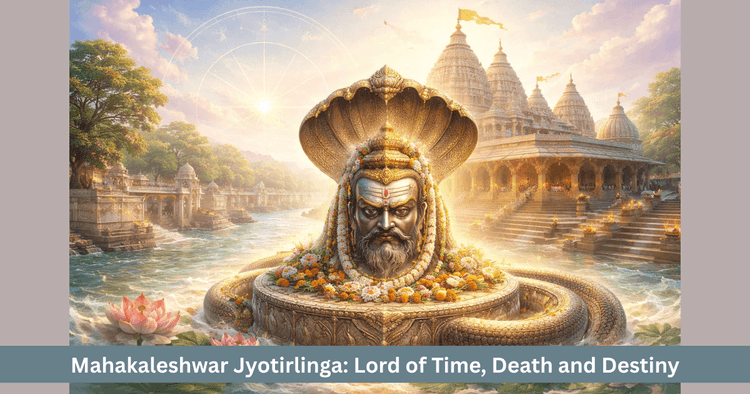
Table of Contents
On the sacred banks of the Shipra River stands Ujjain, counted among the seven moksha puris of Bharat. In this ancient spiritual city resides Mahakaleshwar Jyotirlinga, where Shiva is worshipped as Mahakal, the Lord of Time. Here the experience is not only of a temple but of a living presence that touches the deepest questions of life, death and destiny. Mahakaleshwar is especially unique because it is the only south facing jyotirlinga among the twelve, a form that directly addresses fear of death and the limits of time.
Ujjain has long been known as a centre of astronomy, jyotish and cosmic calculation. In earlier times it was treated as a kind of prime meridian for Indian time reckoning. In such a city, where time and planetary movements were measured, Shiva’s presence as Mahakal, beyond time, carries a powerful message. He is not only worshipped for worldly blessings but honoured as the One who holds the very flow of time in his awareness.
Ujjain and the Sacred Ground of Mahakaleshwar
Ujjain, as one of the sapta moksha puris, has been a place where seekers turned to the Shipra’s banks for tapas, japa and deep practice. The Mahakaleshwar temple stands near the heart of the city, which makes it not a remote mountain shrine but a living centre woven into daily life.
Key aspects of Mahakaleshwar Dham can be seen in this table.
| Aspect | Description |
|---|---|
| Location | Ujjain, near Shipra River, Madhya Pradesh |
| Distinct feature | Only south facing jyotirlinga among the twelve |
| Form of Shiva | Mahakal, Lord of time and death |
| Moksha link | Ujjain as one of the seven moksha puris, symbol of release from time and karma |
| Main rituals | Bhasma Aarti, night vigil, Shiva nama japa |
For many visitors, entering this temple feels like stepping into a zone where the rush of outer time slows down and the mind naturally starts reflecting on its own relationship with time and mortality.
Legend of Mahakal and the Fall of Arrogance
According to the sacred tradition, in ancient times a demon named Dushana began to terrorise the region of Ujjain. He specifically targeted Brahmins and tapasvins, disturbing their rituals, breaking their yajnas and causing havoc in all dharmic practices. Unable to bear the torment, the sages gathered and prayed intensely to Lord Shiva for protection.
In response to their collective devotion, a powerful radiance arose. From this light, Shiva manifested in a fierce form and destroyed Dushana, restoring balance and safety to the land. After this act, Shiva chose to remain in Ujjain in the form of Mahakaleshwar, protector of the devoted and the one who holds authority over death and destiny. The story shows that when arrogance and adharma grow, the call of sincere seekers can invite a powerful corrective presence.
Inner Meaning of the Name Mahakal
The name Mahakal is composed of two profound ideas. Kala means time and also death, since time eventually brings all forms to an end. Maha means supreme. Mahakal therefore signifies the One who is supreme over time and over death.
In this form Shiva is not worshipped merely as a giver of prosperity or success. He is honoured as the one who governs the entire cycle of birth, life, death and rebirth. For a seeker this is significant, because turning to Mahakal means entrusting not only specific desires but the whole journey of one’s life and karma to a higher order.
Why Is the South Facing Jyotirlinga of Mahakal Unique
Mahakaleshwar Jyotirlinga is especially remarkable because it is south facing. In the traditional symbolic language of Sanatana Dharma, the south is linked with Yama, the lord of death and with the realm of ancestors. Most deities face east or north, directions associated with sunrise, growth and upliftment.
Here, the south facing form indicates that Mahakal holds mastery over death and fear. When a devotee stands before this jyotirlinga and prays, it is believed to help
- reduce fear of death
- ease heavy karmic burdens
- and strengthen courage in the face of uncertainty.
The energy at this shrine feels serious and powerful, yet it carries a quiet assurance that the devotee’s life is not left to chaos but held within a just and compassionate order.
What Is the Bhasma Aarti and What Does It Teach
The famous Bhasma Aarti of Mahakaleshwar is performed at dawn and is regarded as one of the most striking rituals in the Hindu world. During this Aarti the jyotirlinga is adorned with bhasma, sacred ash. Ash is the final state to which all physical forms return. It reminds the seeker that body, possessions and status ultimately dissolve into dust.
Through this, the Bhasma Aarti conveys that ego and attachment cannot remain. Only the inner light of consciousness continues. For those who witness it, the Aarti becomes more than a ritual. It becomes a direct encounter with the truths of mortality and impermanence, while simultaneously offering a sense of protection and refuge in Mahakal’s presence. It gently urges the devotee to live each day with awareness, knowing that every moment is precious.
Temple Structure and Descent into the Womb of Time
The structure of Mahakaleshwar temple has evolved over centuries, reflecting influences from the Maratha period and traditional temple design. One of its distinctive features is that the garbhagriha lies below ground level. To reach the sanctum, devotees descend steps, moving downward into a darker, more enclosed space.
This descent feels not only physical but symbolic, like entering the womb of time. Inside, the atmosphere is dense, charged with long accumulated devotion. The continuous chanting of Mahakal’s name, the sound of bells and the rhythm of the rituals create a vibration that anchors the mind firmly in the present moment. While many mountain shrines emphasise spacious peace, Mahakaleshwar carries a sense of command, awakening and inner authority.
Astrological Significance of Mahakaleshwar
In Vedic astrology, Mahakaleshwar is closely linked with phases of life that bring intense karmic testing. These include
- Saturn’s Sade Sati
- difficult Saturn transits or placements
- challenging Rahu influences
- and Mahadashas or transits that trigger deep transformation.
These themes can be summarised in this table.
| Aspect | Indication |
|---|---|
| Related grahas | Saturn, Rahu and time bound karmic cycles |
| Difficult phases | Sade Sati, harsh Rahu effects, heavy Mahadashas and transits |
| Typical experiences | Fear, insecurity, mental pressure, anxiety about the future |
| Suggested practices | Worship of Mahakaleshwar, Maha Mrityunjaya japa, Bhasma Aarti darshan, cultivating trust in divine timing |
In such periods, turning to Mahakal is not seen as a way to erase karma but as a way to gain strength, patience and acceptance. With this support, even difficult times can shape maturity instead of breaking the spirit.
Festivals, Maha Shivratri and Simhastha Kumbh
During Maha Shivratri, the flow of devotion at Mahakaleshwar becomes extraordinarily strong. Throughout the night, abhishekas, Rudra chanting, Shiva bhajans and continuous japa fill the temple and surrounding streets. Many devotees remain awake until dawn, using the night to offer their fears and burdens into the care of Mahakal.
Ujjain is also renowned for the Simhastha Kumbh Mela, held periodically on the banks of the Shipra. At these times, the city takes on the feel of a vast spiritual gathering. Ascetics, seekers and householders come together and Ujjain seems, for a while, to stand between worlds. Questions of time, death and liberation become very immediate and real for many who participate.
Life Perspective Offered by Mahakaleshwar
Mahakaleshwar offers a clear spiritual insight. Time is not the enemy. It is the instrument of change. Fear arises when the mind clings to permanence in a realm where all forms must change. Mahakal reminds us that body, circumstance and worldly identity are temporary, while the essence of consciousness is not destroyed.
The Bhasma Aarti, the south facing jyotirlinga and the descent into the underground garbhagriha together create a direct experience. They invite the seeker not to flee from the reality of death but to accept it as part of the divine design. As one accepts this, courage and surrender begin to grow. Standing before Mahakal, a person can hold the understanding that life unfolds within time but the soul belongs to what lies beyond time.
With this faith, when someone offers their karma, their future and their fears at the feet of Mahakaleshwar, they begin to move not only beyond outer insecurity but beyond the inner grip of fear itself. Mahakal seems to assure the devotee that, even in the tight grip of time, a touch of eternity is always available to one who sincerely seeks it.
Common Questions
Where is Mahakaleshwar Jyotirlinga located and what makes it unique.
Mahakaleshwar Jyotirlinga is located in the city of Ujjain in Madhya Pradesh, near the banks of the Shipra River. It is unique because it is the only south facing jyotirlinga among the twelve, with Shiva present here as Mahakal, Lord of Time.
What does the story of the demon Dushana teach about Mahakaleshwar.
The story of Dushana shows that when adharma oppresses seekers and disrupts spiritual practice, Shiva can arise as Mahakal to protect dharma and restore balance. It highlights Mahakal’s role as defender of sincere devotion.
Why is the Bhasma Aarti considered so special.
In the Bhasma Aarti, the jyotirlinga is adorned with sacred ash, symbolising the mortality of the body and the end of all material forms. This Aarti confronts the devotee with impermanence while offering a sense of protection, making it a powerful aid for inner awakening.
For whom is worship of Mahakaleshwar especially recommended from an astrological viewpoint.
Those undergoing Saturn’s Sade Sati, harsh Saturn transits, difficult Rahu periods or other intense karmic phases, who feel fear and pressure about the future, are often advised to worship Mahakaleshwar, chant Maha Mrityunjaya mantra and seek inner trust in divine timing.
What key life lesson does Mahakaleshwar give to a seeker.
Mahakaleshwar teaches that everything in time changes and dissolves but the core of the self is not lost. Accepting this, a seeker can live with less fear, more courage and a deeper sense of surrender to a just and compassionate cosmic order.
Get your accurate Kundali
Generate KundaliDid you like it?
Author

Pt. Narendra Sharma (63)
Experience: 20
Consults About: Family Planning, Career
Clients In: Punjab, Haryana, Delhi
Share this article with friends and family
About ZODIAQ
ZODIAQ is an online Vedic Astrology platform. It connects clients seeking astrological advice to experienced astrologers with deep knowledge. Our users also generate kundali and perform kundali milan for free. ZODIAQ also offers services to the Astrologers. Astrologers utilize various offerings by ZODIAQ to serve their clients effectively.
If you are a User
Consult with experienced astrologers and seek their guidance. You can also order handwritten Janm Patrika report with life prediction prepared by experienced astrologers. Generate accurate Kundali, perform Kundali Matching and check horoscope and muhurat. Utilize our online library for all the necessary astrological and spiritual information.
If you are an Astrologer
Create accurate kundali for your clients and perform Kundali Matching for up to 5 people at a time. Write comprehensive Janm Patrika report for your clients with ZODIAQ. Check client details anytime by saving it in client directory. Become more productive by tracking how many clients you guide every day.
WELCOME TO
ZODIAQ
Right Decisions at the right time with ZODIAQ
