Moral Strength Of Trust In Ramayana
By Pt. Amitabh Sharma
Discover the timeless lessons of trust and loyalty from the sacred narratives of the epic Ramayana.
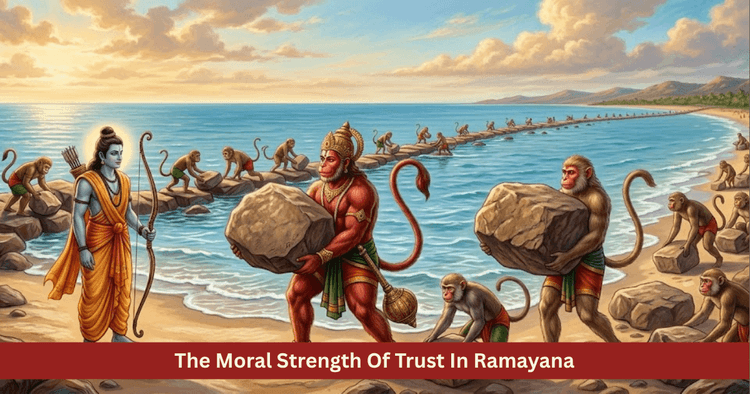
Table of Contents
Across the history of the world, numerous sagas of the rise and fall of civilizations are available. When we read the epic Ramayana not merely as a sacred religious story but as the practical wisdom of life, one supreme truth appears before us repeatedly in an exceptionally quiet manner. That truth is that the construction and continuity of any society or civilization do not depend solely on physical power, material wealth or intellectual superiority but its true foundation rests upon mutual trust. The Ramayana delivers the education of this great truth beautifully through various relationships of life, difficult turns where decisions were taken and moments of moral courage. From the perspective of Vedic spirituality and astrology, trust is not a weak emotion but it is that sattvic quality of the soul which destroys the internal darkness of a human being and connects him with divine consciousness.
Scriptural Rules Of Trust And Establishing Dharma
According to the Ramayana, when an environment of insecurity and mistrust gets constructed in society, the influence of negative planets begins to increase there. To get freedom from this and to establish mutual fidelity in life, following certain specific principles has been considered mandatory in the scriptures.
| Life Context | Core Characters | Astrological Planet Significator | Moral Quality | Impact on Society |
|---|---|---|---|---|
| Divine Incarnation | Sri Rama and Devas | Sun and Jupiter | Righteousness and Duty | Re-establishment of Dharma and freedom from fear |
| Guru-Disciple Fidelity | Sage Vishwamitra and Sri Rama | Jupiter and Sun | Insight and Obedience | Awakening of hidden capabilities within the individual |
| Accepting Refugee | Sri Rama and Vibhishana | Mars and Saturn | Justice and Compassion | Rise of righteousness even within the enemy camp |
| Alliance of Equality | Sri Rama and Sugriva | Moon and Venus | Equanimity and Partnership | Attainment of unbroken cooperation during crisis |
| Boundary Trust | Nishadraj Guha and Bharata | Pacification of Rahu and Ketu | Destruction of doubt and simplicity | Social and political harmony across borders |
The Rule Of Mutual Fidelity At A Cosmic Level
At the very commencement of the Ramayana in the Balakanda, trust is seen operating at an exceptionally comprehensive and cosmic level. When the tyranny and unrighteousness of the king of Lanka, Ravana, takes entire worlds under his control, the gods do not choose any demonic force or magical shortcut for his destruction. On the contrary, they express full trust in the justice of Lord Vishnu, praying to Him to incarnate in human form. Lord Vishnu not only accepts taking birth in human form but He also readily adopts all the vulnerabilities, doubts, physical pain, sufferings of exile and ideological conflicts occurring in the life of an ordinary human being.
Here, the flow of trust appears identical in both directions. On one hand, where all the deities possess a firm belief that the ideal dharma lived as an ordinary human being can defeat the pride and arrogance of Ravana, on the other hand, Lord Hari Vishnu also places complete trust in that comprehensive moral system of the world for which He has to renounce all His pleasures. In astrology, the Sun is considered the significator of the king and leadership, who suffers himself to maintain the trust of his subjects. This context of the Ramayana teaches us that true leadership begins only with the courage to carry the heavy burden of responsibility without any prior guarantee or safety.
The Insight Of The Guru And Awakening Of Youth Capability
This idea becomes far more personal and practical when Sage Vishwamitra comes to the royal court of Ayodhya and expresses his full trust in the young prince Rama. At that time, Sri Rama was an exceptionally young prince who had not obtained any direct experience of the harsh struggles of the world and the rules of the battlefield. Even after this, Sage Vishwamitra goes past his young age and tender physical structure to see the hidden divine element within him. He remains stubborn about taking Sri Rama with him to protect his sacred yajnas from terrible demons.
- This was not any blind faith or emotionalism but it was the spiritual wisdom of a realized Guru that recognizes internal capability even before external proof.
- Sri Rama protects the sanctity of this trust of the Guru, which proves that trust is not a mental burden but a sacred responsibility that awakens the sleeping capacities of a human being.
- When a person is trusted with complete purity, transparency and auspicious intent, such infinite powers come out from within him with which he himself was unacquainted.
The Surrender Of Vibhishana And The Firm Base Of Dharma
The most discussed context from the perspective of ethics occurring in the Yuddhakanda of the Ramayana is the acceptance of Vibhishana by Sri Rama. This was a time when the horrors of war had accelerated the feelings of suspicion and mistrust within both sides. Vibhishana had come to take refuge under Sri Rama after abandoning the unrighteous path of his own brother Ravana. At that time, Sugriva and other vanara chiefs held deep doubts in their minds that this might be a deceptive trap of the enemy.
however Sri Rama remains completely firm on his decision and declares that whosoever comes to him once, surrenders himself and begs for protection, accepting him is his supreme duty. This trust of His was not the result of emotionalism or a momentary impulse but its roots were deeply embedded in the unalterable principles of dharma and justice.
Sri Rama understood this psychological truth thoroughly that when a person rises above the greed of power and blind nepotism to listen to the voice of his inner soul, his true transformation begins right from there. By trusting Vibhishana, Sri Rama delivered this eternal message to the world that a true and righteous leader never compromises on his moral values and ideals even at times of grave crisis and risk.
Friendship With Sugriva And The Alliance Of Equanimity
The alliance of Sri Rama and Sugriva is an exceptionally unique example of mutual dependence and unbroken fidelity towards each other. Both these kings were such individuals who were deprived of their rights and kingdom due to adverse circumstances. One had received exile due to the decree of destiny, while the other had become the victim of the betrayal of his own brother Vali.
Their friendship did not originate from any political benefit or clever diplomacy but its birth happened on the foundation of shared sufferings and emotions. Sugriva held full trust in Sri Rama that He would deliver him from the terror of Vali and Sri Rama trusted the vanara army of Sugriva that they would be helpful in searching for Mother Sita. In the beginning, nobody possessed any irrefutable proof of each other's capabilities, yet they chose the path of faith instead of fear and doubt.
When Sugriva forgets his promise after obtaining the royal post and drowns in material pleasures, Sri Rama does not break that bond completely but cautions him. This lesson of the Ramayana is subtle yet highly relevant for today's society, that trust in true relationships does not mean the complete absence of mistakes but it is giving an opportunity to correct those mistakes and maintaining fidelity.
The Sacred Dialogue Between Nishadraj Guha And Bharata
An exceptionally quiet yet socially meaningful context of the Ramayana is the dialogue between Nishadraj Guha and Bharata. Guha was a king of the forest who was naturally habituated to remaining suspicious of external power. When he saw Bharata arriving towards the forest with a huge army, a natural doubt arose in his mind whether Bharata was coming to attack Sri Rama residing in the forest. In his view, the hunger for the royal post often makes a human being cruel.
however Nishadraj Guha does not give any immediate violent reaction with the feeling of hostility but he observes the behavior of Bharata patiently. He beholds the immense grief present on the face of Bharata, his infinite humility and his deep detachment towards the royal throne. Here, trust was not earned through any high post or social status but it was acquired through pure conduct and sacred behavior. Bharata kept the honor of that trust completely by placing the wooden sandals of Sri Rama on the throne and living in Lakhanpur as a servant. This context teaches us that if trust has to be constructed past social and political boundaries, it is highly essential to possess openness and self restraint in the mind.
The Eternal Currency Of A Society Governed By Boundaries
Through all these stories and contexts, the Ramayana presents trust before us not as a vulnerability but as the greatest moral and spiritual power of a human being. To maintain trust, deep wisdom, infinite patience and the courage to walk on the correct path without any complete certainty are required. This is the very power that binds scattering societies together, re-establishes the self respect of fallen individuals and provides energy to dharma to function smoothly even in this defective world.
In today's fast moving modern world, the discussion of trust is often performed only in the context of huge systems, financial institutions, paper contracts and metrics of the economy. Although all these are also essential for the running of society, the Ramayana takes us towards a truth far deeper than this.
According to the epic Ramayana, trust is always born from those heroes who live their life as an ideal example. It fructifies in those relationships that are connected with complete honesty and fidelity and in which there is the generosity to listen and understand the views of others without any prejudice. The Ramayana does not instruct us to live in an imaginary world but it inspires us to remain firm on our principles. By doing so, this epic reminds us in an exceptionally quiet manner that if trust is offered at the correct place with complete wisdom and followed with full fidelity, it will remain the most valuable and powerful currency of any human society even today.
FAQ
What is the core mantra to strengthen the foundation of trust in any relationship according to the Ramayana?
According to the Ramayana, the core mantra to strengthen the foundation of trust is the alignment between speech and action. When an individual fulfills his promises with complete honesty like Sri Rama and does not renounce righteousness even during crises, unbroken trust is born in relationships.
What should a leader learn from the character of Sri Rama when there is an environment of mistrust all around?
In such a situation, a leader should take inspiration from the context of Sri Rama accepting Vibhishana. Even when there is doubt all around, one must not abandon moral values and righteousness and must trust the individual who wishes to walk on the path of truth without any prejudice.
Is blind faith or trusting someone without thinking supported anywhere in the Ramayana?
Absolutely not, the Ramayana never supports blind faith. Whether it is Sage Vishwamitra trusting Sri Rama or Sri Rama making an alliance with Sugriva, in all these contexts, internal capability, shared ideals and fidelity towards truth were tested first, which indicates deep wisdom.
What does the behavior of Sri Rama teach us about modern family relationships when Sugriva accepts his mistake?
This context teaches us that no human being is perfect and mistakes do happen in relationships at some point or another. Trust does not mean that the opposite person will never make a mistake but true trust is that which gives an opportunity to correct the mistake and remains free from revengeful feelings.
What message of social harmony and trust construction do we receive from the meeting of Nishadraj Guha and Bharata?
This meeting teaches us that rising above caste, class or political boundaries, the construction of trust is not possible merely through external pomp but through simplicity of mind, behavior devoid of ego and sensitivity towards each other.
Get your accurate Kundali
Generate KundaliDid you like it?
Author
Pt. Amitabh Sharma (56 Years)
Experience: 20
Consults About: Family Planning, Career
Clients In: Punjab, Haryana, Delhi
Share this article with friends and family
About ZODIAQ
ZODIAQ is an online Vedic Astrology platform. It connects clients seeking astrological advice to experienced astrologers with deep knowledge. Our users also generate kundali and perform kundali milan for free. ZODIAQ also offers services to the Astrologers. Astrologers utilize various offerings by ZODIAQ to serve their clients effectively.
If you are a User
Consult with experienced astrologers and seek their guidance. You can also order handwritten Janm Patrika report with life prediction prepared by experienced astrologers. Generate accurate Kundali, perform Kundali Matching and check horoscope and muhurat. Utilize our online library for all the necessary astrological and spiritual information.
If you are an Astrologer
Create accurate kundali for your clients and perform Kundali Matching for up to 5 people at a time. Write comprehensive Janm Patrika report for your clients with ZODIAQ. Check client details anytime by saving it in client directory. Become more productive by tracking how many clients you guide every day.
WELCOME TO
ZODIAQ
Right Decisions at the right time with ZODIAQ
