The Story of Narali Purnima and Faith along the Coast
By Pt. Abhishek Sharma
A Festival of Coastal Livelihood, Safety, and Prosperity
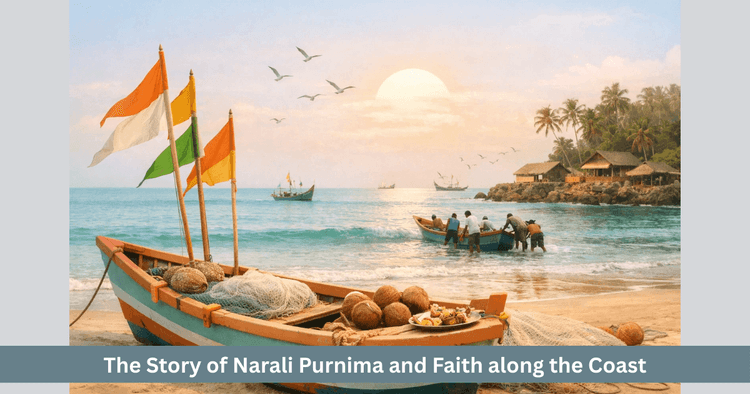
Table of Contents
For the coastal fishing communities, Narali Purnima is far more than a festival. It is regarded as a sacred vow of livelihood, safety and hope linked with the sea. Celebrated on the full moon of the month of Shravana, it marks the end of the monsoon season and the beginning of the new fishing cycle. On this day the sea, boats and nets are not treated merely as tools but honoured almost like family members so that the coming year may be safe and prosperous.
This festival is celebrated mainly in Maharashtra, Goa, Gujarat and the coastal regions of Karnataka. The same full moon appears in different forms in other places as Avani Avittam in Tamil Nadu, Kerala and parts of Karnataka and as Kajri Purnima in regions of Uttar Pradesh and Chhattisgarh, yet for those who directly live by the sea, Narali Purnima remains strongly linked to the ocean and livelihood.
When and How Is Narali Purnima Celebrated
In Sanskrit the word naral or narikela refers to the coconut and purnima means the full moon day. Narali Purnima falls on the full moon of Shravana, usually in August and often coincides with the date of Raksha Bandhan. In many places one can feel the shared festive atmosphere of both Rakhi and Narali Purnima on the same day.
On this day the seashore becomes a colourful scene of traditional attire, drums, cymbals and folk instruments, blended with deep devotion. Koli fishermen carry coconuts, garlands and lamps to the sea. They worship Varuna and Samudra Devata, offer coconuts into the waters and pray for safe voyages and abundant catch in the new season.
| Aspect of the festival | Inner meaning |
|---|---|
| Shravana full moon | End of monsoon and start of a new season |
| Offering of coconuts | Gratitude and prayer to the sea and Varuna |
| Worship of boats and nets | Respect for the tools that sustain livelihood |
Why Is Narali Purnima So Important for the Koli Community
For the Koli community the sea is not just an expanse of water. It is truly a giver of life. During the monsoon, high waves, storms and unstable weather often keep fishermen away from the waters. Narali Purnima stands at the turning point where this difficult pause ends and the new fishing season is welcomed with faith.
Before this day the community repairs boats and nets, paints them afresh and prepares for the work ahead. Once the rituals and coconut offerings are completed, it is believed that the sea is now ready to receive the boats more gently. The festival therefore becomes a meeting point of occupation, tradition and inner faith.
Main Preparations and Rituals of Narali Purnima
1. Repair and Decoration of Boats
During the rainy weeks, when the sea is rough, fishermen devote time to mending their boats and nets. Broken wooden planks are fixed, new colours are applied and torn nets are patiently repaired with needles and thread.
On the day of Narali Purnima the same boats appear decorated with flower garlands, colourful flags and cloth pieces. Rows of these adorned boats along the shore make it clear that they are not seen as objects only. The entire community places its hopes and prayers on them.
2. Decoration of Homes and Settlements
Not only the boats but the Koli settlements also take on a special appearance. Doorways are adorned with rangoli designs and toran garlands, while homes are thoroughly cleaned. Family members wear traditional clothes. Women drape the nauvari sari and jewellery and join in the worship and celebrations with dignity and joy.
3. Purna Kalasha and Procession
In many localities the purna kalasha occupies a central place in the festivities. A pot filled with water is topped with mango leaves and crowned with a coconut. It is carried in procession as a symbol of fertility, blessing and new beginnings and is finally placed near the seashore as part of the main worship.
Meaning of Coconut Offerings and Sea Worship
The core ritual of Narali Purnima is the offering of coconuts to the sea. Fisher families gather at the shore, chant prayers to Varuna and Samudra Devata, sing devotional songs and gently cast the coconuts into the waves.
In some places special coconuts decorated or wrapped in golden paper are offered. This expresses the feeling that what is most precious is also joyfully given back to the divine source in gratitude. In certain traditions the three dark marks on the coconut are also associated with the triple gaze of Lord Shiva, making the fruit especially auspicious.
During the worship of boats married women perform aarti, apply tilak and sometimes float small lamps upon the water. In this way both reverence and the plea for protection towards the sea are expressed together.
Music, Dance and Coastal Folk Culture
Narali Purnima does not end with formal rituals. After the offerings, the Koli settlements come alive with folk music, song and dance.
Traditional Koli songs are closely tied to the sea, boats, nets, love and family. With drums, cymbals and other instruments, groups move in rhythm along the shore, singing about their bond with the ocean.
Among the dances, the Nakhwa or boatman’s dance is especially well known. The movements of hands and body often imitate rowing, casting nets and the rocking of waves. Men and women in traditional costumes participate together, expressing through dance their attachment and respect for the sea.
Narali Purnima Kitchen and Coconut Based Dishes
Coconut holds a central place in the food prepared for Narali Purnima. It is seen as a symbol of prosperity, nourishment and purity, so it features abundantly in sweets and festive dishes.
Offerings Made from Coconut and Jaggery
Many dishes offered as naivedya are prepared from grated coconut, jaggery and dry fruits. After the worship, these items are distributed as prasad among family and neighbours.
Some of the key preparations are as follows.
| Dish name | Main ingredients and symbolic meaning |
|---|---|
| Narali karanji | Coconut, jaggery, dry fruits, half moon shaped sweet |
| Narali laddoo | Coconut with jaggery or sugar, symbol of sweetness and abundance |
| Narali barfi | Thickened milk, coconut and jaggery, shared festive joy |
| Narali bhaat | Rice, coconut, jaggery, saffron and dry fruits, gratitude and prosperity |
In these dishes the hard shell of the coconut is seen as the challenges of life, while the water and kernel within symbolise inner calm and nourishment. Just as the coconut survives amid the waves while protecting life giving water within, the fishing community preserves its resilience and hope amid storms.
Importance of Narali Bhaat
Narali bhaat, the sweet rice cooked with coconut and jaggery, is especially loved in the coastal regions of Maharashtra. Rice represents the earth and agriculture, while coconut reflects the sea. When they are cooked together with jaggery, saffron, cardamom and nuts, they symbolise a life nourished by both land and ocean.
The fragrance and taste of this dish softly remind that when effort, nature and divine grace come together, life too can become fragrant and harmonious.
Why Is the Combination of Coconut and Jaggery Considered Auspicious
Traditional understanding sees the combination of coconut and jaggery as highly auspicious and health supportive. Coconut provides natural fats, fibre and minerals that sustain energy, while jaggery is regarded as a more wholesome form of sweetness than refined sugar.
Together they are believed to aid digestion, maintain energy and support the body’s defences at times of seasonal change. This is one reason why during the full moon of Shravana, as the weather begins to shift, sweets made of coconut and jaggery are valued not only for taste but also for their gentle nourishment.
Seafood and the Opening of the Fishing Season
On or soon after Narali Purnima, when the sea is considered relatively calm, fishermen set sail for the first catch of the season. When they return, fresh fish, prawns and other seafood form the centre of communal meals.
These feasts are not merely about eating together. They mark the auspicious beginning of the working year. Families, relatives and friends gather, share stories of the first journey, sing songs and strengthen the sense of mutual support that is vital for a community that depends on the sea.
Sensitivity towards Nature, Sea and Environment
The rituals of Narali Purnima express a deep bond between the fishing communities and the sea. The festival reminds everyone that while the ocean supports life, it must also be respected and cared for.
In some regions, people combine the festival with acts such as tree planting or beach cleaning and resolve to reduce pollution. In this way the younger generation learns that tradition includes not only worship but also responsibility towards nature.
Narali Purnima’s Message in Changing Times
Today, with growing urbanisation, pollution and declining fish stocks, Narali Purnima has also become a symbol of struggle and hope. The Koli community upholds traditional rituals, dances, songs and communal feasts even while facing modern challenges, thus preserving its cultural identity.
Dressed in colourful traditional attire, members of the community participate in processions, worship and dance with pride and affection. Their reverence for the sea, faith in their boats and devotion expressed through coconut offerings all help keep their heritage alive for future generations.
Common Questions Related to Narali Purnima
For which community is Narali Purnima considered most significant?
It is especially important for the Koli and other coastal fishing communities because it marks the sacred opening of the new fishing season and their return to the sea.
Why is coconut specifically offered on Narali Purnima?
Coconut is regarded as pure, complete and auspicious. Its hard shell symbolises protection and patience, while the water and kernel inside represent nourishment and peace, which is why it is offered to the sea and deities.
How is Narali Purnima connected with Raksha Bandhan?
Both festivals often fall on the full moon of Shravana, so the dates coincide. Raksha Bandhan focuses on the bond of siblings, whereas Narali Purnima centres on the sea, livelihood and safety of the fishing communities.
Which main dishes are prepared on Narali Purnima?
Dishes such as narali karanji, narali laddoo, narali barfi and narali bhaat are especially prepared. All use coconut and often jaggery and are first offered to the deities, then distributed as prasad.
What is the most important message of Narali Purnima in today’s context?
The festival teaches gratitude towards nature and the sea, along with the need to protect the environment, uphold community unity and respect traditional wisdom. Narali Purnima reminds us of a balanced relationship with the ocean and of the shared strength of community life.
Get your accurate Kundali
Generate KundaliDid you like it?
Author

Pt. Abhishek Sharma (63)
Experience: 20
Consults About: Family Planning, Career
Clients In: Punjab, Haryana, Delhi
Share this article with friends and family
About ZODIAQ
ZODIAQ is an online Vedic Astrology platform. It connects clients seeking astrological advice to experienced astrologers with deep knowledge. Our users also generate kundali and perform kundali milan for free. ZODIAQ also offers services to the Astrologers. Astrologers utilize various offerings by ZODIAQ to serve their clients effectively.
If you are a User
Consult with experienced astrologers and seek their guidance. You can also order handwritten Janm Patrika report with life prediction prepared by experienced astrologers. Generate accurate Kundali, perform Kundali Matching and check horoscope and muhurat. Utilize our online library for all the necessary astrological and spiritual information.
If you are an Astrologer
Create accurate kundali for your clients and perform Kundali Matching for up to 5 people at a time. Write comprehensive Janm Patrika report for your clients with ZODIAQ. Check client details anytime by saving it in client directory. Become more productive by tracking how many clients you guide every day.
WELCOME TO
ZODIAQ
Right Decisions at the right time with ZODIAQ
