Nirjala Ekadashi Vrat Katha: The Ekadashi that Grants the Fruit of All Ekadashis
By Pt. Suvrat Sharma
Importance, Rules, and Story of Nirjala Ekadashi
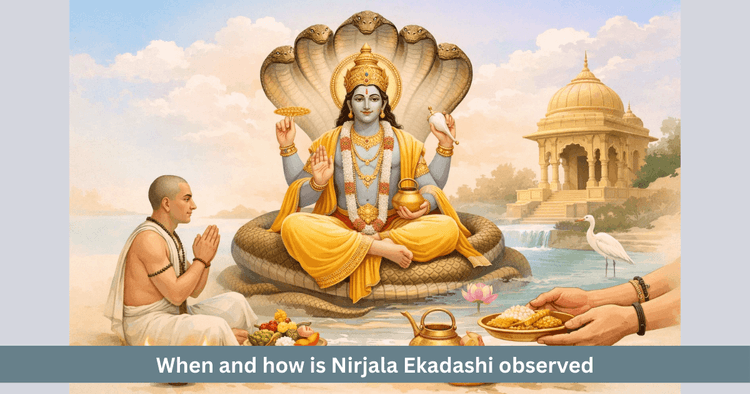
Table of Contents
In the Sanatana tradition Nirjala Ekadashi is regarded as the most austere and most rewarding Ekadashi of the year. This sacred Nirjala Ekadashi falls on the Ekadashi tithi of the Shukla paksha of the month of Jyeshtha and is observed by renouncing even water. It is believed that a devotee who observes the vow of this day with proper discipline receives merit equal to observing all Ekadashis of the year and clears the path towards Vaikuntha.
On this day the observer should bathe early, take a firm resolve, worship the Lord, engage in japa, charity and listening to the sacred story while remaining without water. On Dvadasi one should feed Brāhmanas and give charity before breaking the fast. During the worship it is considered very auspicious to recite the Nirjala Ekadashi vrat katha with faith.
When and how is Nirjala Ekadashi observed
Nirjala Ekadashi occurs in the Shukla paksha of the month of Jyeshtha. This period falls when the sun lies in the zodiac signs of Vrishabha Taurus or Mithuna Gemini and the heat is intense, therefore renouncing water in such conditions is considered a very powerful austerity.
From sunrise on Ekadashi until the next day’s sunrise the vow requires giving up not only food but also water. Only a small quantity of water for rinsing the mouth or āchamana is permitted. One who follows this Nirjala discipline is described in the scriptures as receiving the accumulated merit of all Ekadashis of the year through this single vrata.
On Dvadasi, after bathing in the morning, one should worship Lord Vishnu, offer charity of water and gold, feed Brāhmanas and then take food. Only then is the fast regarded as complete.
Brief overview of Nirjala Ekadashi
| Aspect | Detail |
|---|---|
| Month | Jyeshtha |
| Fortnight | Shukla paksha |
| Tithi | Ekadashi |
| Nature of fast | Waterless fast, only āchamana water allowed |
| Special names | Nirjala Ekadashi, Bhimaseni, Pandava Dvadasi |
| Presiding Lord | Lord Keshava, Lord Vishnu |
| Main fruits | Fruit of all Ekadashis, removal of sins |
Why is Nirjala Ekadashi so special
The traditional stories describe Nirjala Ekadashi as the essence of all Ekadashi observances. A devotee who is unable to keep all other Ekadashis regularly, if that person observes this one Nirjala Ekadashi with full discipline, receives the combined merit of all.
The uniqueness of this vrata lies in the renunciation of water along with food. Rising above the natural need of the body and choosing remembrance of the Lord and self restraint makes this observance far higher than a normal fast. Scriptures clearly state that the merit of Nirjala Ekadashi destroys sins and opens the way towards Vaikuntha, the divine abode of Lord Vishnu.
Question of Yudhishthira and instruction of Vedavyasa
At the beginning of the story Yudhishthira requests Lord Shri Krishna to describe the Ekadashi of Jyeshtha Shukla paksha after hearing the glory of Aparā Ekadashi. He prays that the Lord reveal its procedure and fruits. Shri Krishna replies that the description of this special Ekadashi will be given by Vedavyasa the son of Satyavatī, who is fully versed in all scriptures and Vedas.
Then Vedavyasa tells Yudhishthira that one should not eat on Ekadashi of either fortnight. On Dvadasi after bathing and worshipping Keshava one should complete the daily duties, first feed Brāhmanas and then take food oneself. He further explains that even during the period of impurity caused by birth or death, food should not be taken on Ekadashi because this tithi itself is a remover of sin.
What was Bhimasena’s difficulty
Vedavyasa continues and tells Yudhishthira to listen carefully. King Yudhishthira, Mother Kunti, Draupadi, Arjuna, Nakula and Sahadeva all observe Ekadashi fasts and they repeatedly urge Bhimasena to fast as well.
Bhimasena, true to his nature, replies that he cannot tolerate hunger. He says that even fasting for half a day is very difficult for him, so how can he remain without food for the entire day. Bhima explains that in his stomach there is a fire named Vrika which always burns and becomes quiet only when he eats in abundance. Therefore he feels it impossible to keep fast on both Ekadashis of each month throughout the year.
Humbly he requests Vedavyasa to show him one vrata which he can perform only once a year yet which will grant heaven and welfare. He promises that he will follow that vrata with full discipline.
Solution given by Vedavyasa and rules of Nirjala Ekadashi
Vedavyasa first says that if Bhima truly desires heaven and wants to avoid hell then the best way is to keep fast on both Ekadashis. Yet understanding his limitation he reveals a special vrata. He instructs that in the month of Jyeshtha, when the sun is in Vrishabha or Mithuna, the Ekadashi that falls in the Shukla paksha should be observed with complete nirjala fasting.
He states clearly that during this vow water may be taken only for mouth rinsing or āchamana. In every other form water should not be taken, otherwise the fast is broken. From sunrise on Ekadashi until the next sunrise, if a person renounces even water, only then the vrata is considered perfectly complete.
On Dvadasi morning one must bathe, give charity of water and gold to Brāhmanas and then a self controlled person should eat together with them. Vedavyasa concludes that the merit obtained from all Ekadashis of the year is attained by this single Nirjala Ekadashi when it is observed in this strict manner.
Word of Lord Keshava and fruits of Nirjala Ekadashi
Vedavyasa further recounts the statement of Lord Keshava himself. The Lord, who holds shankha, chakra and gada, has declared that if a person abandons all other supports and comes only to his refuge and remains without food on Ekadashi, that person becomes free from all sins.
When such a devotee leaves the body, terrifying Yamadutas with dark complexion, huge bodies, sticks and nooses never appear before him. Instead gentle and radiant Vishnudutas, clad in yellow garments and holding the Sudarshana chakra, arrive with the speed of the mind and lead the soul to the supreme abode of Lord Vishnu.
For this reason it is said that a person should observe Nirjala Ekadashi with full faith and correct procedure. Lord Krishna also states that even if someone has committed sins as great as Mount Meru, the effect of Nirjala Ekadashi, when observed properly, can burn those sins.
Importance of charity, bath and japa on this day
The story explains that one who follows the water rule on Nirjala Ekadashi accumulates very great merit. It is mentioned that the merit gained on this day can be equal to giving away crores of golden coins in charity during each watch of the day.
Any act of bathing, charity, japa, homa and other auspicious deeds performed on this day yields akshaya never ending fruits. This is described as the clear promise of Lord Shri Krishna. By performing the Nirjala Ekadashi vrata in the prescribed manner a person attains the Vaishnava position, becoming qualified for the abode of Lord Vishnu.
On the other hand, one who eats grains on Ekadashi and ignores the vow is said to be consuming sin itself. Such a person is compared to a chandala in this world and after death faces an unfortunate destination. In contrast, one who fasts and gives in charity on Jyeshtha Shukla Ekadashi attains the supreme state and becomes free even from grave sins such as killing a Brāhmana, drinking liquor, stealing and insulting the spiritual teacher.
What charity should be given on Nirjala Ekadashi
Lord Shri Krishna instructs Yudhishthira saying, O son of Kunti, listen to the special offerings recommended for devoted men and women on Nirjala Ekadashi. That day one should worship Lord Vishnu who lies on the waters and offer charity of jalamayi dhenu a symbolic cow made of water.
If possible, giving a real cow in charity is considered best, otherwise an image of a cow made with ghee as a symbolic ghritamayi dhenu may be offered. Along with this, generous dakshina and various sweet preparations should be offered to Brāhmanas with respect. When Brāhmanas are pleased, Lord Shri Hari is pleased and grants moksha.
On this day charity of food, clothes, cows, water, beds, good seats, kamandalu and umbrellas is considered highly auspicious. It is said that one who donates good sandals or shoes to a worthy Brāhmana is honoured in heaven, seated on a golden aerial chariot.
Vow that uplifts a hundred generations
The story also says that those who worship Shri Hari with mental peace, self control and charity and who keep vigil at night while performing this vrata, uplift one hundred past generations and one hundred future generations by helping them reach the abode of Vasudeva.
Both the person who listens to the glory of this Ekadashi with faith and the one who narrates it faithfully are said to attain the heavenly worlds. The fruit gained by performing shraddha during a solar eclipse on Amavasya with Chaturdashi is said to be obtained simply by listening to the katha of Nirjala Ekadashi.
In the morning after cleaning the teeth one should resolve that, for the pleasure of Lord Keshava, one will remain without food on Ekadashi and will not take any water except for āchamana. On Dvadasi Lord Vishnu should be worshipped with fragrance, incense, flowers and cloth and then one should offer a pot filled with water while reciting the following mantra.
Mantra of Nirjala Ekadashi and its high goal
The mantra given in the story is
Devadeva Hrishikesha samsārārṇava tāaraka
udakumbha pradānena naya mām paramām gatim.
Meaning, O Lord of lords, O Hrishikesha, O saviour from the ocean of worldly existence, by the donation of this water pot kindly grant me the highest state. This mantra clearly shows that the deeper aim of Nirjala Ekadashi is not only worldly benefit but attainment of the supreme destination and liberation.
Why is it known as Pandava Dvadasi
Finally Vedavyasa tells Bhimasena that in the month of Jyeshtha the auspicious Ekadashi of the Shukla paksha should be observed as a nirjala fast. On that day one should donate pots filled with water mixed with sugar to worthy Brāhmanas. By doing so a person comes closer to Lord Vishnu and experiences happiness and inner joy.
On the following Dvadasi, after feeding Brāhmanas, one should take food. One who thus completely observes this sin destroying Nirjala Ekadashi becomes free from all sins and attains the anāmaya state, that is, an existence free from disease and sorrow.
Hearing all this Bhimasena also accepted and began to observe this auspicious Ekadashi. From that time this observance became famous in the world by the names Pandava Dvadasi and Bhimaseni Ekadashi, because through this single vrata Bhimasena received the merit of all Ekadashis.
Frequently asked questions about Nirjala Ekadashi
On which date is the fast of Nirjala Ekadashi observed
The fast of Nirjala Ekadashi is observed on the Ekadashi tithi of the Shukla paksha of the month of Jyeshtha. From sunrise on Ekadashi until sunrise on Dvadasi one should renounce both food and water, allowing only minimum water for āchamana.
Why is Nirjala Ekadashi called Bhimaseni or Pandava Dvadasi
According to the story, Bhimasena found it difficult to fast on every Ekadashi. Vedavyasa advised him to observe only this one Nirjala Ekadashi in the year with full strictness. Because Bhima adopted this vrata, the Ekadashi became known as Bhimaseni Ekadashi and, due to its connection with the Pandavas, it is also called Pandava Dvadasi.
How does the fast of Nirjala Ekadashi grant the fruit of all Ekadashis
On Jyeshtha Shukla Ekadashi the devotee remains without water, worships Lord Vishnu, performs japa, charity and listens to the sacred story throughout the day and night. On Dvadasi one bathes, donates water and gold, feeds Brāhmanas and then breaks the fast. Because of this intense austerity and one pointed devotion the scriptures state that the combined merits of all Ekadashis of the year accrue from this single fast.
Which offerings are considered especially auspicious on Nirjala Ekadashi
On this day charity of jalamayi dhenu, real cow, pots filled with water and sugar, food, garments, cow, kamandalu, umbrella, bed and good sandals is regarded as very auspicious. By these acts Brāhmanas become pleased and through their satisfaction Lord Shri Hari opens the way to moksha and Vaikuntha.
What benefit is obtained by listening to or narrating the story of Nirjala Ekadashi
The story mentions that both the devotee who listens to the glory of Nirjala Ekadashi with faith and the one who narrates it with devotion attain heavenly realms. The merit equated with that of shraddha performed during a solar eclipse on Amavasya with Chaturdashi is said to be gained simply by hearing this katha.
Get your accurate Kundali
Generate KundaliDid you like it?
Author
Pt. Suvrat Sharma (63)
Experience: 20
Consults About: Family Planning, Career
Clients In: Punjab, Haryana, Delhi
Share this article with friends and family
About ZODIAQ
ZODIAQ is an online Vedic Astrology platform. It connects clients seeking astrological advice to experienced astrologers with deep knowledge. Our users also generate kundali and perform kundali milan for free. ZODIAQ also offers services to the Astrologers. Astrologers utilize various offerings by ZODIAQ to serve their clients effectively.
If you are a User
Consult with experienced astrologers and seek their guidance. You can also order handwritten Janm Patrika report with life prediction prepared by experienced astrologers. Generate accurate Kundali, perform Kundali Matching and check horoscope and muhurat. Utilize our online library for all the necessary astrological and spiritual information.
If you are an Astrologer
Create accurate kundali for your clients and perform Kundali Matching for up to 5 people at a time. Write comprehensive Janm Patrika report for your clients with ZODIAQ. Check client details anytime by saving it in client directory. Become more productive by tracking how many clients you guide every day.
WELCOME TO
ZODIAQ
Right Decisions at the right time with ZODIAQ
