Omkareshwar Jyotirlinga: Living Form of Om in the Lap of Narmada
By Pt. Nilesh Sharma
Omkareshwar Jyotirlinga on Narmada Island Connects Devotees to Primordial Sound and Spiritual Energy
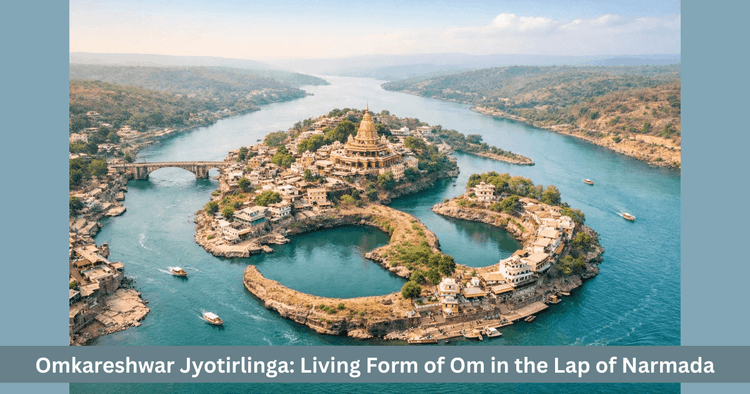
Table of Contents
On the gentle waters of the sacred Narmada River in Madhya Pradesh rests the serene and holy Mandhata Island, home to Omkareshwar Jyotirlinga. This is the island that many traditions regard as resembling the form of Om when viewed from above. The way Narmada encircles the island feels like an unbroken mantra being recited around it. A seeker who comes here does not only visit a temple or see a jyotirlinga but also touches a deeper connection with the primordial sound and vibration from which creation unfolds.
Among the twelve jyotirlingas, Omkareshwar holds a distinct place because its power appears to arise not merely from architecture or history but from sound, resonance and the principle of Om itself. Narmada is revered in many lineages as a living tirtha and the presence of Omkareshwar in her embrace gives this site a particularly subtle spiritual dimension.
Mandhata Island and the Sacred Hint of Om
According to traditional accounts, the Mandhata Island formed by the Narmada is believed to resemble the symbol of Om. Even if not every eye sees this form with the same clarity, the spiritual tradition has long accepted this association. Om is not just a syllable. It is the seed sound that stands for the original vibration of the universe.
The sacred geography of Omkareshwar can be understood briefly in this table.
| Aspect | Description |
|---|---|
| State | Madhya Pradesh |
| River | Mandhata Island in the Narmada River |
| Special indication | Island believed to resemble Om, encircled by Narmada |
| Main deities | Omkareshwar Jyotirlinga and nearby Mamleshwar temple |
| Spiritual tone | Focus on sound, meditation, mantra and inner quiet |
The boat ride to Mandhata Island, the touch of Narmada’s waters and the climb up the steps together guide the seeker away from outer noise and toward a more listening, inward awareness.
Penance of King Mandhata and the Manifestation of Omkareshwar
Ancient tradition speaks of King Mandhata, a noble ruler of the Ikshvaku dynasty, who undertook intense austerity on this very island. He did not seek only royal success or victories. He longed for divine grace and lasting peace. Through prolonged tapas, japa and one pointed concentration on Narmada’s bank, Lord Shiva became pleased and manifested here as Omkareshwar, granting the land his enduring presence.
Another narrative describes how the Devas, troubled by the oppression of the demon Tripurasura, prayed to Shiva to restore balance. Shiva is said to have appeared in a radiant form in this region before moving to end the disturbance. Both narratives, though different in detail, point to the same essence. When devotion, sacred sound and sincere prayer meet on holy ground, divinity finds a way to reveal itself.
Inner Meaning of the Name Omkareshwar
The name Omkareshwar itself is a complete spiritual statement. Om is regarded as the seed syllable of creation, formed from the subtle union of A, U and M, pointing to the arising, sustaining and dissolving aspects of existence. Ishwara means the Supreme Lord, the governing consciousness behind all life.
Thus Omkareshwar refers to the Lord as the presence abiding within Om. The jyotirlinga established here symbolises not only a sacred image but the union of sound, consciousness and form. For a seeker this understanding is very important. When one sits before Omkareshwar and chants Om, one is not merely repeating a mantra. One is attempting to tune the individual life to the original sound current of the universe.
Omkareshwar and Mamleshwar: Two Temples, One Energy
One unique feature of this tirtha is that its spiritual force is not confined to a single shrine. On the island, the Omkareshwar Jyotirlinga is worshipped, while on the southern bank of Narmada, the Mamleshwar temple holds parallel importance. Tradition regards the pilgrimage as complete only when both shrines have been visited with devotion.
As the devotee crosses the river by boat, moving from island to bank or bank to island, it is more than a physical crossing. It gently reflects a movement between duality and unity, between form and formless, between sound and silence. The calm flow of Narmada softens this experience and makes it naturally contemplative.
Architecture of Omkareshwar and the Experience of Sound
The Omkareshwar temple reflects elements of North Indian architectural style. The rising shikhara, carved stone structures and long standing traditions of Aarti, bells and mantra chanting together fill the space with a particular rhythm. The garbhagriha is relatively close and intimate. Sitting in front of the jyotirlinga, a seeker can easily become aware of the subtle play between the heartbeat, the breath and the pauses in between.
Many devotees describe a subtle vibration within the sanctum, as if a very gentle yet stable Om sound is present in the background. Compared with shrines that radiate fierce intensity, Omkareshwar carries a quiet, deep and gentle energy. This makes it especially supportive for meditation, silent japa and inner listening.
Astrological and Spiritual Significance of Omkareshwar
Omkareshwar is often considered particularly helpful for those who struggle with
- confusion about life direction
- indecision
- obstacles in education
- or inner restlessness and scattered thoughts.
From an astrological viewpoint many teachers link this tirtha with balancing the energies of Mercury and Jupiter. Mercury governs clear thinking, learning and communication, while Jupiter supports wisdom, faith and higher perspective. When this balance is disturbed, a person may become trapped either in over analysis or in ungrounded emotion and balanced decisions become difficult.
Sadhana at Omkareshwar, including mantra chanting and moving with awareness along the Narmada, is regarded as a way to encourage clarity, steadiness and deeper understanding in the mind.
Key Practice Themes at Omkareshwar
Some of the key threads of practice related to Omkareshwar can be understood through this table.
| Aspect | Indication |
|---|---|
| Inner focus | Peace of mind, direction, learning, spiritual understanding |
| Astrological tone | Balance of Mercury’s intellect and Jupiter’s wisdom |
| Suggested practices | Chanting Om, meditating on Narmada’s bank, darshan of Omkareshwar and Mamleshwar |
| Special observance | Circumambulation of Mandhata Island with Om mantra japa |
These practices are not only aimed at outer success. They also help the mind move into a coherent rhythm, where thought, feeling and choice begin to support rather than contradict each other.
Festivals, Month of Shravan and Island Parikrama
During Maha Shivratri, Omkareshwar fills with pilgrims. Night long worship, abhishekas and Shiva mantra chanting blend with the gentle sound of the river. In the month of Shravan, nearly every day brings abhisheka, Rudra chanting and offerings and the temple bells combine with the water’s flow to create a continuous sacred echo.
One of the most meaningful practices here is the parikrama of Mandhata Island. As a devotee walks along Narmada’s edge, circling the island while chanting Om, each step begins to feel like it is falling upon a syllable of mantra. For many people this circumambulation becomes more than a vow or ritual. It becomes a way of gradually handing the burdens of life over to the sustaining current of divine sound.
Subtle Life Guidance from Omkareshwar
Omkareshwar Jyotirlinga conveys the insight that creation is not chaotic. It moves in a patterned, rhythmic flow. The beginning is sound. Within that sound rests both order and grace. When the mind becomes scattered, when thoughts are tangled and inner noise increases, returning to Om, to its chanting and to its meaning, can gently restore balance.
Sitting before Omkareshwar, a seeker may feel that divinity is not distant but present in every breath, every sound and every word spoken with awareness. The slow movement of Narmada, the Om like shape of the island and the resonance of temple bells together suggest that existence itself is a mantra and Omkareshwar is its living source.
When this understanding is accepted in the heart, outer circumstances may remain the same, yet the inner soundscape begins to change. Restlessness gives way to calm, confusion to clarity and noise to a more harmonious inner vibration. This is the subtle blessing that many recognise as the true gift of Omkareshwar.
Common Questions
Where is Omkareshwar Jyotirlinga located and what is its main feature.
Omkareshwar Jyotirlinga is located on Mandhata Island in the Narmada River in Madhya Pradesh. Its main feature is that the island is traditionally associated with the form of Om and Shiva is worshipped here as Omkareshwar, connected with the primal sound of creation.
How is the penance of King Mandhata related to Omkareshwar.
According to tradition, King Mandhata of the Ikshvaku lineage performed intense penance on Mandhata Island. Pleased with his devotion, Lord Shiva manifested here as Omkareshwar, blessing the region with his enduring presence and making it a revered jyotirlinga tirtha.
Why is it important to visit both Omkareshwar and Mamleshwar temples.
The Omkareshwar Jyotirlinga on the island and the Mamleshwar temple on the Narmada bank are seen as two parts of a single energy circuit. Visiting both helps the seeker honour the balance between duality and unity, form and formlessness, which is why the pilgrimage is considered complete only with darshan at both places.
From an astrological angle, who is especially supported by Omkareshwar.
Those dealing with confusion about direction, obstacles in study, difficulty in taking decisions or mental restlessness are often advised to visit Omkareshwar, chant Om and meditate by Narmada. This practice is regarded as helpful in harmonising energies related to Mercury and Jupiter.
What is the significance of chanting Om during the parikrama of Mandhata Island.
During the island parikrama, chanting Om brings the rhythm of one’s steps and the rhythm of the mantra into alignment. This steadies the mind, calms inner disorder and helps the seeker feel more deeply connected with the foundational sound of existence.
Get your accurate Kundali
Generate KundaliDid you like it?
Author

Pt. Nilesh Sharma (63)
Experience: 20
Consults About: Family Planning, Career
Clients In: Punjab, Haryana, Delhi
Share this article with friends and family
About ZODIAQ
ZODIAQ is an online Vedic Astrology platform. It connects clients seeking astrological advice to experienced astrologers with deep knowledge. Our users also generate kundali and perform kundali milan for free. ZODIAQ also offers services to the Astrologers. Astrologers utilize various offerings by ZODIAQ to serve their clients effectively.
If you are a User
Consult with experienced astrologers and seek their guidance. You can also order handwritten Janm Patrika report with life prediction prepared by experienced astrologers. Generate accurate Kundali, perform Kundali Matching and check horoscope and muhurat. Utilize our online library for all the necessary astrological and spiritual information.
If you are an Astrologer
Create accurate kundali for your clients and perform Kundali Matching for up to 5 people at a time. Write comprehensive Janm Patrika report for your clients with ZODIAQ. Check client details anytime by saving it in client directory. Become more productive by tracking how many clients you guide every day.
WELCOME TO
ZODIAQ
Right Decisions at the right time with ZODIAQ
