Onam Story and the Divine Vow of King Mahabali
By Pt. Sanjeev Sharma
Festival of Prosperity, Gratitude and the Return of King Mahabali
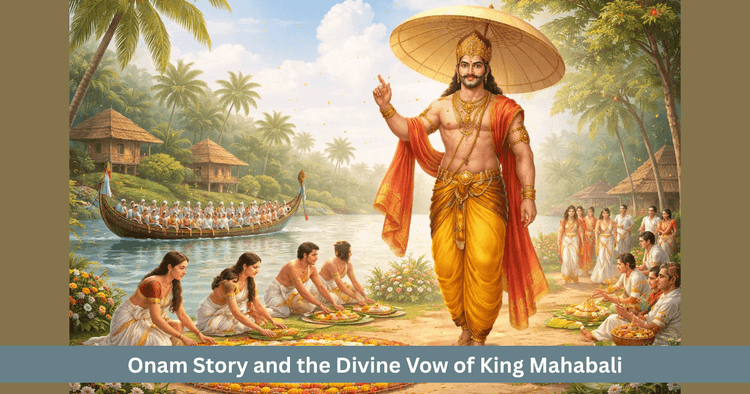
Table of Contents
The festival of Onam is not only a harvest celebration or a time of enjoyment. It is regarded as a sacred day connected with the return of the Asura king Mahabali to his people. In the Malayali community the belief is deeply rooted that during Onam King Mahabali comes from the nether world to see the condition and happiness of his beloved subjects.
During this ten day festival, floral decorations, traditional dishes, dance and ornaments together express the abundance and good fortune that Onam symbolises. The new harvest, new clothes and family gatherings transform this festival into a beautiful experience of joy and gratitude.
What Makes the Celebration of Onam Special
Onam is also called a new grain festival, a celebration of the freshly harvested crops. The waving fields and filled granaries symbolise that through hard work and divine grace the necessities of life are provided.
In Kerala, during the days of Onam people decorate the courtyard with colourful flower patterns known as pookkalam. These floral designs awaken a sense of abundance, auspiciousness and well being in both home and heart.
Women take part in the celebrations dressed in traditional attire and gold ornaments. At home a grand meal with many delicacies is served on banana leaves in a community feast known as Onam Sadya.
Various forms of folk dance of Kerala are presented during Onam. Among them Kaikottikali, Thumbi Thullal, Kummattikali and Pulikali are especially famous. Through these dances the ancient traditions, folk arts and unity of the community become vividly alive.
Who Was King Mahabali
The central story of Onam is related to the Asura king Mahabali. Mahabali is described as the grandson of Prahlada, the great devotee of Lord Vishnu. Although he belonged to the race of Asuras, Mahabali is remembered as a just, generous king who respected knowledge and righteousness.
Under his rule the people were happy and fearless. His reign was full of dharma, generosity and prosperity and is remembered as an ideal period. For this reason his subjects still lovingly remember him and welcome his symbolic return in the form of Onam.
Vamana Avatar and the Request for Three Steps of Land
According to the legend, once Mahabali organised a great sacrifice. In that sacrifice he took a vow that any supplicant who approached him would receive the gift he asked for. At that time a short yet radiant Brahmin boy entered the sacrificial arena.
According to the custom of the sacrifice Mahabali welcomed the lustrous boy with honour. He asked the guest his purpose and said that he could ask for wealth, land or any object he desired.
The boy replied calmly that a person should ask only for what is truly needed. He requested only so much land as could be measured by his three steps. The boon sounded small, so Mahabali was pleased and ready to grant it.
At that moment his guru Shukracharya signalled him to be cautious. He revealed that this was not an ordinary boy but Lord Vishnu himself in the form of Vamana and that a divine play was-taking place. However out of adherence to royal duty and the sacredness of hospitality, Mahabali did not withdraw his promise and granted the three steps of land.
Trivikrama Form, Three Steps and Mahabali’s Surrender
As soon as Mahabali gave consent for the three steps of land, the small Vamana assumed the vast form of Trivikrama. His divine body stretched towards the sky.
With his first step he measured the entire earth. With his second step he spanned the whole sky. In just these two steps all the realms of Mahabali, the land and the regions of the directions came under the feet of Trivikrama.
Then the Lord asked Mahabali where he should place the third step, since the gift was for three paces of land. To keep his word Mahabali had to offer a place for that step.
When the Lord questioned him, Mahabali did not hesitate. With deep reverence and complete surrender he offered his head and requested that the third step be placed upon it. This moment is seen as the highest expression of his devotion and the final removal of his ego.
Blessings Granted to Mahabali by Lord Vishnu
Seeing the sincerity and surrender of Mahabali, Lord Vishnu became extremely pleased. He granted him a place in the nether world and blessed him that in a future Manvantara he would attain the position of Indra.
Along with this the Lord promised that He Himself would guard the gates of the nether world and protect Mahabali. When Mahabali’s subjects felt grief at parting from their beloved king, they prayed to the Lord that they might have the chance to see him again.
Honouring their feelings Lord Vishnu allowed Mahabali to come once every year from the nether world to the earth to meet his people. This day came to be celebrated as Onam. On this day people decorate their homes, prepare floral designs and light lamps to offer a symbolic welcome to King Mahabali.
Deeper Meaning of Vamana Avatar and Victory over Pride
The story of Vamana Avatar not only recounts a sacred legend. It also gives a deep teaching about pride, knowledge and humility. Mahabali, because of his fame, splendour and invincible power, had begun to feel that all the land visible to him belonged to him alone.
The real test comes when a person has to offer everything before the divine or before truth. The Vamana incarnation shows that however vast pride may be, it can be overcome through three apparently simple symbolic steps.
Why the First Step Is Important
The first step of Vamana was placed upon the earth. This indicates that a person must first truly see the earth, the world around. On this earth countless beings live, of many forms and species.
When one becomes aware of the existence of so many living creatures, a natural humility arises. It becomes clear that human beings are not the only centre of creation but just one small link in a vast chain.
Why the Second Step Is Turned to the Sky
The second step of Vamana spread across the sky. The meaning is that sometimes the mind must look upwards towards the boundless heavens. When we reflect on the innumerable worlds, stars and planets in the universe our individual existence appears very small.
This contemplation melts pride and helps a person accept that life, strength and ability are all gifts of a higher power. With this feeling behaviour naturally becomes more gentle and balanced.
Why the Third Step Comes upon the Head
In the third step Vamana placed his foot upon the head of Mahabali. Symbolically it means that finally one has to examine one’s own ego, thoughts and identity.
If a person sincerely places a hand on the head and reflects on the endless cycle of birth and death, it becomes clear that a single life is very short. Recognising how small our role is in the vast design of the universe is the essence of true humility.
| Three symbolic steps of Vamana | Inner step of spiritual practice |
|---|---|
| First step on earth | Becoming humble by seeing all living beings |
| Second step in the sky | Melting pride through awareness of cosmic vastness |
| Third step on the head | Accepting the brevity of life and offering the ego |
Astrological and Spiritual Link of Onam with Shravana Month
The word Onam is taken as a shortened form of Thiruvonam or Shravanam. This festival is celebrated in the month of Shravana of the Indian calendar when the star of Shravana is prominent. In North India this month usually falls in the middle of the rainy season, while in South India the period extends slightly later into the latter part of the monsoon.
The month of Shravana is regarded as highly auspicious for worship, vows and spiritual practice. The earth becomes green with rainwater and the atmosphere is filled with freshness and serenity. In this same month the presence of the Shravana star makes the festival of Onam even more sacred.
Three Footprints of Vamana Marked in the Sky
The Shravana star is recognised in the sky as a special group of stars. In Western astronomy it is identified with the bright star Altair in the constellation Aquila, along with the stars Beta and Gamma on either side.
In Indian tradition these three stars are visualised as the three footprints of Vamana in his Trivikrama form. It is as if the three steps of the Lord have become permanent marks in the sky reminding human beings of their limits and measure.
One may naturally ask why the Shravana star plays such an important role in the story of Mahabali and Vamana. The word Shravana itself means listening and attentive hearing.
These three stars symbolise that Mahabali did not fully listen to the warning of his guru. In the enthusiasm of giving and the pride of generosity he did not reflect deeply upon his teacher’s advice and the resulting events shaped his destiny.
Thus the Shravana star constantly reminds that whenever good counsel or guidance comes in life it must be heard carefully and applied. Mere hearing is not enough. Putting it into practice is what makes knowledge meaningful.
Inner Message of Onam and the Story of Mahabali
The story of Onam and King Mahabali teaches that glory, power and fame shine only while they are joined with humility and surrender. The splendour and generosity of Mahabali were unparalleled, yet in the final test his highest glory lay in bowing his head at the feet of the Lord.
The Vamana incarnation suggests that whenever pride begins to grow, one should remember the earth, the sky and one’s own head. In this remembrance balance and peace arise and festivals like Onam become not only occasions of outer joy but also opportunities for inner awakening.
Common Questions Related to Onam and the Story of Mahabali
With whom is Onam mainly associated?
Onam is primarily associated with the Asura king Mahabali. The day is regarded as the sacred occasion when he returns to his people, who symbolically welcome their beloved king.
Why is King Mahabali considered great?
Mahabali is remembered as a just, generous and compassionate ruler. Under his reign there was no fear or scarcity, which is why his people continue to honour and love him.
What is the meaning of the three steps of land in Vamana Avatar?
The three steps symbolise three stages of conquering pride. The first teaches humility by seeing the world, the second by understanding the vast sky and the third by surrendering one’s own ego.
Why is the Shravana star connected with Onam?
Onam is celebrated when the Shravana star is prominent and Shravana means listening. The star reminds us to hear the good advice of teachers and noble people with attention and to act upon it.
Why is it helpful to remember this story while celebrating Onam?
Remembering the story ensures that the festival is not limited to outer joy. The values of generosity, humility, surrender and alertness stay alive, bringing harmony and prosperity to both family and society.
Get your accurate Kundali
Generate KundaliDid you like it?
Author

Pt. Sanjeev Sharma (63)
Experience: 20
Consults About: Family Planning, Career
Clients In: Punjab, Haryana, Delhi
Share this article with friends and family
About ZODIAQ
ZODIAQ is an online Vedic Astrology platform. It connects clients seeking astrological advice to experienced astrologers with deep knowledge. Our users also generate kundali and perform kundali milan for free. ZODIAQ also offers services to the Astrologers. Astrologers utilize various offerings by ZODIAQ to serve their clients effectively.
If you are a User
Consult with experienced astrologers and seek their guidance. You can also order handwritten Janm Patrika report with life prediction prepared by experienced astrologers. Generate accurate Kundali, perform Kundali Matching and check horoscope and muhurat. Utilize our online library for all the necessary astrological and spiritual information.
If you are an Astrologer
Create accurate kundali for your clients and perform Kundali Matching for up to 5 people at a time. Write comprehensive Janm Patrika report for your clients with ZODIAQ. Check client details anytime by saving it in client directory. Become more productive by tracking how many clients you guide every day.
WELCOME TO
ZODIAQ
Right Decisions at the right time with ZODIAQ
