Parivartini Ekadashi Vrat Katha and the Leela of Vamana Avatar
By Pt. Amitabh Sharma
Vamana Avatar, King Bali’s Devotion, and Spiritual Significance of Parivartini Ekadashi
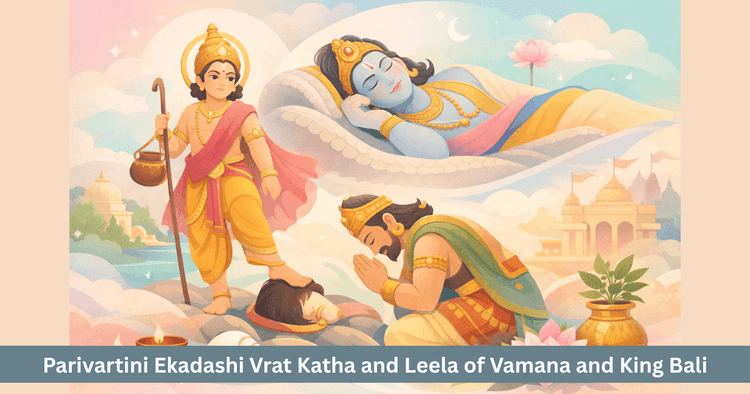
Table of Contents
The story of Parivartini Ekadashi is not only a vrata katha. It is also a deep teaching about the Vamana avatar of Bhagavan Vishnu, the devotion of King Bali and the subtle difference between surrender and pride. This Ekadashi is also known as Jayanti Ekadashi and is closely linked with the worship of Lord Vamana, the resting state of Shri Hari and the special period of Chaturmasya.
Tradition explains that on the day of Parivartini Ekadashi, Bhagavan Vishnu turns to another side while resting. For this reason it is called Parivartini, the day of divine turning. Devotees who observe the fast on this Ekadashi and worship Lord Vamana and Shri Hari are believed to gain purification from sins, eligibility for higher realms and the grace of Vishnu’s abode. The fruit of this vrata is even compared with that of the great Ashvamedha yajna.
Arjuna’s Question and Shri Krishna’s Reply
The katha begins in a setting reminiscent of the Mahabharata. Arjuna, son of Pandu, humbly asks Shri Krishna about the Ekadashi that falls in the bright fortnight of Bhadrapada. He wishes to know its name, its prescribed observances and the results that arise from fasting on this day.
Shri Krishna, speaking as the compassionate guide of Partha, replies that the Ekadashi of the bright half of Bhadrapada is known as Jayanti Ekadashi. He explains that merely hearing the katha of this Ekadashi can pacify sins and make a person eligible for heaven. The power of this story is such that even those who have fallen into great wrongdoing may be uplifted through it.
Significance of Jayanti and Parivartini Ekadashi
Shri Krishna further tells Arjuna that a righteous person who worships him on this day receives the merit of having performed all forms of worship in the world. One who sincerely worships his form gains the qualification to reach his divine abode. It is said that there is not the slightest doubt in this.
He adds that a devotee who worships Bhagavan Vamana on this Ekadashi attains the fruit of worshipping the three deities Brahma, Vishnu and Mahesh together. Those who observe the fast of this Ekadashi are described as having no spiritual duty left unfinished, because their life becomes aligned with dharma and devotion.
In this context, Shri Krishna reveals that the Ekadashi is called Parivartini because on this day Lord Vishnu, while in a state of yogic sleep, changes his side. This turning is taken as a sign of a subtle shift in the flow of energy in the universe and a special turning point within the four month period of Chaturmasya.
Arjuna’s Curiosity and the Beginning of the Vamana Bali Story
Hearing these words, Arjuna becomes deeply curious. He asks how the Lord rests, what it means for him to turn and why King Bali was bound. He also requests a detailed explanation of the lilas of the Vamana form, the observances of Chaturmasya and the duties of humans when the Lord is resting.
Shri Krishna addresses Arjuna with affection and says that he will now narrate a katha that destroys all sins. With this he begins to describe a great episode from Treta Yuga, in which the character of King Bali and the power of his devotion are clearly shown.
Power, Charity and the Anxiety of the Devas
In Treta Yuga, there was a powerful asura king named Bali. The story describes him as deeply devout, generous, truthful and devoted to the service of brahmanas. He regularly performed yajnas, austerities and charity with great faith. Through such spiritual strength and worldly prowess, he rose to such a position that even the heavenly realm came under his control.
In time, the situation reached a point where King Bali ruled in the seat of Indra, the king of the devas. The devas could not bear this reversal. Indra and the other gods went together to Bhagavan Shri Hari and prayed for protection and restoration of balance. Hearing their plea, the Lord decided to incarnate as Vamana, to test Bali and to re establish the rightful order of the devas.
Descent of Lord Vamana and His Arrival at Bali’s Sacrifice
Shri Krishna tells Arjuna that he assumed the form of Vamana, a radiant brahmana dwarf. In this form he came to the yajna ground where King Bali was engaged in a great sacrifice and was joyfully giving in charity. Seeing the brahmana boy, Bali welcomed him with honour and asked what he desired.
Lord Vamana requested in simple words, “O king, grant me three steps of land. By giving so little, you will gain the merit of giving the three worlds.” King Bali, who was renowned for generosity, was delighted by this small request. Without hesitation he gave his word that he would donate three steps of land to the young brahmana.
Vamana’s Cosmic Form and the Three Steps of Land
As soon as Bali granted his promise, Lord Vamana began to expand his form. From the small stature of a boy, he manifested a vast, cosmic figure. With one step he covered the entire earth and with the second step he spanned the heavenly region.
The katha describes that in his expanded form, his foot rested upon Bhuloka, his legs reached into the middle realms, his waist stood in the heaven world, his abdomen in Maharloka, his heart in Janaloka, his throat in Tapoloka and his face in Satyaloka. His head rose beyond and the Sun, stars, Indra and the other devas all glorified this wondrous form.
Then the Lord turned to King Bali and asked where he should place the third step, since the three worlds had already been taken in just two strides.
Surrender of Bali and His Placement in the Netherworld
Hearing this question, the heart of King Bali trembled, yet his commitment to truth and promise remained stronger than fear. To honour his word, he bowed his head and offered his own body, saying that the Lord could place the third step upon his head.
The Lord then placed his third step upon the head of Bali. In this way, for the sake of the devas, for the re establishment of dharma and for the removal of hidden pride, the Lord sent his asura devotee to the netherworld, Patala. This was not merely punishment. It was a divine arrangement in which Bali received both correction of pride and a unique spiritual position.
The story relates that when Bali humbly prayed, the Lord assured him that he would remain with him. Thus, even in Patala, Bali gained the special blessing of the Lord’s presence.
Dual Presence of the Lord with Bali and in the Ocean of Milk
Shri Krishna explains that on the Parivartini Ekadashi of the bright fortnight of Bhadrapada, one form of the Lord remains near King Bali in the netherworld and another form rests upon Shesha in the ocean of milk. This dual presence signifies that the Lord is with his devotee and at the same time remains the cosmic preserver of the entire universe.
On this day, the Lord is believed to turn from one side to another while resting, symbolising a subtle change in the rhythm of creation. For seekers, this turning is a reminder to bring change, alertness and renewal into their own lives.
Simple Observance of the Parivartini Ekadashi Vrat
The katha also gives a brief outline of the observance of Parivartini Ekadashi. On this day, devotees perform special worship of Shri Vishnu, the Lord of the three worlds. Charity of rice, curd and silver is considered especially auspicious and is seen as a means to gain stable prosperity and merit.
Night long vigil is also mentioned. Devotees spend the night in bhajan, kirtan or silent remembrance of the divine name. Through fasting, restraint and wakefulness, body and senses are turned away from indulgence and directed towards the grace of the Lord.
By observing the fast of Parivartini Ekadashi and listening to its katha, a person is said to become free from sins and attain higher realms. The story even declares that hearing this vrata katha with faith brings the fruit of performing an Ashvamedha yajna.
Lessons of Humility and the True Spirit of Charity
At the end of the narration, the story gently highlights that after giving, a person must not fall into pride. King Bali was undeniably a great donor and devotee, yet a subtle pride in his strength and charity arose within him. This became the cause for his being sent to Patala, even though divine grace remained with him.
The teaching is that excess in any direction, whether of power, charity or ego, ultimately becomes unbalanced. True charity is that which is offered with humility, surrender and freedom from self glorification. The Parivartini Ekadashi katha reminds the seeker that along with bhakti, vrata and daan, inner modesty and balance are equally essential.
Frequently Asked Questions
Why is Parivartini Ekadashi also called Jayanti Ekadashi?
It is called Jayanti because its observance and katha are described as powerful enough to destroy sins and grant eligibility for higher realms. The story says that even hearing this katha can uplift those who have fallen.
What is the special importance of worshipping Lord Vamana on this day?
Worship of Lord Vamana on this Ekadashi is considered equivalent to worshipping the three deities Brahma, Vishnu and Mahesh. In the Vamana avatar, the Lord tested Bali, restored the position of the devas and gave a shining example of generosity, devotion and humility.
What does the turning of Lord Vishnu on Parivartini Ekadashi signify?
The turning of the Lord is understood as a subtle shift in the order of creation. For devotees, it marks a favourable time to reassess life, renew vows and introduce positive changes in spiritual discipline.
Was sending King Bali to Patala a punishment or a blessing?
The katha shows it as both correction and grace. Bali’s pride was checked, yet he was given a respected place in Patala and the constant presence of the Lord. Thus it was a divine arrangement rather than a mere punishment.
What does the Parivartini Ekadashi katha teach about charity?
The katha teaches that charity should be free from ego. Even great gifts lose their purity when joined with pride. When daan is given with humility and surrender to the Lord, it becomes a true source of spiritual welfare and protection.
Get your accurate Kundali
Generate KundaliDid you like it?
Author
Pt. Amitabh Sharma (56 Years)
Experience: 20
Consults About: Family Planning, Career
Clients In: Punjab, Haryana, Delhi
Share this article with friends and family
About ZODIAQ
ZODIAQ is an online Vedic Astrology platform. It connects clients seeking astrological advice to experienced astrologers with deep knowledge. Our users also generate kundali and perform kundali milan for free. ZODIAQ also offers services to the Astrologers. Astrologers utilize various offerings by ZODIAQ to serve their clients effectively.
If you are a User
Consult with experienced astrologers and seek their guidance. You can also order handwritten Janm Patrika report with life prediction prepared by experienced astrologers. Generate accurate Kundali, perform Kundali Matching and check horoscope and muhurat. Utilize our online library for all the necessary astrological and spiritual information.
If you are an Astrologer
Create accurate kundali for your clients and perform Kundali Matching for up to 5 people at a time. Write comprehensive Janm Patrika report for your clients with ZODIAQ. Check client details anytime by saving it in client directory. Become more productive by tracking how many clients you guide every day.
WELCOME TO
ZODIAQ
Right Decisions at the right time with ZODIAQ
