Pitru Paksha Katha: Puranic Stories of Shraddha and Ancestral Bond
By Pt. Abhishek Sharma
Understanding Shraddha, gratitude and the sacred connection with ancestors
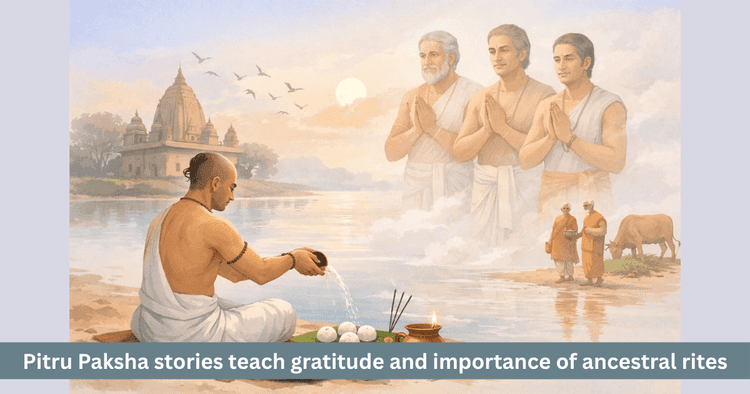
Table of Contents
Pitru Paksha is the sacred period in which the living remember their ancestors, offer them reverence and express gratitude toward them. It is not only a religious observance, but a deeply rooted Indian spiritual understanding that reminds a person that life does not begin with the present individual alone. Behind each person stands a lineage, inherited values, blessings and countless sacrifices. For this reason, the period beginning from Bhadrapada Purnima and continuing until Ashwin Krishna Paksha Amavasya is considered highly sacred. Whatever is offered with devotion during these days for the peace of the ancestors is called Shraddha.
During Pitru Paksha, not only are offerings, tarpan and rituals performed, but many puranic stories are also read and narrated. Through these stories, one understands why remembering the ancestors is important, why food donation is considered sacred, why the giving of wealth alone is not enough and why the satisfaction of the ancestors is linked with blessings, peace and stability in life. This is why a Pitru Paksha Katha is not merely a story. It is a spiritual teaching that helps a person understand the deeper meaning of gratitude, duty and remembrance.
What is Pitru Paksha and what is the true meaning of Shraddha
Pitru Paksha, according to tradition, begins on Bhadrapada Purnima and continues until Ashwin Krishna Paksha Amavasya. It is this sacred fortnight during which descendants remember their ancestors and perform offerings for the peace of their souls. Food, water, tarpan, feeding of Brahmins, charity and remembrance of the departed are regarded as major parts of this observance. The very essence of Shraddha lies in shraddha, which means faith filled reverence. Whatever is done with deep sincerity, gratitude and devotion becomes Shraddha in its true sense.
This sacred observance also teaches that life belongs not only to the present generation. A person carries the unfinished karma, blessings, teachings and subtle presence of the ancestors. Therefore, Pitru Paksha is not only about ritual. It is about spiritual responsibility toward one’s lineage.
Why is reading Pitru Paksha stories considered important
The stories connected with Pitru Paksha were not preserved merely for narration. Their purpose is to explain the greatness of Shraddha, the value of food donation, the satisfaction of ancestors, the importance of humility and the need for right intention. When a person listens to or reads these stories, it becomes clear that Shraddha should not remain an outer formality. If the inner feeling is absent, the act remains incomplete. If a feast is arranged only to impress others, the ancestors are not truly satisfied. If devotion, simplicity and compassion are present, then even the smallest offering becomes spiritually meaningful.
That is why these traditional narratives continue to be read with reverence. They encourage people to reflect not only on external actions, but also on the emotional and spiritual quality behind them.
Why is the story of Daanveer Karna so famous during Pitru Paksha
Among all the stories associated with Pitru Paksha, the story of Daanveer Karna is among the most widely known. It is not only a memory from the Mahabharata, but also a profound teaching on Shraddha and the sanctity of offering food. It is said that Kunti Putra Karna donated large amounts of gold, wealth and material possessions to the needy during his lifetime. For this reason, he became renowned as a great donor. Yet one important act was missing. He had never offered food in charity.
After death, when Karna reached heaven, he was granted many luxuries, but he did not receive food. It is said that he was served gold coins in a golden plate instead of food. Surprised, he asked Indra for the reason. Indra replied that in heaven the soul receives according to what was given on earth. Karna had donated gold throughout life, but never donated food. He had also failed to perform Shraddha and tarpan for his ancestors due to attachment and lack of awareness. Therefore, he was receiving gold in place of food.
When Karna understood this, he realized his mistake. He prayed to Yamaraj and requested permission to return to earth for a limited period so that he could offer food to Brahmins and the poor and perform Shraddha for his ancestors. Yamaraj accepted his request and allowed him to return. After Karna performed food donation and remembered his ancestors with devotion, he returned and was welcomed with abundant food. This is why the story is considered a profound symbol of Brahmin bhoj, ann daan and the spiritual importance of feeding others.
Main teachings from the Karna story
- Donation of wealth alone is not considered complete
- Food donation holds a deeply sacred place
- Ancestor remembrance is an essential aspect of duty
- Even after error, sincere correction is possible
- Shraddha is linked with both gratitude and satisfaction
What does the Mahabharata era story of Pitru Paksha teach
Another well known form of the Karna story also appears in the traditional understanding of Pitru Paksha. In it, Karna reaches heaven after attaining veergati in the Mahabharata war. There too he is served gold instead of food. When he questions this, he is told that although he donated gold in life, he did not donate food. Karna then explains that he lacked knowledge about his ancestors and therefore could not make proper offerings in their memory.
Upon hearing this, Indra allows him to return to earth for sixteen days so that he may correct his mistake. During that time he remembers his ancestors, performs Shraddha and offers food in their name. This sixteen day period is traditionally associated with Pitru Paksha. The deeper teaching of this story is that one may realize too late that wealth without nourishment and devotion remains incomplete. The story highlights that remembrance, food offering and gratitude complete the cycle of duty toward ancestors.
Why does the story of Joge and Bhoge give the most human message of Pitru Paksha
Among the traditional narratives of Pitru Paksha, the story of Joge and Bhoge is one of the most touching. It teaches not only the value of Shraddha, but also that the ancestors are pleased not by show, but by true feeling. The two brothers lived separately. Joge was wealthy, while Bhoge was poor. There was affection between the brothers, but Joge’s wife was proud of her wealth. Bhoge’s wife, by contrast, was simple, warm hearted and humble.
When Pitru Paksha arrived, Joge’s wife asked him to perform Shraddha for the ancestors. Joge tried to dismiss it, but his wife felt that if Shraddha was not performed, people would speak badly. She decided to turn it into an opportunity to invite her relatives and display her prosperity. She called Bhoge’s wife to help prepare the feast. Bhoge’s wife came, worked with sincerity, cooked many dishes and then returned home, because she too had to offer tarpan for her ancestors.
At noon, the ancestors descended to earth. They first went to Joge’s house, where they saw Joge’s in laws eating grandly. There was no place of true reverence for them there, so they felt deeply saddened and left. Then they went to Bhoge’s house. There was poverty there, and almost nothing in the house, but an agiyari had been offered in the name of the ancestors. It is said that the ancestors licked the ashes and went away hungry toward the riverbank. Later, when the ancestors gathered together and spoke of how they had been worshipped in different homes, the ancestors of Joge and Bhoge shared their sorrow.
They realized that if Bhoge had possessed means, he would certainly have fed them with devotion, but there was not even enough food for the family. Moved by compassion, the ancestors blessed Bhoge and declared that wealth should come to Bhoge’s home. By evening, Bhoge’s children were hungry and asked their mother for food. To distract them, she told them to open the vessel in the courtyard and eat whatever they found. The children discovered that the vessel was filled with gold coins. They ran to their mother, and she too was astonished. In this way, Bhoge became prosperous, yet he did not become arrogant. The following year, he prepared rich offerings with devotion, fed Brahmins, gave dakshina and respectfully offered food even to Joge and his wife. The ancestors were then fully satisfied.
What should be understood from the story of Joge and Bhoge
| Event | Teaching |
|---|---|
| Joge’s house | Shraddha done for show and pride remains spiritually incomplete |
| Bhoge’s house | Even in poverty, true devotion reaches the ancestors |
| Reaction of the ancestors | Ancestors value sincerity more than outer wealth |
| Bhoge receiving wealth | Blessings follow genuine remembrance and humility |
| Next year’s Shraddha | Prosperity should never destroy simplicity or gratitude |
How does this story establish the supremacy of feeling in Shraddha
The story of Joge and Bhoge makes it clear that Shraddha is not merely about elaborate dishes or outward arrangements. If at the center there is no faith, humility and true remembrance, then the act remains empty. On the other hand, even a poor home can become spiritually rich when the feeling is pure. This reflects the deeper Indian teaching that the heart behind the act matters more than the act’s outward scale.
In this story, the simple and selfless nature of Bhoge’s wife becomes the real focus. Her reverence, her service and her sincerity become the reason why the ancestors bless the family. This is why the story still teaches that in Shraddha, pride is useless and humility is supreme.
How does Rahul’s story explain Pitru Paksha to the child’s mind
Another gentle and meaningful story associated with Pitru Paksha is that of a young boy named Rahul. Rahul lived with his grandparents because his parents had passed away in his childhood. His grandparents loved him dearly, and Rahul too was deeply attached to them. When Pitru Paksha arrived, Rahul performed Shraddha for his parents along with his grandparents. After the ritual, he asked his grandfather why Pitru Paksha is observed.
His grandfather replied that Pitru Paksha is the sacred time when we remember our departed ancestors, offer them respect and pray for the peace of their souls by offering food, water and other items in devotion. Listening to this, Rahul understood that Pitru Paksha is not merely a festival or ritual. It teaches us never to forget our ancestors. This story is simple, yet its message is deep. It shows that Pitru Paksha is also a way of passing ancestral values and gratitude to the younger generation.
Why is food donation considered so important during Pitru Paksha
Whether in the story of Karna or in the story of Joge and Bhoge, one truth appears repeatedly, the sacred importance of food donation. Food is not only nourishment for the body. It symbolizes compassion, satisfaction and life itself. That is why during Pitru Paksha, offering food, water, feeding Brahmins, serving cows and feeding the needy are considered especially significant. Just as food is the most basic support for the living, food offered in memory of the ancestors becomes a symbol of spiritual satisfaction and continuity.
The importance of food donation may be understood for the following reasons:
- It represents compassion and fulfillment together
- It is seen not merely as charity, but as a sacred offering of life itself
- It connects ancestor remembrance with tangible action
- It strengthens the spirit of sharing in society
- It makes the person humble and grateful
What spiritual teaching does Pitru Paksha offer
The deepest message of Pitru Paksha is that no human being exists alone. Behind one life stands a lineage, a history and an invisible stream of blessings. Remembering one’s ancestors is therefore not only a religious act, but a practice of remaining rooted in one’s source. This sacred period makes a person humble. One begins to understand that whatever one has today is not merely the result of individual effort. It carries the unseen contribution of many who came before. This is the inner essence of Shraddha.
Pitru Paksha teaches three profound truths:
| Spiritual teaching | Meaning |
|---|---|
| Gratitude | What one has received is not created by oneself alone |
| Remembrance | To forget ancestors is to forget one’s roots |
| Offering | A sincere act keeps the bond with the lineage spiritually alive |
Why are Pitru Paksha stories still relevant today
Even today these stories remain deeply relevant because human beings still struggle with the same questions. What is the right use of wealth. What is the role of family. Why should one remember those who are gone. How should giving be done. Karna’s story teaches the correct meaning of donation. The story of Joge and Bhoge teaches that feeling is superior to display. Rahul’s story teaches the younger generation the values of remembrance and reverence. This is why Pitru Paksha stories are not only part of scripture, but living values within family and society.
What should be remembered most during Pitru Paksha
The most important truth to remember during Pitru Paksha is that Shraddha is not merely about observing a rule. It is a union of faith, remembrance, gratitude, food donation, humility and sanskars. Even the simplest act offered with true devotion may become spiritually great. And a grand arrangement without true feeling may remain hollow. This is the shared message of all the stories associated with the sacred fortnight.
Stability in life comes through reverence toward the ancestors
The stories of Pitru Paksha teach that true prosperity is not found only in wealth, grand meals or social standing. True prosperity lies in the feeling with which one remembers the ancestors, offers gratitude to them and continues the tradition of sharing in society. The story of Daanveer Karna explains the greatness of food donation. The story of Joge and Bhoge shows that true feeling is supreme. Rahul’s story reveals the importance of giving this value to the next generation.
For this reason, reading a Pitru Paksha Katha is not only about gaining information. It is about awakening humility within. When the ancestors are remembered with sincere reverence, what happens is not only a religious act. A subtle bridge of lineage, value and blessing becomes alive again. This is the true importance of Pitru Paksha.
FAQs
What is Pitru Paksha
Pitru Paksha is the sacred period that begins on Bhadrapada Purnima and continues until Ashwin Krishna Paksha Amavasya. During this time, acts done with devotion for the peace of the ancestors are called Shraddha.
What is the main teaching of Daanveer Karna’s story
This story teaches that donation of wealth alone is incomplete. Food donation and remembrance of one’s ancestors are also considered deeply important.
What is the main message of the story of Joge and Bhoge
The main message of this story is that the ancestors are pleased not by display, but by true devotion, simplicity and heartfelt offering.
Why is food donation considered important during Pitru Paksha
Food donation symbolizes nourishment, compassion and fulfillment. Therefore feeding Brahmins, guests and the needy is regarded as highly sacred during Pitru Paksha.
What does Pitru Paksha teach us
Pitru Paksha teaches gratitude, remembrance of ancestors, faith and the continuity of family values and spiritual inheritance.
Get your accurate Kundali
Generate KundaliDid you like it?
Author

Pt. Abhishek Sharma (63)
Experience: 20
Consults About: Family Planning, Career
Clients In: Punjab, Haryana, Delhi
Share this article with friends and family
About ZODIAQ
ZODIAQ is an online Vedic Astrology platform. It connects clients seeking astrological advice to experienced astrologers with deep knowledge. Our users also generate kundali and perform kundali milan for free. ZODIAQ also offers services to the Astrologers. Astrologers utilize various offerings by ZODIAQ to serve their clients effectively.
If you are a User
Consult with experienced astrologers and seek their guidance. You can also order handwritten Janm Patrika report with life prediction prepared by experienced astrologers. Generate accurate Kundali, perform Kundali Matching and check horoscope and muhurat. Utilize our online library for all the necessary astrological and spiritual information.
If you are an Astrologer
Create accurate kundali for your clients and perform Kundali Matching for up to 5 people at a time. Write comprehensive Janm Patrika report for your clients with ZODIAQ. Check client details anytime by saving it in client directory. Become more productive by tracking how many clients you guide every day.
WELCOME TO
ZODIAQ
Right Decisions at the right time with ZODIAQ
