Significance of Pratipada Shraddha and the Grace of Ancestors
By Pt. Suvrat Sharma
Pratipada Shraddha: Beginning of Pitru Paksha and Rituals for Ancestors
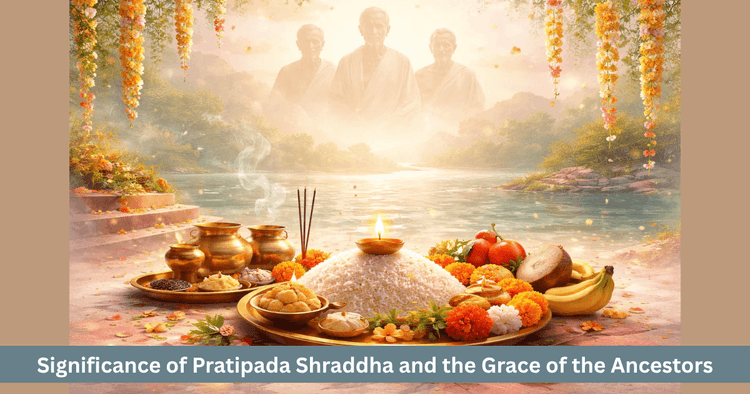
Table of Contents
Pratipada Shraddha, also known as Padwa Shraddha, is regarded as the first day of the sacred fortnight called Pitru Paksha. From this day until Mahalaya Shraddha, a continuous series of rituals is performed for the peace and satisfaction of the ancestors. Each day of Pitru Paksha is linked with a particular lunar date and Pratipada Shraddha forms the opening link in this chain.
According to traditional reckoning, Pratipada Shraddha is performed on the first day of the bright fortnight of the Bhadrapada month. In the Purnimanta calendar system, this corresponds to the month of Ashwin. On this day, Shraddha is performed for those family members who passed away on the Tithi of Pratipada, whether in the dark fortnight or in the bright fortnight.
For Whom and Why Is Pratipada Shraddha Performed
The word Shraddha comes from the Sanskrit phrase “Shraddhyaa Deeyate Yat”, meaning an act performed with deep faith. The annual ceremony offered to the ancestors is not merely a ritual, it is an expression of remembrance, gratitude and inner connection with the lineage.
Pratipada Shraddha is especially performed for those departed souls who left the body on the Tithi of Pratipada, whether it was Krishna Paksha or Shukla Paksha. It is also stated that on this day, Shraddha may be performed for departed family members in those lineages where there is no male offspring to carry out the regular rites, irrespective of the exact date of death. This gives special relief to families where the traditional male performer of Shraddha is not present.
| Point | Meaning connected with Pratipada Shraddha |
|---|---|
| Date | Bhadrapada shukla Pratipada, in Ashwin by Purnimanta reckoning |
| Place in Pitru Paksha | First day, opening of the sequence up to Mahalaya Shraddha |
| For whom it is observed | Departed on Pratipada and those without male descendants |
| Main purpose | Satisfaction of ancestors, removal of Pitru dosha, family peace and prosperity |
Religious Importance of Pratipada Shraddha
In Vedic and Pauranic tradition, Shraddha is considered a very important observance. It is not seen as a private family custom alone but as a living expression of the connection between generations. Texts such as Matsya Purana, Garuda Purana and Agni Purana describe in detail the methods and inner meaning of Shraddha and Pitru Tarpana.
The core purpose of Shraddha is to offer peace to the ancestors, to nourish their subtle bodies and to help them move beyond the bondage of birth and death towards liberation. Tarpana and Pinda daana are the central parts of this process. Through water, sesame, barley and food offerings, one expresses gratitude to those who have gone before.
Holy places such as Kashi, Gaya, Prayag Sangam, Haridwar, Rishikesh and Rameshwaram are especially revered for performing Pratipada Shraddha and other Pitru rites. Pinda daana at such tirthas is believed to bring long lasting satisfaction to many generations of ancestors.
Why Is Pratipada Considered Inauspicious for New Work but Auspicious for Shraddha
In traditional belief, the day of Pratipada is not chosen for starting major new worldly undertakings. It is viewed as a suitable time for introspection and for fulfilling duties towards the ancestors. For this reason, performing Shraddha on Pratipada is considered particularly beneficial.
The understanding is that when Pratipada Shraddha is observed properly, the grace of the ancestors becomes active in the home. This brings stability, prosperity and harmony within the family. It can also help to calm subtle afflictions known as Pitru dosha, which are described as ancestral imbalances reflected in the horoscope and in life events.
What Does the Origin Story of Shraddha Teach
The Varaha Purana records a touching story about the origin of Shraddha. It tells that Nimi, the son of the sage Atreya, had a son who practised meditation for many years and then departed from his body.
Nimi was heartbroken at the death of his son. He was restless and inconsolable. In his grief he invited brahmanas to his home and offered them the foods that his son had loved during his lifetime. As he served them, his mind remained fixed in remembrance of his departed child.
At that time Devarshi Narada visited his house. He saw that even in sorrow Nimi was offering his son’s favourite food to the brahmanas. Narada reassured him and said that he had done nothing wrong. He explained that to remember one’s ancestors with faith and to offer their favourite items to brahmanas is itself an act of Shraddha.
Nimi then performed full Shraddha according to Narada’s guidance. His ancestors blessed him and from that time the tradition of Shraddha became clearly established. The story reveals that Shraddha has its roots not in fear but in love, remembrance and gratitude.
Main Procedure of the Pratipada Shraddha
The observance of Pratipada Shraddha includes Tarpana, Pinda daana, offerings into the fire, feeding of brahmanas and acts of charity. Generally the eldest male member of the family acts as the karta or performer. He wears a ring made of kusha grass, dresses in traditional dhoti and ideally is one who has undergone the sacred thread ceremony.
In the morning or forenoon, after bathing and making a resolve, the karta invokes the ancestors and performs Tarpana. In this, water mixed with sesame and other substances is offered with the names of the departed. Then Pinda daana is performed, in which rice, barley, sesame and ghee are formed into balls and offered to the ancestors. These are later given to a cow or immersed in a river, both being regarded as auspicious ways of conveying the offering.
The midday period is considered most suitable so that, after the rituals, food can be offered to the brahmanas and then to the family members as prasada. First the brahmanas are fed and after that the same sanctified meal is taken by the family. Gifts of money, cloth and other items are also offered in charity in the name of the ancestors.
Rules and Restraints during Pratipada Shraddha and Pitru Paksha
During the entire period of Pitru Paksha, especially on the day of Pratipada Shraddha, certain restraints are advised. Their purpose is to keep both the environment and the mind pure and focused.
Many families avoid non vegetarian food, intoxicants and excessive indulgence during this time. Some people observe a fast or take simple food in order to maintain a sattvic state. Cutting hair, shaving and unnecessary bodily adornment are also generally avoided on Shraddha days.
Shraddha is often performed near a temple or on the bank of a river. The karta is expected to maintain purity in behaviour, speech and business dealings on that day so that the energy of the ritual may flow unobstructed towards the ancestors.
Inner Meaning of Tarpana, Pinda daana and Charity
In Shraddha, Tarpana means more than the physical act of pouring water. It is the offering of inner satisfaction to the ancestors. As the karta utters their names and offers water, he acknowledges that his own life is a continuation of their efforts and blessings.
In Pinda daana, rice, barley, sesame and ghee are shaped into offerings that symbolically nourish the subtle bodies of the ancestors. Giving these to water or to a cow expresses that what is given for the ancestors reaches them through nature and through sacred beings such as the cow.
Feeding brahmanas, serving cows and also giving food to crows and dogs are all mentioned as auspicious acts on the day of Shraddha. This reflects the idea that pleasing the ancestors is not limited to one group alone. It extends through compassion and food offerings to many forms of life.
Spiritual Message of Pratipada Shraddha
Pratipada Shraddha reminds a seeker that life is not confined to a single generation. Behind every person stand many generations of effort, sacrifice and guidance. Without honouring this unseen support, lasting balance does not arise in family life.
One who performs Pratipada Shraddha and the rites of Pitru Paksha with faith finds that the day becomes more than a ritual. It becomes a living expression of gratitude, humility and respect for the lineage. Such Shraddha brings peace to the ancestors and draws a subtle line of protection and blessing across the lives of their descendants.
Frequently Asked Questions
For whom is Pratipada Shraddha mainly performed?
Pratipada Shraddha is primarily for those whose death occurred on the Tithi of Pratipada, in either fortnight. It may also be performed on this day for departed family members in lineages where there is no male descendant to conduct regular Shraddha, regardless of the exact date of death.
Why is Shraddha described as an act rooted in faith?
The word Shraddha comes from “Shraddhyaa Deeyate Yat,” meaning an act given with faith. In rites for the ancestors, it is the inner feeling of reverence and gratitude, along with the outer action, that makes the ritual effective.
What lesson does the story of Nimi in Varaha Purana convey?
The story shows that when Nimi offered his son’s favourite food to brahmanas in a spirit of remembrance, it became the seed of Shraddha. It teaches that the essence of Shraddha lies in love, remembrance and thankfulness, not mere formality.
What is special about feeding and charity on the day of Pratipada Shraddha?
On this day brahmanas are fed first and then the family partakes of the same food as prasada. Offerings of cloth, money and other gifts are made in the name of the ancestors. Feeding cows, crows and dogs is also regarded as an extended form of satisfying the ancestors.
Why is abstinence from non vegetarian food and alcohol encouraged during Pitru Paksha?
Pitru Paksha is a period of restraint, remembrance and purification. Avoiding meat and alcohol helps to keep body and mind light and sattvic so that emotions remain pure and the call to the ancestors reaches them with clarity.
Get your accurate Kundali
Generate KundaliDid you like it?
Author
Pt. Suvrat Sharma (63)
Experience: 20
Consults About: Family Planning, Career
Clients In: Punjab, Haryana, Delhi
Share this article with friends and family
About ZODIAQ
ZODIAQ is an online Vedic Astrology platform. It connects clients seeking astrological advice to experienced astrologers with deep knowledge. Our users also generate kundali and perform kundali milan for free. ZODIAQ also offers services to the Astrologers. Astrologers utilize various offerings by ZODIAQ to serve their clients effectively.
If you are a User
Consult with experienced astrologers and seek their guidance. You can also order handwritten Janm Patrika report with life prediction prepared by experienced astrologers. Generate accurate Kundali, perform Kundali Matching and check horoscope and muhurat. Utilize our online library for all the necessary astrological and spiritual information.
If you are an Astrologer
Create accurate kundali for your clients and perform Kundali Matching for up to 5 people at a time. Write comprehensive Janm Patrika report for your clients with ZODIAQ. Check client details anytime by saving it in client directory. Become more productive by tracking how many clients you guide every day.
WELCOME TO
ZODIAQ
Right Decisions at the right time with ZODIAQ
