Raksha Bandhan Legends and the Deeper Meaning of the Sacred Thread
By Aparna Patni
A Celebration of Love, Protection, and Trust Between Siblings
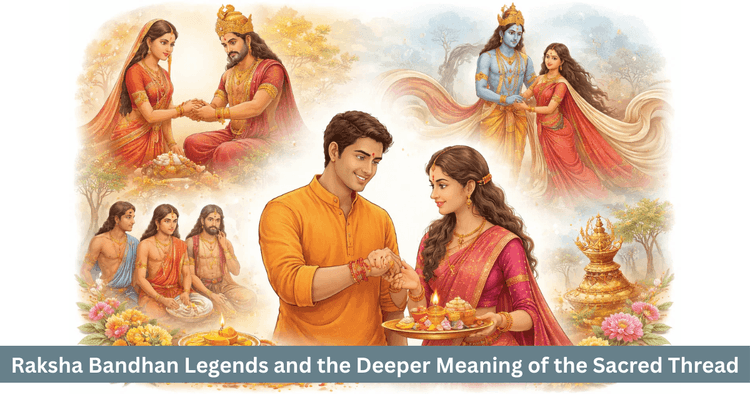
Table of Contents
Raksha Bandhan is not just the name of a festival. It is regarded as a celebration of the sacred vow of love, protection and trust between brothers and sisters. On this day the thread tied by the sister on the brother’s wrist is called Raksha Bandhan in Sanskrit, which literally means the knot of protection.
With time the scope of Raksha Bandhan has expanded beyond blood relations. In many places it has become a festival that rises above boundaries of religion, caste and community. It honours every form of pure affection, where any woman who is like a sister may tie a rakhi on the wrist of a trusted protector.
What Does the Ritual of Tying Rakhi Signify
In the main ritual of Raksha Bandhan the sister or a sister like woman ties a colourful, often ornate, thread on the brother’s wrist. This thread is not mere decoration. It is a symbol of prayer and blessing. Within her heart the sister takes a vow for the well being, long life and safety of her brother.
After the rakhi is tied, the brother offers gifts, blessings and a promise of protection to his sister. The ritual indicates that relationships are strengthened not only by words but also by visible symbols and inner resolve. The protective thread works like an invisible circle of safety around both hearts.
| Raksha Bandhan practice | Inner meaning |
|---|---|
| Rakhi or protective thread | Bond of safety, blessing and faith |
| Tilak, aarti and sweets | Prayer for auspiciousness and gentle conduct |
| Brother’s gift | Gratitude, love and acceptance of responsibility |
Where Do the Earliest Mentions of Raksha Bandhan Appear
References to Raksha Bandhan go back to ancient times. Some popular legends link it as far back as the days of Alexander, when his wife is said to have sent a protective thread to an Indian king. In Vedic traditions the practice of tying a raksha sutra is also seen, where a sacred thread was tied with mantras before sacrifices or battles.
In the scriptures of Hindu tradition similar practices appear in various forms. At times a wife ties a protective thread on her husband’s wrist. At other times the consort of a deity ties a thread to pray for his victory and safety. These episodes suggest that originally the protective thread was a symbol of general safety and auspiciousness, not limited to the bond of siblings.
Importance of the Protective Thread in the Story of Indra and Sachi
In the Bhavishya Purana there is an episode connected with Indra and his wife Sachi that reflects the spirit of Raksha Bandhan. The story tells of a fierce war between the gods and a powerful demon king. The outcome was uncertain and the gods were troubled.
At this time Sachi prepared a sacred thread charged with protective mantras. After performing bath, worship and resolve she tied this thread on Indra’s wrist. She believed that this raksha sutra would grant him strength, courage and divine protection.
The story suggests that in earlier times the protective thread was deeply connected with the safety of warriors going into battle. Women tied such threads on the wrists of their loved ones to invoke grace and victory.
Raksha Bandhan Story of Lakshmi and King Bali
The Bhagavata Purana and Vishnu Purana contain a very famous Raksha Bandhan story involving Lord Vishnu, Goddess Lakshmi and King Bali. When Vishnu appears as Vamana and asks Mahabali for three steps of land, He later measures all the worlds in those steps. Afterwards Bali requests Vishnu to stay with him and protect his realm.
Pleased with his truthfulness and generosity, Lord Vishnu agrees to dwell at the gate of his palace in the nether world. In Vaikuntha, Goddess Lakshmi is not happy that Vishnu is away from her and living in the abode of the Asura king. She decides on a gentle solution.
Lakshmi takes the form of a Brahmin woman and goes to Bali’s palace. She asks for shelter and stays there as a guest. On the full moon of Shravana she ties a rakhi on his wrist and addresses him as her brother.
Moved by her affection Bali accepts her as his sister and promises to grant whatever wish she expresses. Lakshmi then reveals her true identity and explains that she is the consort of Vishnu and wishes Him to return to Vaikuntha. Respecting the sanctity of the rakhi, Bali happily agrees and lets Vishnu go.
From this story we learn that Raksha Bandhan is grounded not only in relationships of birth but also in bonds of faith and dharma. Wherever there is trust, a vow and righteousness, the sacred relationship of brother and sister can be formed.
Ganesha, Shubh, Labh and the Story of Santoshi Maa
Folk tradition also links Raksha Bandhan with Lord Ganesha, His sons Shubh and Labh and Santoshi Maa. According to one story, on Raksha Bandhan a sister of Ganesha visits Him and ties a rakhi on His wrist.
Seeing this, Shubh and Labh are delighted by the custom but feel sad that they do not have a sister to perform the same ritual for them. They request their father to give them a sister so that they too may celebrate Raksha Bandhan.
The legend says that Ganesha granted their wish and Santoshi Maa was brought forth as their sister. She was accepted as the beloved sister of both brothers. From then on the three siblings joyfully celebrated Raksha Bandhan together each year.
In this story Raksha Bandhan is connected with contentment, family wholeness and loving relationships. The very names Shubh and Labh hint that the affection between siblings brings auspiciousness and prosperity into life.
Krishna, Draupadi and the Spirit of Raksha Bandhan
The friendship between Krishna and Draupadi also carries the feeling of Raksha Bandhan. One episode tells that Krishna once injured His finger and blood began to flow. Seeing this, Draupadi immediately tore a strip from her garment and tied it around His finger.
This small act was filled with deep care and devotion. Krishna accepted it in His heart as a bond of protection and resolved that He would guard Draupadi’s honour in every situation.
Later, during the attempt to humiliate her in the royal assembly, when Draupadi called upon Krishna with full surrender, her garments were safeguarded. The endless sari is seen as a fulfilment of that inner vow.
Some narrations also mention that before the great war, Draupadi tied a protective thread to Krishna and Kunti tied a rakhi on her grandson Abhimanyu. These references show that the protective thread can bind friends and relatives in a vow of safety and blessing.
Spiritual and Social Message of Raksha Bandhan
If all these stories are viewed together, Raksha Bandhan appears not merely as a family ritual but as a deep spiritual practice. It weaves love, sacrifice, safety, vow and trust into one thread.
The festival reminds us that relationships are formed not only by blood but also by feeling. When a rakhi is tied with sincerity, compassion and a resolve to uphold dharma, this small thread can bring profound change in the heart and in relationships.
Common Questions About Raksha Bandhan
Why is Raksha Bandhan known mainly as a festival for brothers and sisters?
Because the central ritual focuses on a sister tying rakhi on her brother’s wrist, it is widely seen as a sibling festival. Yet the stories show wives, deities and friends also tying protective threads, giving it a wider spiritual reach.
Is rakhi to be tied only to a biological brother?
There is no such restriction. Any man who sincerely plays the role of protector, guide or guardian may be accepted as a brother in dharma and honoured with a rakhi. The purity of the bond depends on intention and faith.
What is the main inner feeling behind tying the raksha sutra?
The essence is a mutual resolve for safety, honour and well being. The sister offers prayer and blessing and the brother responds with a heartfelt promise of protection and support.
What lesson comes from the story of Ganesha, Shubh, Labh and Santoshi Maa?
It shows that the bond of siblings is not only a matter of birth but also of heartfelt desire for love and completeness in the family. Where there is contentment and unity, auspiciousness and prosperity naturally grow.
How can Raksha Bandhan be made more meaningful in today’s world?
By going beyond formality and truly committing to communication, mutual respect and support in difficult times. Then Raksha Bandhan becomes not just a festival but an ongoing spiritual discipline that strengthens relationships.
Get your accurate Kundali
Generate KundaliDid you like it?
Author

Aparna Patni (63)
Experience: 20
Consults About: Family Planning, Career
Clients In: Punjab, Haryana, Delhi
Share this article with friends and family
About ZODIAQ
ZODIAQ is an online Vedic Astrology platform. It connects clients seeking astrological advice to experienced astrologers with deep knowledge. Our users also generate kundali and perform kundali milan for free. ZODIAQ also offers services to the Astrologers. Astrologers utilize various offerings by ZODIAQ to serve their clients effectively.
If you are a User
Consult with experienced astrologers and seek their guidance. You can also order handwritten Janm Patrika report with life prediction prepared by experienced astrologers. Generate accurate Kundali, perform Kundali Matching and check horoscope and muhurat. Utilize our online library for all the necessary astrological and spiritual information.
If you are an Astrologer
Create accurate kundali for your clients and perform Kundali Matching for up to 5 people at a time. Write comprehensive Janm Patrika report for your clients with ZODIAQ. Check client details anytime by saving it in client directory. Become more productive by tracking how many clients you guide every day.
WELCOME TO
ZODIAQ
Right Decisions at the right time with ZODIAQ
