Raksha Bandhan Stories and the Sacred Bond of Protection
By Pt. Suvrat Sharma
Tradition of Affection, Protection, and Trust Between Siblings
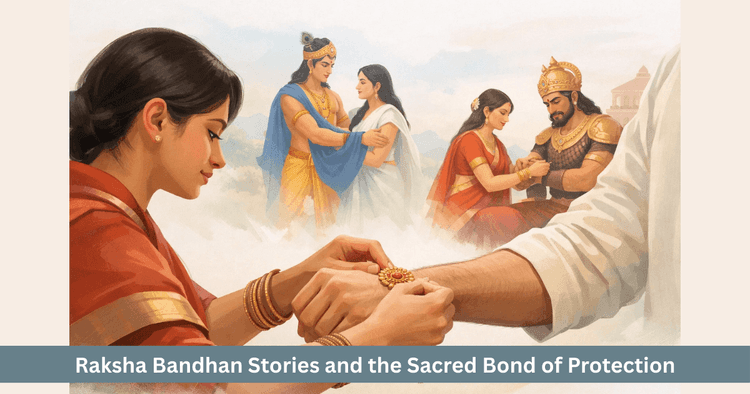
Table of Contents
Raksha Bandhan is not limited to tying a thread and exchanging gifts. It is a festival that renews the vow of affection, protection and trust between brothers and sisters. On this day the simple thread tied by the sister becomes a blessing and a promise of protection which both agree to honour throughout life.
The roots of Raksha Bandhan are very deep. Its stories are spread across Puranas, history and folk traditions. In one story Goddess Lakshmi ties a protective thread on the wrist of a mighty Asura king and accepts him as brother. In another, the memory of a small strip of cloth becomes the basis of Krishna’s unshaken pledge to protect Draupadi. By understanding these narratives, the spiritual and emotional meaning of Raksha Bandhan becomes clearer.
Why Is the Story of King Bali and Goddess Lakshmi Linked to Raksha Bandhan
One of the most famous stories of Raksha Bandhan is connected with the Asura king Mahabali, also known as King Bali. He is the same Mahabali whose story is told in the Vamana Avatar. When Lord Vishnu in the form of Vamana takes three steps of land from him and thereby measures all the worlds, Mahabali is later sent to the nether realms. From here the Raksha Bandhan connection begins.
Lord Vishnu becomes so pleased with Bali’s truthfulness, generosity and devotion that at his request He agrees to stay in the nether world as his guardian at the gate. When Goddess Lakshmi in Vaikuntha comes to know that Lord Vishnu is staying away from His abode she becomes concerned. She decides upon a divine plan to bring her Lord back.
How Did Goddess Lakshmi Accept King Bali as Brother
The story narrates that Goddess Lakshmi took the form of a Brahmin woman and went to the palace of King Bali. She asked for shelter there and stayed in his house as a guest for some time. King Bali treated her with great honour and respect.
On the full moon of the month of Shravana the disguised Goddess took a protective thread and tied it on the wrist of Bali. She told him that this was a sacred bond of brother and sister, a thread of protection. Bali became moved and accepted her as his sister. He promised that he would fulfil any wish that she expressed.
At that moment Goddess Lakshmi revealed her true form and spoke about her relationship with Lord Vishnu. She requested Bali to allow Vishnu to return to Vaikuntha. Respecting the sanctity of the rakhi as a brother he agreed and gave the Lord permission to leave.
In this story Raksha Bandhan is not limited to relationships of birth. It shows that on the basis of dharma, faith and vow, the bond of brother and sister can be formed. The rakhi of Goddess Lakshmi reminds that the protective thread is not merely cotton, it is a subtle spiritual commitment.
| Character | Role in Raksha Bandhan theme |
|---|---|
| King Bali | Symbol of a generous and promise keeping brother |
| Goddess Lakshmi | Sister who creates the bond with Rakhi |
| Lord Vishnu | Balance between vow and devotion |
Krishna and Draupadi and the Inner Feeling of Rakhi
Another very touching Raksha Bandhan narrative is related to Shri Krishna and Draupadi. In the Mahabharata it is described that on one occasion blood started flowing from Krishna’s hand. Some texts connect it to the incident of Shishupala’s killing, others to a different event but the central feeling is that His hand was wounded and blood began to drip.
Draupadi, who stood nearby, saw this and her heart was filled with compassion. She immediately tore a piece from her sari and tied it as a bandage on Krishna’s hand so that the bleeding would stop. She used no formal ritual or decorated plate. Her feeling was pure and selfless.
Krishna accepted this gesture of care as a deep vow of protection. Within His heart He decided that when the time came He would stand by Draupadi in every way and protect her honour.
Protection of Draupadi’s Honour and Fulfilment of the Vow
Everyone knows the episode of Draupadi’s humiliation in the royal court. When she was dragged into the assembly and her garments were pulled, she called upon Krishna. Letting go of all other means she surrendered with complete faith and chanted His name.
The story describes that at that moment her sari became unending. However much it was pulled, it continued to lengthen. This event is seen as the fruit of that small strip of cloth and of Krishna’s inner promise to protect her always.
From this story the message is that Raksha Bandhan is not just a ritual tied with a thread. It is a pledge that must be honoured when the moment of test arrives. Here the love of the sister and the protection of the brother are both treated as sacred.
Historical Rakhi of Rani Karnavati and Emperor Humayun
Apart from the stories of the epics, a significant historical event is often remembered in connection with Raksha Bandhan. This is the story of the queen of Mewar, Rani Karnavati and the Mughal emperor Humayun.
It is said that when Bahadur Shah, the Sultan of Gujarat, prepared to attack Mewar, Rani Karnavati became anxious for the safety of her kingdom and people. At that time she had no direct family relationship with Emperor Humayun. Yet she sent him a rakhi along with a message appealing to him as a brother for aid and protection.
Humayun accepted this rakhi with respect and took it as the affection of a sister. He immediately gathered his forces and set out to help Mewar. Although he could not completely change the course of the war in time, his effort and his regard for the rakhi became a historical example of the dignity of Raksha Bandhan.
From this incident it becomes clear that rakhi is not confined within households. It can act as a thread of trust, protection and respect between different rulers, regions and communities.
Why Is the Story of Yamuna and Yama Important
An old legend speaks of Yama, the god of death and his sister Yamuna. Yamuna loved her brother deeply and wished that he would come to her house and spend time with her.
It is said that Yama remained busy in his duties for a long time and could not visit. At last one day he went to meet his sister. Yamuna welcomed him lovingly, offered a bath, food and hospitality and tied a protective thread on his wrist.
Pleased with her affection and devoted service, Yama asked her to request a boon. Yamuna prayed that on this day any sister who ties a rakhi on the wrist of her brother and both promise mutual protection should be blessed with long life and auspiciousness.
Yama accepted this and blessed that those who observe Raksha Bandhan with such faith would receive subtle protection and long life. In this way the festival is connected with the idea of longevity and safety.
Santoshi Maa and the Defeat of Shumbha and Nishumbha
Another folk narrative links Raksha Bandhan with Santoshi Maa. It tells of two Asura brothers, Shumbha and Nishumbha, who began to spread terror across the earth. The gods, unable to overcome them, turned to the divine feminine power for help.
In one form of the story the same divine power is honoured as Santoshi Maa. It is said that she tied a sacred thread on her own wrist, took a vow to destroy these forces of adharma and then went forth to battle.
Through her divine strength the tyranny of Shumbha and Nishumbha ended and peace and contentment returned to the world. The story symbolically teaches that rakhi is not limited to human brothers and sisters. It can also represent a vow taken by divine power to protect dharma.
History and Rituals of Raksha Bandhan
The practice of tying a protective thread existed in Vedic times, when priests used to tie such threads during sacrifices and important rituals, accompanied by mantras for protection and success. Before undertaking journeys or major tasks people often sought such a blessing.
With time this thread became closely associated with the relationship between brother and sister. Today on Raksha Bandhan sisters tie rakhi on the wrist of their brothers, apply a tilak, perform aarti and offer sweets. In return the brother accepts the responsibility to protect the dignity, safety and well being of his sister in every circumstance.
| Raksha Bandhan custom | Inner meaning |
|---|---|
| Tying of rakhi | Promise of safety, trust and love |
| Tilak and aarti | Prayer for auspiciousness and long life |
| Giving gifts | Gratitude, affection and acceptance of responsibility |
Wider Message of Raksha Bandhan in Modern Times
In the present era Raksha Bandhan is no longer restricted to biological siblings. In many places it has become a symbol of social harmony and mutual protection. Girls and women sometimes tie rakhi to cousins, relatives, mentors or trusted friends, accepting them as brothers in dharma.
All these stories make it clear that the essence of Raksha Bandhan is love, trust, protection and selflessness. Whether it is the emotional bond of Lakshmi and Bali, the vow of Krishna to Draupadi or the historical gesture of Rani Karnavati and Humayun, in every episode the rakhi appears as a witness of dharma and of promise.
Common Questions Related to Raksha Bandhan and These Stories
Why does the sister tie rakhi on Raksha Bandhan?
Tying rakhi is a way for the sister to bind her love and good wishes into a visible thread. Along with it she prays that her brother’s life may remain safe, successful and blessed.
Is rakhi meant only for real brothers?
There is no such limitation. Many sisters tie rakhi to cousins, to elders whom they respect or to a trustworthy protector and accept them as brothers in dharma. The foundation is faith and feeling more than blood.
How is the story of Krishna and Draupadi related to Raksha Bandhan?
The act of Draupadi tying a strip of cloth to Krishna’s bleeding hand is taken as the essence of rakhi. Krishna accepted it as a bond of protection and later safeguarded her honour in the royal court.
What is the message of the Yama and Yamuna legend?
This legend connects Raksha Bandhan with long life and good fortune. According to it, those who tie rakhi with sincerity and vow to protect each other receive subtle blessings of safety and longevity.
How can Raksha Bandhan become more meaningful today?
By going beyond formality and truly committing to respect, support and stand by each other in difficult times. Then Raksha Bandhan becomes not only a festival but also a spiritual practice of strengthening relationships.
Get your accurate Kundali
Generate KundaliDid you like it?
Author
Pt. Suvrat Sharma (63)
Experience: 20
Consults About: Family Planning, Career
Clients In: Punjab, Haryana, Delhi
Share this article with friends and family
About ZODIAQ
ZODIAQ is an online Vedic Astrology platform. It connects clients seeking astrological advice to experienced astrologers with deep knowledge. Our users also generate kundali and perform kundali milan for free. ZODIAQ also offers services to the Astrologers. Astrologers utilize various offerings by ZODIAQ to serve their clients effectively.
If you are a User
Consult with experienced astrologers and seek their guidance. You can also order handwritten Janm Patrika report with life prediction prepared by experienced astrologers. Generate accurate Kundali, perform Kundali Matching and check horoscope and muhurat. Utilize our online library for all the necessary astrological and spiritual information.
If you are an Astrologer
Create accurate kundali for your clients and perform Kundali Matching for up to 5 people at a time. Write comprehensive Janm Patrika report for your clients with ZODIAQ. Check client details anytime by saving it in client directory. Become more productive by tracking how many clients you guide every day.
WELCOME TO
ZODIAQ
Right Decisions at the right time with ZODIAQ
