Ramanathaswamy Temple: The Jyotirlinga Established By Rama And The Bridge Between Devotion And Dharma
By Pt. Nilesh Sharma
Divine Site of Shiva and Rama Amidst the Seas of Rameswaram
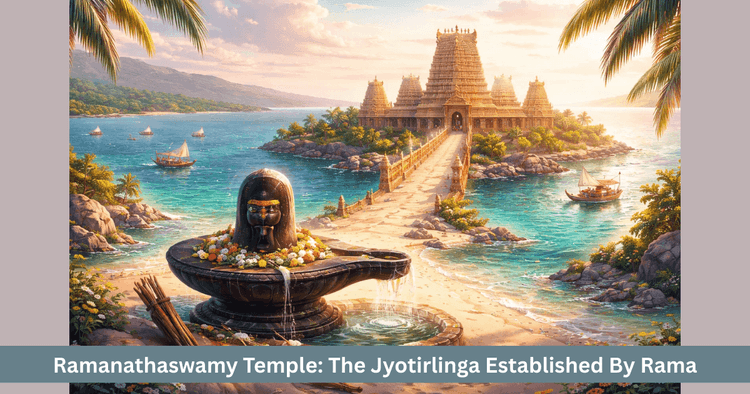
Table of Contents
On the island of Rameswaram in Tamil Nadu, the Ramanathaswamy Temple holds a special place among the twelve Jyotirlingas. Surrounded by the waters of the Bay of Bengal and the Indian Ocean, the Rameswaram Jyotirlinga awakens both humility and depth in the mind of a seeker. On this island the land seems to gradually merge into the vast sea, as if the ego itself is dissolving into the refuge of the Divine. This is why Rameswaram is regarded not only as a shrine of Shiva but as a meeting place of Shri Rama, Shiva and Dharma.
The most distinctive feature of Ramanathaswamy Temple is that the Jyotirlinga established here is traditionally understood to have been worshipped and sanctified by Lord Rama himself. Unlike shrines such as Dwarka, Kashi or Ujjain, Rameswaram stands on an island near the sea where a pilgrim truly feels as if life has reached a kind of outer edge and the soul is quietly questioning itself. As soon as a seeker steps into this pilgrimage two currents arise together. One is the memory of the epic Ramayana and the other is fresh awareness about present responsibilities in life.
Special Character Of Rameswaram Jyotirlinga And The Sacred Island
The island of Rameswaram in the southern part of India is the place from which the journey to Lanka, the building of the bridge and the return of Shri Rama are remembered. On this same island stands the Ramanathaswamy Temple known as Rameswaram Jyotirlinga. This shrine is regarded as an important part of the Char Dham pilgrimage along with Dwarka, Badrinath and Jagannath Puri. A seeker who comes here does not arrive merely for darshan. The atmosphere itself gently encourages deeper reflection on karma, dharma and personal choices.
The geographical setting of this sea bound island leads the seeker into a form of threshold awareness. On one side there is the wide expanse of water. On the other there are lofty gopurams, long corridors and a quiet sanctum that all convey the sense that even amid the changing world there is a stable center. This stable center appears in the form of Ramanathaswamy and nurtures a feeling of inner trust.
Deep Connection Between Shri Rama And Rameswaram Jyotirlinga
To understand the glory of Ramanathaswamy Temple it is important to recall the Ramayana episode linked with it. According to the story, when Shri Rama killed Ravana in Lanka, what ended was not only a war. A profound ethical challenge also stood before him. Ravana belonged to a Brahmin lineage and was a king. Although his death occurred in the defence of Dharma, Shri Rama did not see it as victory alone. He felt that for the act of killing a Brahmin king some form of atonement was necessary.
On the advice of sages and learned seers Shri Rama decided that before returning to Ayodhya he would worship Lord Shiva at Rameswaram and pray for release from the burden of this karma. In this decision a subtle message is hidden. Shri Rama, who is regarded as an incarnation of Vishnu, takes shelter in Shiva with humility. This shows that there is no rivalry among the deities. Rather there is mutual respect and balance. Even when one walks on the path of Dharma and is required to take difficult decisions, there remains a need for humility and repentance afterwards.
Sand Lingam Created By Sita And The Meaning Of The Name Ramanathaswamy
The story narrates that Shri Rama made a firm resolve to perform worship of Shiva at Rameswaram. For this purpose Hanuman was sent to Mount Kailasa to bring a sacred Shiva linga. Hanuman is famous for speed and power, yet in this instance the time of the ritual was very important. In order that the worship should not be delayed Mata Sita created a linga of sand with her own hands from the seashore. This sand linga became the focus of worship at the appointed time.
When Hanuman returned, the linga brought from Kailasa was also regarded as very sacred. However Shri Rama first worshipped the sand linga that Sita had shaped with effort and devotion. Afterwards the linga brought by Hanuman was also installed. The Shiva linga that received worship from Shri Rama as an act of spiritual atonement and confirmation of Dharma later became renowned as Ramanathaswamy Jyotirlinga. The name Ramanathaswamy means the Lord of Rama, the deity worshipped by Rama.
This episode conveys that devotion does not depend only on external means or on the idea of directly obtaining a divine object from a distant abode. It also depends on respect for time, the resources available in the moment and the faith of those who stand nearby. The sand linga created by Sita shows that whatever the circumstances may be, if there is humility and resolve in the heart, a seeker can complete worship using what is immediately present.
Architectural Grandeur Of Ramanathaswamy Temple And The Secret Of Sacred Wells
The architecture of Ramanathaswamy Temple is regarded as truly remarkable. Its most famous feature is the long pillared corridor which is counted among the longest temple corridors in the world. The regularly spaced pillars, the carved art on them, the images on the walls and the apparently endless passage create the feeling that one is walking through a symbolic journey of life itself. Light and shadow alternate at every turn, reminding the mind of the interplay between an unstable world and the stable presence of the Divine.
Within the temple complex there are twenty two sacred wells called theerthams. Traditionally pilgrims bathe or sprinkle water from these wells before entering the sanctum. Each well is associated in belief with a particular purifying quality. The water of one is linked with calming mental agitation, another with washing away sins and another with fulfilling vows made for the upliftment of ancestors.
The presence of these sacred wells helps the seeker sense that just as the waters of different theerthams are distinct yet finally serve purification, so too the varied experiences, people and situations of life become opportunities for inner maturity. To bathe in the waters of these wells and then walk into the sanctum symbolises the intention to stand before Shiva cleansed both outwardly and inwardly.
Spiritual And Astrological Importance Of Rameswaram Jyotirlinga
Rameswaram Jyotirlinga is considered especially helpful for seekers who are carrying heavy karmic results, ancestral difficulties and deep psychological burdens. In the Ramayana story Shri Rama himself performed worship here as an act of atonement after killing Ravana. This indicates that the practice at this shrine is closely related with purification of karma and inner cleansing.
From an astrological viewpoint many teachers link Rameswaram with the balancing of combinations connected with Surya and Mangala, that is the Sun and Mars. The Sun reflects self confidence, honour and life force. Mars represents courage, capacity for action and the fire of effort. When these energies are disturbed a person may become overly aggressive, excessively withdrawn, burdened by guilt or filled with pride. The worship of Ramanathaswamy can support the seeker in learning to live both strength and Dharma in a balanced form.
Those who seek forgiveness, self release from the past, freedom from long held remorse or a way to honour ancestors in a sincere manner often find it meaningful to undertake a pilgrimage to Rameswaram. At this shrine practices such as abhishek, chanting of Rudra mantras, offerings for ancestors and worship with Ganga water are common. Tradition holds that Shri Rama desired to worship with water from the Ganga, so even today many devotees bring this water from the north and use it during abhishek at Ramanathaswamy.
Some of the key spiritual indicators associated with Rameswaram Jyotirlinga can be viewed in this table.
| Aspect | Indication |
|---|---|
| Detail | Rameswaram Jyotirlinga, Ramanathaswamy Temple, Rameswaram Island |
| Core themes | Atonement, inner purification, balance of Dharma and strength |
| Astrological tone | Imbalance involving Sun and Mars, weight of karmic results |
| Suggested practice | Abhishek, Rudra chanting, rituals for ancestors, worship with Ganga water |
| Inner objective | Forgiveness, humility, courage and stability on the path of Dharma |
Is Rameswaram A Symbol Of Balance Between Divine Forces
A very significant message of Rameswaram is that it shows Shiva and Vishnu not as rivals but as complementary expressions of the Divine. The Ramayana narrative makes it clear that Shri Rama, recognised as an incarnation of Vishnu, worships Shiva with humility. This indicates that different forms of divinity do not work against one another. They operate as allies and supports in the unfolding of Dharma.
This perspective nurtures balance in the mind of a seeker. When a person follows a spiritual path, there can sometimes arise a tendency to regard one’s own view or chosen deity as superior and to become harsh toward other paths. The story of Rameswaram teaches that authentic Dharma is not about elevating oneself and belittling others. It is about working for truth, justice and compassion with humility and effort. The worship of Shiva by Shri Rama shows that strength, policy and humility together make Dharma alive.
Corridors, Seashore And The Memory Of The Bridge At Ramanathaswamy Temple
When a seeker walks through the long circumambulatory corridors of the temple, the journey does not feel like a mere passage between stone pillars. It feels like moving through layers of personal thoughts, memories and decisions. As the inner journey proceeds there comes a realisation that many turning points have appeared in life, yet in the end everything seeks rest only in the shelter of the Divine.
The seashore near the temple is also associated with the memory of the bridge to Lanka described in the Ramayana. Whatever the historical details may be, for a seeker this place evokes the image of an inner bridge. On one side stands human effort. On the other is the support of the Divine. Real progress and peace become possible only when there is balance between these two.
Festivals And Living Tradition At Rameswaram
At Ramanathaswamy Temple Maha Shivratri is observed with deep devotion. Throughout the day and night there are Rudrabhisheka rituals, chanting of Shiva’s name and special forms of worship. Devotees keep fast, remain awake and engage in meditation with the intention of recognising inner darkness and praying that it may be removed through the grace of Shiva.
Rameswaram is also an integral part of the Char Dham yatra. Many seekers who travel from north to south include Badrinath, Dwarka and Jagannath Puri along with Rameswaram in their journey. In this way a beautiful harmony becomes visible. North and south, Vaishnava and Shaiva traditions, the banks of the Ganga and the shores of the sea all appear to join in one continuous spiritual stream.
Inner Guidance From Rameswaram Jyotirlinga
Rameswaram Jyotirlinga teaches that humility gives true meaning to strength. In the life of Shri Rama there is courage, adherence to principles, discipline and Dharma. Yet after the killing of Ravana he does not hesitate to acknowledge that without atonement and worship of Shiva the work would remain incomplete. From this it becomes clear that the higher one rises, the more humility is required.
This shrine invites the seeker to reflect in a similar way. Just as Shri Rama accepted responsibility for his actions and chose to worship at Rameswaram, every person is called upon to look honestly at decisions and deeds. If there is a sense of guilt, bitterness or incompleteness within, one can sit before Ramanathaswamy and pray for forgiveness, self acceptance and a fresh beginning.
The waves of the sea, the sound of temple bells and the footsteps of pilgrims in the corridors together suggest that rises and falls will continue in life. However if the thread of Dharma, devotion and humility remains unbroken, every wave ultimately carries the seeker closer to the Divine. Rameswaram Jyotirlinga stands as a living center of this understanding.
Frequently Asked Questions
Question 1. Where is Ramanathaswamy Temple located and why is it called Rameswaram Jyotirlinga
Ramanathaswamy Temple is located on Rameswaram Island in Tamil Nadu and is called Rameswaram Jyotirlinga because tradition holds that the Shiva linga here was worshipped by Shri Rama. The shrine is therefore known as the abode of the Lord of Rama.
Question 2. Why did Shri Rama worship Shiva at Rameswaram
Ravana was a king from a Brahmin lineage. After killing him, Shri Rama did not see it as mere victory but as a serious karmic responsibility. On the advice of sages he decided to worship Shiva at Rameswaram as an act of atonement and expressed his humility toward Dharma through this worship.
Question 3. What is the significance of the sand linga created by Sita
When Hanuman was delayed in returning with a linga from Kailasa, Sita fashioned a Shiva linga from sand on the seashore so that worship could begin on time. Shri Rama first worshipped this linga, showing that in devotion the available means, respect for time and inner faith are more important than outward splendour.
Question 4. For what kinds of situations is Rameswaram Jyotirlinga considered helpful from an astrological perspective
Rameswaram Jyotirlinga is considered especially helpful for those who struggle with imbalances involving the Sun and Mars, heavy karmic results, ancestral disturbances, guilt or long standing memories of past actions. The practice here can guide them toward purification, courage and more balanced decisions.
Question 5. What practical lesson can a seeker learn from a pilgrimage to Rameswaram
A pilgrimage to Rameswaram can teach that as strength and success increase, humility, repentance and reverence for the Divine must also deepen. Accepting responsibility for one’s actions and walking forward with inner cleansing becomes the true bridge between Dharma and devotion.
Get your accurate Kundali
Generate KundaliDid you like it?
Author

Pt. Nilesh Sharma (63)
Experience: 20
Consults About: Family Planning, Career
Clients In: Punjab, Haryana, Delhi
Share this article with friends and family
About ZODIAQ
ZODIAQ is an online Vedic Astrology platform. It connects clients seeking astrological advice to experienced astrologers with deep knowledge. Our users also generate kundali and perform kundali milan for free. ZODIAQ also offers services to the Astrologers. Astrologers utilize various offerings by ZODIAQ to serve their clients effectively.
If you are a User
Consult with experienced astrologers and seek their guidance. You can also order handwritten Janm Patrika report with life prediction prepared by experienced astrologers. Generate accurate Kundali, perform Kundali Matching and check horoscope and muhurat. Utilize our online library for all the necessary astrological and spiritual information.
If you are an Astrologer
Create accurate kundali for your clients and perform Kundali Matching for up to 5 people at a time. Write comprehensive Janm Patrika report for your clients with ZODIAQ. Check client details anytime by saving it in client directory. Become more productive by tracking how many clients you guide every day.
WELCOME TO
ZODIAQ
Right Decisions at the right time with ZODIAQ
