Story and Inner Meaning of Ratha Yatra
By Pt. Narendra Sharma
Experience of Lord Jagannath’s Darshan and Devotion
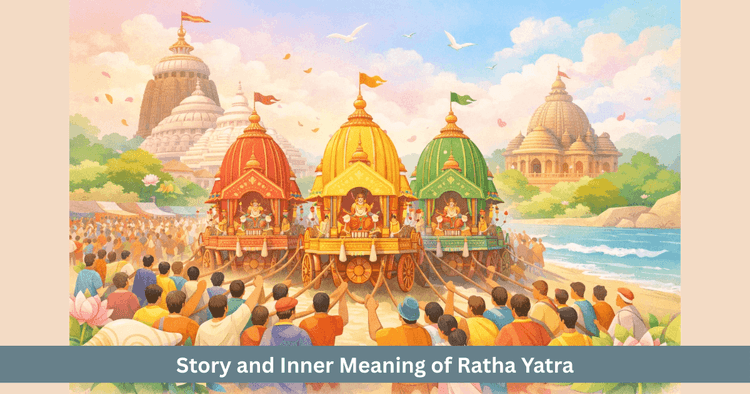
Table of Contents
Ratha Yatra is not seen merely as a festival of grandeur. It is loved as a living experience of the Lord coming out into the midst of His devotees. On this day Lord Jagannath leaves His high shrine and rides the chariot like a compassionate king who wishes to walk among his people. The majesty of the chariots, the joy of the devotees and the sound of kirtana together create an atmosphere where devotion becomes tangible.
According to sacred tradition, Lord Jagannath travels from His Sri Mandira in Puri, also called Niladri, to His garden temple known as Gundicha Mandir. This temple is situated about two miles to the north east of the main Jagannath Temple at Sundarachala. Because of this, the people of Odisha often refer to this festival affectionately as Gundicha Yatra. Ratha Yatra is observed on the second day of the bright fortnight of Ashadha, when the Lord gives special darshana seated on His grand chariot.
What does the Ratha Yatra story teach
Behind Ratha Yatra there is much more than a grand procession. There is a deep spiritual emotion that flows through the entire festival.
One traditional description connects Ratha Yatra with the pastimes of Lord Krishna. When Krishna left Vrindavana and went first to Mathura and then to Dvaraka, the gopis of Vrindavana, especially Radharani, were plunged into separation. They did not go with Him because they did not enjoy the royal opulence and formality of Dvaraka. Their hearts belonged to the simple groves of Vrindavana, where they had lived with Him as Shyamasundara in intimate joy.
It is said that during a solar eclipse, a great sacrifice was held at Kurukshetra. Krishna, Balarama and Subhadra came there from Dvaraka. The gopis of Vrindavana, led by Radharani, also reached Kurukshetra and met Krishna again. They expressed a strong wish to take Him back to Vrindavana. In their inner mood, they wanted to draw Krishna away from royal chariots and weapons, back to the forest paths and flute songs of Vrindavana.
Symbolically it is described that the gopis tried to pull the chariot of Krishna, Balarama and Subhadra towards Vrindavana. Ratha Yatra is said to reflect this very mood, where devotees pull the Lord’s chariot as if they are drawing Him back into the Vrindavana of the heart. In this understanding, Gundicha Temple represents Vrindavana and Sri Mandira indicates Niladri or the royal abode.
The thousands of devotees who pull the chariots, the waves of Harinama sankirtana, the sound of conches and mridangas and the dancing groups of musicians and dancers in front of the chariots, all express one simple desire. They want to bring the Lord from the position of distant majesty into the centre of their own lives.
Journey from Sri Mandira to Gundicha Temple
During Ratha Yatra, Lord Jagannath travels with His brother Baladeva and sister Subhadra from Sri Mandira to Gundicha Temple. Every step of this journey is honoured as part of a sacred drama.
- Lord Jagannath’s main residence is His Sri Mandira at Puri, where He stays throughout the year.
- On the day of Ratha Yatra, three grand chariots are brought to the main road. The chariot of Baladeva is known as Taladhvaja, the chariot of Subhadra is her own special ratha and the chariot of Jagannath is called Nandighosha.
- Thousands of devotees hold the ropes of these chariots and pull them with deep love towards Gundicha Temple. Musicians, singers and dancers move in front of the chariots, offering kirtana and dance for the pleasure of the Lord.
Along the way many preparations of food are cooked and offered to the Lord. Later this sanctified food is distributed as prasada to the devotees and general public. When the chariots finally reach Gundicha Temple, the Lord enters and stays there for some days, filling that temple with a special sweetness of presence.
Snana Yatra, anavasara and the pastime of youthful form
About fifteen days before Ratha Yatra, the bathing festival known as Snana Yatra is celebrated on the full moon of Jyeshtha, called Jyeshtha Purnima.
- On this day the Deities of Jagannath, Baladeva, Subhadra, Sudarshana and Madana Mohana (the utsava vigraha) are brought to the snana vedi, the bathing platform.
- One hundred and eight pots of sanctified water are drawn from a sacred well situated on the northern side of the temple and used to bathe the Deities.
- After this elaborate bathing, it is said that Lord Jagannath appears to become unwell and retires to His private chamber for rest.
For about fifteen days, the Lord does not give public darshana. This period is called anavasara, which means that the Lord is not available to the outside public. During this time, special work is carried out on the body of the Deities. This is known as nava yauvana, the renewal of the youthful form of Jagannath. When this is completed, the Lord appears again in His ever youthful form on the day of Ratha Yatra, ready to bless the devotees.
Pahandi Vijaya, Gajapati king’s service and the glory of the chariots
When the anavasara period is over, the Lord comes out from seclusion to mount His chariot. This ceremonial procession is known as Pahandi Vijaya.
- During Pahandi, the Deities of Jagannath, Baladeva and Subhadra are carried in a swaying movement on the shoulders of the servitors. The sound of drums, conches and the cries of “Jai Jagannath” fill the air as they are brought from the temple to the chariots.
- After the Deities are placed on their chariots, a very touching tradition is observed. The Gajapati king of Odisha personally comes and performs a service in front of the Lord.
- Holding a gold handled broom, he gently sweeps the road in front of Jagannath’s chariot and sprinkles scented water and sandalwood paste upon the ground, showing that even a king becomes a servant in front of the Lord.
This tradition is connected with the time of Sri Chaitanya Mahaprabhu and Maharaja Prataparudra. It is said that the king pleased Chaitanya Mahaprabhu by accepting this humble service to Lord Jagannath. The descendants of Maharaja Prataparudra continue this service even today. Before the start of Ratha Yatra the king still comes, takes the gold handled broom and sweeps in front of the Nandighosha chariot.
Devotees perform grand sankirtana in front of the chariots. The chariot of Baladeva, Taladhvaja, moves first, followed by the ratha of Subhadra Devi. Finally the Nandighosha chariot of Lord Jagannath moves behind them. Many varieties of food are cooked and offered to the Lord and later distributed widely as prasada. Step by step the Lord proceeds until He reaches Gundicha Temple, where He stays for about one week.
Lakshmi Devi’s loving anger and Ratha bhanga
When Lord Jagannath leaves Sri Mandira with His brother and sister, the temple of Puri appears almost empty without Him.
- After some days have passed, on the fifth day, Goddess Lakshmi begins to feel concern that her Lord has not returned.
- She travels with her attendants from Sri Mandira to Gundicha Mandir and asks Lord Jagannath to return to His original abode.
- The Lord agrees and gives her an ajya mala, a garland of consent, as a sign that He will indeed come back.
however to express her deep mood of divine anger, Lakshmi Devi orders her maidservants to damage the Nandighosha ratha. This act is known as Ratha bhanga, the breaking or striking of the chariot. Afterwards, fearing the outcome of her strong action, she hides behind a tamarind tree outside Gundicha Temple and then slips away through another lane, returning quietly to her home shrine at Sri Mandira.
Through this playful exchange, the scriptures show that in divine relationships there is space not only for reverence but also for love, longing, complaint and reconciliation. Lakshmi’s journey, her anger and her return all deepen the sweetness of the Lord’s pastimes.
Inner teachings of Ratha Yatra
The tradition of Ratha Yatra carries several gentle lessons for spiritual life.
- When the Lord comes out of His temple and rides the chariot, it shows that divinity does not remain confined to a sanctum. The Lord wishes to meet people in the open streets of their lives.
- The act of pulling the chariot teaches that if one wants God to stand at the centre of life, some effort must come from the devotee’s side as well. Just as many hands pull the ropes together in one direction, life moves towards God when thoughts, words and actions all aim at Him.
- The sequence of Snana Yatra, anavasara and nava yauvana reminds that renewal is often preceded by withdrawal and quiet repair. Sometimes it is necessary to step back, heal and then return with fresh strength.
Ratha Yatra also teaches humility. The Gajapati king sweeping the road, the gopis longing to pull Krishna back to Vrindavana and Lakshmi Devi’s intense love all show that in front of the Lord, status and pride have no real value. What remains is only the sincerity of the heart.
Common questions about Ratha Yatra
Is it necessary for every devotee to pull the chariot during Ratha Yatra?
Pulling the chariot is considered highly meritorious, yet it is not possible for everyone. Those who cannot pull the ropes can still participate through kirtana, darshana, service or simply remembering the Lord with faith.
Which names or mantras are especially suitable to chant on Ratha Yatra day?
Chanting Harinama, especially the Hare Krishna Mahamantra and simple invocations such as “Jai Jagannath” are considered very auspicious. The most important element is heartfelt remembrance of Lord Jagannath.
Does Ratha Yatra have value only in Jagannath Puri?
The original and most ancient Ratha Yatra is in Puri, yet wherever Lord Jagannath’s chariot is taken out with devotion, the observance carries spiritual value. The essence lies in genuine honour and worship of the Lord.
Are Snana Yatra and anavasara observed in the same way everywhere?
Their full and detailed form is seen most prominently in Puri. In other temples the festivals may follow simpler forms but the core ideas of special bathing, temporary withdrawal and renewed darshana are respected in many places.
What kind of personal resolve is helpful to take on Ratha Yatra?
It is beneficial to resolve that the chariot of one’s own life will be drawn away from distractions and towards devotion, that anger, pride and negligence will be reduced and that remembrance, service and humility will be increased step by step.
Get your accurate Kundali
Generate KundaliDid you like it?
Author
Pt. Narendra Sharma (63)
Experience: 20
Consults About: Family Planning, Career
Clients In: Punjab, Haryana, Delhi
Share this article with friends and family
About ZODIAQ
ZODIAQ is an online Vedic Astrology platform. It connects clients seeking astrological advice to experienced astrologers with deep knowledge. Our users also generate kundali and perform kundali milan for free. ZODIAQ also offers services to the Astrologers. Astrologers utilize various offerings by ZODIAQ to serve their clients effectively.
If you are a User
Consult with experienced astrologers and seek their guidance. You can also order handwritten Janm Patrika report with life prediction prepared by experienced astrologers. Generate accurate Kundali, perform Kundali Matching and check horoscope and muhurat. Utilize our online library for all the necessary astrological and spiritual information.
If you are an Astrologer
Create accurate kundali for your clients and perform Kundali Matching for up to 5 people at a time. Write comprehensive Janm Patrika report for your clients with ZODIAQ. Check client details anytime by saving it in client directory. Become more productive by tracking how many clients you guide every day.
WELCOME TO
ZODIAQ
Right Decisions at the right time with ZODIAQ
