Rishi Panchami Vrat Katha and the Inner Path of Purification
By Pt. Nilesh Sharma
Rishi Panchami Vrat for Atonement and Disciplined Living
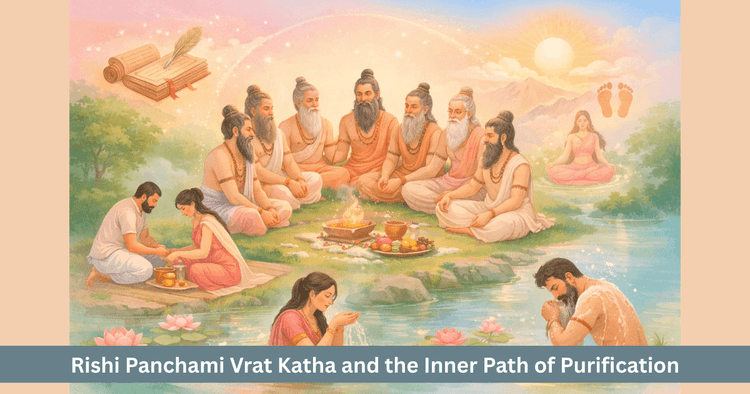
Table of Contents
Rishi Panchami, observed on the fifth lunar day of the bright fortnight of Bhadrapada, is regarded as a sacred occasion for inner purification, repentance and disciplined living. The vow is dedicated to the Saptarishis, the seven great sages who are seen as pillars of Vedic wisdom and righteous conduct. Both women and men observe this vrata with the intention of cleansing sins committed unknowingly and strengthening purity in thought and action.
Tradition holds that the Rishi Panchami vrata is especially effective as a form of atonement for mistakes that arise from ignorance of scriptural rules. It is not limited to removal of past sins. It also becomes a resolve to lead a more aware, disciplined and pure life in the future.
When and Why Is Rishi Panchami Observed
Rishi Panchami is celebrated on Bhadrapada shukla panchami. In many traditions it follows closely after Hartalika Teej and Ganesh Chaturthi and marks a time when devotees reflect upon their conduct and offer gratitude to the sages.
The vow may be undertaken by both women and men. In several regions it is particularly connected with women’s purification and atonement, yet its deeper meaning extends to anyone who seeks to refine personal conduct and remove the burden of past mistakes.
| Aspect linked to Rishi Panchami | Inner meaning and importance |
|---|---|
| Tithi | Bhadrapada bright fifth day |
| Dedicated to | The seven great sages, Saptarishis |
| Main focus | Removal of sin, repentance and inner purification |
| Eligible observers | Both women and men |
What Does the Rishi Panchami Story Describe
According to the Purana based narrative, there was once a Brahmin couple who had a daughter. She was married and lived with her husband, leading what looked like an ordinary and contented life. Outwardly everything seemed fine, yet the subtle result of past karma had not been exhausted.
One day she fell seriously ill. Her body became afflicted with worms and she began to suffer intense physical pain and distress. Her parents were deeply shaken by this unexpected suffering and could not understand why their daughter, who appeared to have done no obvious wrong, had to endure such a state.
Guidance from the Sage and Revelation of the Cause
Unable to find an explanation, the Brahmin couple approached a wise sage. They narrated their daughter’s condition and humbly requested the sage to reveal the inner cause behind her suffering. The sage entered meditation to perceive the subtle roots of the problem.
When he emerged from contemplation, he explained that in her previous birth the woman had failed to observe the rules of purity related to the rajsvla or menstrual, period. Out of ignorance she had engaged in actions that were restricted during that time, perhaps entering sacred spaces or taking part in rituals where temporary separation was required.
The sage clarified that although these acts were not done out of deliberate malice, they created a subtle impurity because scriptural guidelines were overlooked. The karmic effect of that negligence had now manifested as severe disease in this life.
How Was the Rishi Panchami Vow Prescribed as a Remedy
The sage then offered a remedy. He said that if the woman observed the Rishi Panchami vrata with sincerity on Bhadrapada shukla panchami and worshipped the Saptarishis with proper reverence, she could be freed from the sin and gradually released from the suffering.
He explained that in this vrata outer discipline, purity of body, regulated food and, above all, an inner mood of repentance are essential. It is not just a ritual performance but a conscious acknowledgment of past mistakes and an appeal for forgiveness from the sages and the Divine.
The woman accepted this guidance with humility and resolved to perform the vow as instructed.
How Did Her Repentance Transform Her Life
On the appointed day of Bhadrapada shukla panchami, she bathed in a river or sacred water body. During the bath she silently confessed her past errors and prayed for purification from both earlier and present faults. Afterwards she wore clean clothes and committed herself to a day of restraint and sattvic conduct.
At her place of worship she established symbols or images representing the Saptarishis. With devotion she offered water, flowers and akshata, performed abhisheka with panchamrita where possible and chanted prayers in their honour. Throughout the vow she maintained purity in food, speech and thought.
Because of this honest repentance and disciplined observance, her disease slowly began to recede. The worms disappeared, the pain diminished and over time she regained health and peace.
The story illustrates that even actions done in ignorance have consequences, yet their effect can be softened or removed through sincere acceptance of responsibility, holy vows and heartfelt atonement.
To Which Sages Is Rishi Panchami Dedicated
The Rishi Panchami vow is dedicated to the seven great sages known as the Saptarishis. They are regarded as foundational guides of Vedic knowledge and dharma.
| Name of Rishi | Symbolic qualities |
|---|---|
| Kashyapa | Creation, lineage and compassion |
| Atri | Austerity, insight and inner balance |
| Bharadvaja | Learning, teaching and disciplined life |
| Vishvamitra | Courage, mantra power and strong resolve |
| Gautama | Justice, truth and clarity of reason |
| Jamadagni | Renunciation, control of anger and tapas |
| Vashistha | Wise guidance, patience and the role of true guru |
By remembering and worshipping these sages on Rishi Panchami, a person does not only seek purification from past faults but also invites inspiration to improve behaviour, thought patterns and daily discipline.
Simple Method of Observing the Rishi Panchami Vow
The Rishi Panchami vow emphasises purity and sincere intent more than elaborate ritual. The following steps are commonly observed.
1. Morning bath
A bath in a river, pond or clean water is recommended. Even at home, the bather maintains a quiet mind and prays for inner and outer cleansing.
2. Clean dress and sankalpa
After bathing, one wears clean sattvic clothes and takes a sankalpa, expressing the wish for purification of sins and the blessings of the sages.
3. Worship of the Saptarishis
Symbols or images of the seven sages are placed on an altar. Water, flowers, akshata, incense and lamps are offered. Where available, abhisheka with panchamrita is also performed.
4. Listening to or reading the katha
Hearing or reciting the Rishi Panchami katha with attention is considered the very heart of the observance, as it conveys the purpose and inner meaning of the vow.
5. Sattvic food and fasting
Many devotees keep a fast that is either nirjala or limited to fruits. Others take only light sattvic food and perform parana, the breaking of the fast, on the following day.
Inner Spiritual Message of Rishi Panchami
The essential message of Rishi Panchami is awareness and purity. The vow teaches that discipline and respect for boundaries in physical, mental and social behaviour are important on the spiritual path.
When errors occur, the right response is not denial or justification but acceptance and sincere correction. The remembrance of the Saptarishis encourages a life guided by knowledge, restraint, clarity and commitment to dharma.
Rishi Panchami therefore is not just a religious custom. It is an invitation to examine one’s life, release the weight of past mistakes and move forward with a firmer resolve to live carefully, respectfully and in harmony with higher principles.
Frequently Asked Questions
Who should observe the Rishi Panchami vow?
Both women and men may observe this vow. It is particularly helpful for those who feel the need to atone for past mistakes, whether related to ritual purity or general conduct and who seek peace of mind and spiritual clarity.
Is the Rishi Panchami vrata meant only for women?
In some regional traditions it is emphasised for women as a means of atonement for lapses in menstrual purity rules. however in its broader sense the vow is dedicated to the Saptarishis and may be followed by men as well for cleansing and self refinement.
Why did the woman in the story suffer from disease?
According to the narrative, in her previous birth she had not followed scriptural guidelines during her menstrual period. Even though this was due to ignorance, the neglect created subtle sin, which manifested as serious illness in her present life.
What main practices are recommended on Rishi Panchami?
Bathing with a mood of purification, wearing clean clothes, worshipping the Saptarishis, listening to the katha, observing a sattvic diet or fast and resolving to live more carefully and respectfully in future are the key practices.
What practical lesson does Rishi Panchami give for daily life?
The vow teaches that every action carries consequences and that mindfulness is essential. When a mistake is recognised, one should admit it, seek correction and move forward with greater understanding, guided by the wisdom and discipline exemplified by the sages.
Get your accurate Kundali
Generate KundaliDid you like it?
Author

Pt. Nilesh Sharma (63)
Experience: 20
Consults About: Family Planning, Career
Clients In: Punjab, Haryana, Delhi
Share this article with friends and family
About ZODIAQ
ZODIAQ is an online Vedic Astrology platform. It connects clients seeking astrological advice to experienced astrologers with deep knowledge. Our users also generate kundali and perform kundali milan for free. ZODIAQ also offers services to the Astrologers. Astrologers utilize various offerings by ZODIAQ to serve their clients effectively.
If you are a User
Consult with experienced astrologers and seek their guidance. You can also order handwritten Janm Patrika report with life prediction prepared by experienced astrologers. Generate accurate Kundali, perform Kundali Matching and check horoscope and muhurat. Utilize our online library for all the necessary astrological and spiritual information.
If you are an Astrologer
Create accurate kundali for your clients and perform Kundali Matching for up to 5 people at a time. Write comprehensive Janm Patrika report for your clients with ZODIAQ. Check client details anytime by saving it in client directory. Become more productive by tracking how many clients you guide every day.
WELCOME TO
ZODIAQ
Right Decisions at the right time with ZODIAQ
