Live Telecast of Mahabharata: Was Sanjaya’s Divine Vision the First Remote Consciousness?
By Pt. Suvrat Sharma
Sanjaya’s Divine Sight and the Profound Interpretation of Ancient Consciousness
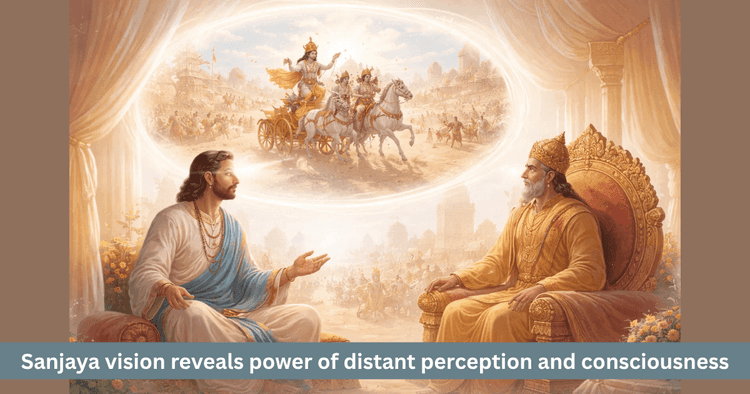
Table of Contents
The Mahabharata is not merely a tale of war. It is a text that explains the limits of the human mind, dharma, which means righteous order, decision, duty, attachment, power and consciousness. Among its many profound episodes, one especially striking and serious episode is that of Sanjaya’s Divya Drishti, which means divine sight. When the war was taking place in Kurukshetra, Dhritarashtra was seated in the palace of Hastinapura and could not see the battlefield himself. At that time Vyasa ji granted Sanjaya such a capacity that he could witness the war from afar, understand the unfolding events and narrate them immediately to Dhritarashtra.
When this episode is read today, many people feel that it resembles the world’s first form of remote vision. Although it would not be appropriate to bind it completely within the language of modern technology, it is still fair to say that the Mahabharata presented, long ago, an image of consciousness in which distance could not obstruct perception. That is why this episode continues to astonish readers and leads them to reflect on how deeply the Indian tradition understood vision, hearing, knowledge and inner consciousness.
Why was Sanjaya given Divya Drishti
Dhritarashtra was blind, though not only in the physical sense. The Mahabharata repeatedly suggests that because of attachment to his sons, he was also unable to see the truth clearly. In such a situation, the actual state of the war had to be conveyed to him by someone who was not merely a narrator but also a witness to truth. This is why Vyasa ji granted Divya Drishti, meaning divine sight, to Sanjaya.
The purpose of this divine sight was not only to see scenes. Several deeper reasons were behind it:
- So that the events of war could be described in a living and immediate manner
- So that Dhritarashtra could be made aware of the true state of the war
- So that the struggle between dharma and adharma, which means unrighteousness, could not only be told but also made experientially present
- So that a reliable witness to this great moment of history could remain preserved
- So that it could be shown that beyond ordinary eyes, a higher capacity of consciousness is possible
These points lift the episode from ordinary storytelling to a spiritual and philosophical plane.
Does Divya Drishti mean only a miracle
The most important thing here is that it would not do justice to this episode to dismiss Divya Drishti as only a miracle. In Indian texts, divine sight often means a way of seeing that can grasp truth beyond the limits of ordinary senses. It belongs to the realm of visual knowledge, and also to the realm of refined consciousness.
In the context of the Mahabharata, the dimensions of Divya Drishti may be understood in this way:
| Aspect | Meaning |
|---|---|
| Physical level | The capacity to see a distant event |
| Mental level | The capacity to understand the fear, emotion and decisions behind the scene |
| Spiritual level | Receiving knowledge beyond ordinary sensory limits |
| Narrative level | A medium through which the war reaches the listener in a vivid form |
| Philosophical level | Truth is known not only through the eyes but also through consciousness |
Therefore, when Sanjaya narrates the war, he does not appear to be merely a reporter. He seems like a witness who is also sensing the inner vibration behind what he sees.
Can this episode of the Mahabharata be called the world’s first live telecast
In popular language, many people call this episode the world’s first live telecast. This expression is attractive and it connects the modern mind very quickly, yet caution is necessary while understanding it. This episode of the Mahabharata is not an electronic broadcast in the modern sense. There is no camera, no screen and no signaling system. Yet one fact remains deeply fascinating, that the immediate observation of an event happening at a distant place, along with its simultaneous narration, lies at the heart of this episode.
If the comparison is made only at the level of feeling, then this episode reminds one of present day live coverage for these reasons:
- There was physical distance between the battlefield and the palace
- The sense of delay between event and narration was very small
- Sanjaya was functioning like a real time witness
- Dhritarashtra was not seeing the battle himself, yet he was coming to know of events immediately
- The effect of the scene was reaching the listener vividly through words
It would therefore be more balanced to say that this episode is a remarkable example of spiritual far seeing that resembles the concept of modern live coverage.
Why is the role of Vyasa ji so important
In the Mahabharata, Vyasa ji is not important only as the composer. He stands as a Drashta Rishi, which means a seer sage. Within him lies that knowledge which can see both the outer and inner sides of events. When he grants Divya Drishti to Sanjaya, he is not merely offering a boon. He is establishing that the transmission of truth becomes possible only through a worthy medium.
A few points are especially important in understanding the role of Vyasa ji:
- He knew that this war was not merely a struggle for political power
- He also knew that this moment had to remain witnessed for future generations
- Dhritarashtra had to hear the truth even if that truth was painful for him
- The choice of Sanjaya shows that worthiness is also required in order to receive sight
Here Vyasa ji appears in three forms at once, as Guru, as witness and as a bridge to truth.
Why was Sanjaya chosen
This is a very natural question. If divine sight had to be granted, why not give it to someone else. The answer lies in Sanjaya’s nature. He was close to Dhritarashtra, but unlike him he was not blinded by attachment. He was connected to the royal court, but he was not merely a servant of power. He possessed patience, discernment, the capacity to listen and clarity in narration.
The signs of Sanjaya’s worthiness may be seen in these points:
- He was trusted by Dhritarashtra
- He was not a person swept away by emotional agitation
- He could speak what he saw in a relatively balanced manner
- He had the inner steadiness to hold the grace of the Guru
- He could look at the war not only with bias but in the light of its larger meaning
That is why Sanjaya’s narration does not remain mere information. It becomes a living historical record of consciousness.
What does the dialogue between Dhritarashtra and Sanjaya teach
This dialogue is not merely an exchange between a king and his attendant. It is the dialogue of a human being who wants to know the truth and yet also wishes to avoid it. Dhritarashtra repeatedly asks about the state of the war, yet within him attachment to his sons, fear and anxiety remain just as strong. On the other side, Sanjaya sees all that cannot be concealed.
A few deeper lessons emerge from this dialogue:
- The capacity to see and the capacity to accept truth may be different
- It is not enough to possess knowledge. One also needs inner honesty
- The burden carried by one who speaks truth is extremely difficult
- It is possible to remain discerning even while standing close to power
- Divine sight does not mean that pain disappears. It means that confusion becomes less
This very depth of the Mahabharata keeps the episode relevant even today.
Was there only vision in this episode, or also feeling
While reading Sanjaya’s narration, it does not seem that he is only reporting the positions of warriors. His words carry the weight of the atmosphere, the tension of battle, the mental states of heroes and the pressure of destiny. This is why the episode is not only an example of visual transmission, but also an example of transmission of feeling.
The breadth of Divya Drishti may be understood in this form:
- Knowledge of the visible scene
- Understanding of the situation and its context
- A sense of the inner states of the characters
- Recognition of moral conflict
- An indication of the larger consequences of the event
When all five of these dimensions come together in a single act of sight, it no longer remains mere seeing. It becomes Sakshatkara, which means direct witnessing.
Why does this episode feel so attractive from a modern point of view
The present age is an age of communication, screens, broadcasting and distant presence. That is why when people hear that a man seated in a palace was watching a war long ago, they naturally remember modern technology. This attraction is not merely a play of words. It also indicates that ancient Indian thought reflected very seriously upon the possibilities of consciousness.
This episode attracts the modern reader on three levels:
- At the level of technological imagination
- At the level of spiritual capacity
- At the level of narrative impact
This is why the episode stands among those rare moments where an ancient narrative and a modern curiosity meet each other with ease.
How far is the comparison with remote vision appropriate
In popular language this is often called remote vision, yet balance is needed here too. In a modern setting, remote vision may be understood as a hypothesis, an experiment or an unusual mode of perception, while in the Mahabharata this episode appears as divine consciousness received through the grace of a Rishi, meaning sage. It would not be appropriate to treat both as entirely identical. Still, a comparison may be made if it remains clear that one is a modern term and the other is a spiritual episode from a sacred epic.
See this difference to understand the comparison
| Basis | The Mahabharata episode | The modern idea of remote vision |
|---|---|---|
| Source | Grace of a Rishi and divine power | Discussion of theory, experiment or mental ability |
| Medium | Consciousness based sight | Modern interpretive language |
| Purpose | Witnessing and narrating a dharma war | Possibility of distant observation |
| Form | Spiritual episode | Modern concept |
| Style of proof | Epic narration | Contemporary thought or testing |
This table makes it clear that the comparison may be inspiring, but the equivalence is not complete.
Why is the placement of this episode in the Bhishma Parva important
In the Bhishma Parva, which means the Book of Bhishma, the description of the war unfolds with special gravity. It is here that Sanjaya’s sight and Dhritarashtra’s questioning come together and carry the reader into the battlefield. The importance of the Bhishma Parva increases further because within this larger war setting the divine teaching of the Bhagavad Gita, which means the Song of the Lord, also emerges later.
From this angle, Sanjaya’s Divya Drishti no longer remains merely a means of watching war. It becomes the doorway to an entire atmosphere in which questions of dharma, karma, attachment, compassion and self realization appear in their most intense form.
What can be learned spiritually from this episode
One of the greatest strengths of the Mahabharata is that within every extraordinary event it hides an inner teaching. The episode of Sanjaya’s Divya Drishti teaches that the greatest lack in the world is not only the lack of information, but the lack of right vision. A person may have eyes and still lack discernment. One may stand at the center of power and still remain far from truth. On the other hand, someone seated in an ordinary place may, through grace, worthiness and purity, be able to see more.
Some spiritual indications that emerge from this episode are:
- The purification of vision is even more important than knowledge
- Guru grace can make an ordinary person an extraordinary medium
- Attachment makes truth appear blurred
- The witness state makes events clearer
- Disciplined speech is also a form of tapasya, which means inner austerity
The importance of the source
The primary basis of this entire episode is found in the Bhishma Parva of the Mahabharata, where the granting of Divya Drishti to Sanjaya by Vyasa ji is described. This mention is not only an interesting event. It is deeply important for understanding the narrative force of the Mahabharata, its philosophical hints and its cultural impact.
Source: Mahabharata, Bhishma Parva
When an episode rests upon such an ancient and serious text, it becomes necessary not only to approach it with reverence but also to maintain balance in interpretation. It is this balance that makes the episode even more powerful.
Beyond seeing
This episode, often described as the live telecast of the Mahabharata, is not remarkable only because Sanjaya was watching the war from afar. Its true depth lies in the fact that vision, narration, truth, worthiness and Guru grace are all present together here. That is why the event does not remain merely a story. It becomes a serious subject for reflection upon the possibilities of consciousness.
Even today, when this episode is remembered, it does not awaken wonder alone. It also raises a question, can a human being develop such vision that it sees not only the outer scene but also the inner truth. Perhaps this is the question that the Mahabharata wishes to keep alive.
FAQs
Was Sanjaya really watching the war while seated in the palace
According to the Bhishma Parva of the Mahabharata, Vyasa ji gave Sanjaya Divya Drishti, through which he could observe the events of the distant battlefield.
What does Divya Drishti mean
In this episode, Divya Drishti means a capacity beyond ordinary eyes through which distant events and their truth can be known.
Can this truly be called the world’s first live telecast
In popular language many say so, because it presents immediate narration of a distant event. However, this is not modern technical broadcasting, but a spiritual episode.
Why was this power given only to Sanjaya
Sanjaya was patient, discerning and trusted by Dhritarashtra. He had the worthiness to describe truth in a balanced way, so this divine capacity was given to him.
What is the greatest lesson of this episode
The greatest lesson is that merely having eyes is not enough. Right vision, discernment and Guru grace together bring a human being closer to truth.
Get your accurate Kundali
Generate KundaliDid you like it?
Author

Pt. Suvrat Sharma (63)
Experience: 20
Consults About: Family Planning, Career
Clients In: Punjab, Haryana, Delhi
Share this article with friends and family
About ZODIAQ
ZODIAQ is an online Vedic Astrology platform. It connects clients seeking astrological advice to experienced astrologers with deep knowledge. Our users also generate kundali and perform kundali milan for free. ZODIAQ also offers services to the Astrologers. Astrologers utilize various offerings by ZODIAQ to serve their clients effectively.
If you are a User
Consult with experienced astrologers and seek their guidance. You can also order handwritten Janm Patrika report with life prediction prepared by experienced astrologers. Generate accurate Kundali, perform Kundali Matching and check horoscope and muhurat. Utilize our online library for all the necessary astrological and spiritual information.
If you are an Astrologer
Create accurate kundali for your clients and perform Kundali Matching for up to 5 people at a time. Write comprehensive Janm Patrika report for your clients with ZODIAQ. Check client details anytime by saving it in client directory. Become more productive by tracking how many clients you guide every day.
WELCOME TO
ZODIAQ
Right Decisions at the right time with ZODIAQ
