Spiritual Significance of Sawan Shivratri Vrat and Sin Destroying Sacred Story
By Pt. Suvrat Sharma
Devotion to Lord Shiva and Auspicious Benefits of the Fast
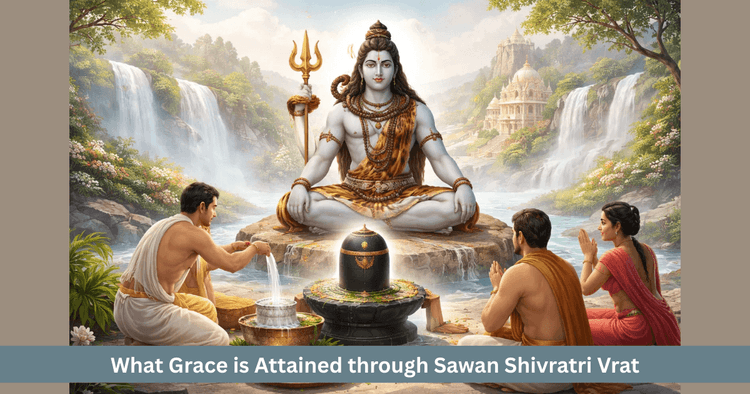
Table of Contents
The Sawan Shivratri that falls in the month of Shravan is regarded as a unique occasion for special worship of Lord Shiva. On this sacred night devotees observe fast with full sincerity and offer water, milk and bilva leaves on the Shiva Linga. It is believed that observing Sawan Shivratri Vrat lightens deep sorrow in the heart, fulfills desires and opens the path of happiness and good fortune in life. Reciting the Shravan Shivratri Vrat Katha on this day with devotion brings special grace of Mahadev and multiplies the result of the vrat.
What Grace is Attained through Sawan Shivratri Vrat
Shiva Purana states that the Shivratri which comes in the month of Shravan is highly auspicious for pleasing Lord Shiva. For those who observe this vrat with faith, sorrows and sufferings begin to fade away. On this special Shivratri through fasting, night vigil and listening to the katha devotees receive blessings of both Shiva and Mata Parvati together. Stability enters domestic life. Good fortune, contentment and mental balance grow in the family.
On the night of Sawan Shivratri there is a tradition of fasting on fruits once or only on water. According to the four parts of the night, abhisheka of Shiva Linga is performed with water and bilva leaves along with incense and lamp. Those who on this day follow proper rules of fasting and listen to the Shivratri Vrat Katha are considered to have performed the most excellent among auspicious vrats.
Why is Listening to the Shivratri Vrat Story Considered Necessary
The sages requested Suta Ji to explain in detail the fruits, method and earlier examples of the Sawan Shivratri Vrat. They asked whether anyone had observed this vrat before and what superior result is attained if someone observes it even unknowingly. Suta Ji said that to explain the nature of this vrat a wonderful story from the life of a Nishad will be narrated which destroys all kinds of sins.
This story does not merely display a miracle. It shows that even when worship of Shiva happens unknowingly and repentance and compassion arise in the heart, the sins of many births begin to burn away through Shiva's grace. Listening to this katha on Sawan Shivratri makes the observance of the vrat complete.
Beginning of the Sinful Life of Gurudraha the Nishad
In an ancient forest there lived a sinful Nishad named Gurudraha. Every day he went into the forest and killed deer and animals. Theft, violence and other evil acts were common for him. From childhood he had never performed any auspicious deed. Gradually his entire life became filled with sin.
Time passed. One day the holy night of Shivratri arrived. On that very day Gurudraha went into the forest in search of food for his pregnant wife and family. He ran about the whole day yet could not capture any prey. He became anxious that a pregnant wife must certainly be given some food, otherwise a great crisis would arise.
He thought of sitting near a water body where some thirsty animal would surely come. Thinking this he reached a beautiful lake and sat there waiting for a target.
Bel Tree, Water and First Accidental Worship on the Shiva Linga
On the bank of the lake stood a dense bel tree. Gurudraha quenched his thirst with the water there and then climbed that bel tree so he could watch over any creature coming below. He did not know that at the base of that tree a Jyotirlinga of Lord Shiva was established.
In the first quarter of the night a deer doe came there tormented by thirst to drink water from the lake. The Nishad saw her and joyfully set an arrow on his bow. As soon as he moved to aim, a few drops of water and some bilva leaves from the tree fell upon the Shiva Linga below. Thus without knowing it the worship of the first quarter of the night was completed.
At that moment through Shiva's grace the heavy burden of his sins began to dissolve. The doe heard the twang of the bow and looked upward. Frightened she said to the Nishad that her small fawns were at home, so she wished to entrust them to her sister or husband and then return to surrender herself according to his wish.
At first Gurudraha tried to refuse with a harsh heart but the doe's truthfulness and humble words awakened a little compassion in him. Finally he let her go. In this way the first quarter of the night passed in fasting, wakefulness and unknowing worship of Shiva.
Second Quarter, the Second Doe and Repeated Abhisheka on the Shiva Linga
In the second quarter the sister of the first doe came searching for her and reached the same place to drink water. As soon as Gurudraha saw her he again took up his bow. When he moved to aim, bel leaves and drops of water fell once more on the Shiva Linga and thus the worship of the second quarter was completed.
The doe spoke with anxiety that she would surely return after entrusting her fawns and husband at home. The Nishad first tried to stop her, yet she continued to reassure him with scriptural statements about truth and righteousness that if she did not return she would not deserve even a place in hell. With this firm vow Gurudraha allowed her to go. Thus in the second quarter also he remained awake without sleep and remained engaged in unknowing worship of Shiva.
Third Quarter, the Stag, His Truthful Oath and Third Worship Completed
In the third quarter a strong and healthy stag, husband of those two does, came there in search of them. Gurudraha saw him and immediately set an arrow to his bow. As he stretched the bow, once again bel leaves and water fell from the tree onto the Shiva Linga, completing the worship of the third quarter.
The stag calmly asked what he intended to do. The Nishad replied that he wished to kill him to feed his hungry family. Then the stag answered that he was blessed if his body could serve others but he wished to return to bid farewell to his children and both does and then come back.
Suspicion arose in Gurudraha's mind since earlier the two does had already gone away with a promise to return. The stag then took strong vows with many scriptural references that if he did not come back those sins would fall upon him which are incurred by eating on Shivratri, by false testimony and by betrayal of trust. After this strict oath the Nishad allowed the stag to go.
Fourth Quarter, Return of All, Completion of Worship and Transformation of the Hunter
Time went on. Slowly the period before dawn, the fourth quarter, arrived. The same stag, both does and their little ones all came together to that place. They had resolved to accept whatever fate awaited them.
Seeing them together before him, both amazement and pity arose in the heart of the hunter. He again set an arrow on his bow and at that moment water and bilva leaves fell once more from the tree upon the Shiva Linga. Thus the worship of the fourth quarter was also completed. The fourfold accidental abhisheka, offering of leaves, fasting and night vigil together formed the complete Shivratri Vrat.
Through Shiva's grace all the sins of Gurudraha began to burn. The deer family urged him to shoot his arrow as promised, yet now his inner being had completely changed. He realised how elevated these deer were who upheld such great truth and self sacrifice. He thought that as a human he had done nothing but violence and sin. Condemning his own life he placed the bow down and released the deer family.
Vision of Lord Shiva, Grant of Boon and Origin of the Name Vyadheshvara
At that very moment Lord Shiva appeared before Gurudraha with a radiant form. With gentle touch they blessed him and said that they were pleased by this vrat and by his unknowing worship. Shiva asked him to request a boon.
The Nishad, overwhelmed, fell at their feet. Shiva granted him a blessing that in his further birth Lord Rama Himself would visit his house and befriend him and through their company he would attain rare liberation. In another account this very Nishad later became famous as Nishadraj Guha, devotee and friend of Shri Rama who served Him and attained union with the Supreme.
In the same way the deer and does too obtained divine bodies and ascended to heaven. Shiva gave the name Vyadheshvara to that holy place and became established on Mount Arbuda.
Through this story the sages clearly taught that though there are many vrats, many holy places and many types of charity and sacrifice in the world, the observance of Shivratri Vrat with proper devotion is counted as the highest among auspicious vows. Whoever truly seeks their spiritual welfare should indeed observe the Sawan Shivratri Vrat.
Special Nature of Shivratri Vrat Practice and Inner Transformation
The Sawan Shivratri Vrat is not completed only by external rules. Along with night vigil, abhisheka and offering of bilva leaves it is essential that compassion, truth and repentance awaken in the heart. In the story the change from cruelty to sensitivity in Gurudraha is the real fruit of Shiva worship.
This sacred account teaches that if a person even unknowingly moves towards Shiva through fasting, wakefulness and worship and then resolves to change their way of life, Shiva does not disappoint that seeker. The night of Sawan Shivratri is regarded as the finest time to purify the mind and give a new direction to the path of life.
Common Questions Related to Sawan Shivratri Vrat
Why is the Sawan Shivratri Vrat observed?
The Sawan Shivratri Vrat is observed to receive the grace of Lord Shiva, to burn sins, to fulfill desires and to increase happiness and good fortune in life.
Does accidental worship also give result of the vrat?
Yes. The story of Gurudraha Nishad shows clearly that even abhisheka and offering of bilva leaves done unknowingly can please Shiva if a true inner change awakens at the end.
What is the importance of night vigil on Sawan Shivratri?
By staying awake in all four quarters of the night and offering water and bilva leaves on the Shiva Linga, one attains the full fruit of Shivratri Vrat and the restless mind gradually becomes peaceful.
Is reciting this story considered necessary for Sawan Shivratri Vrat?
Devout recitation of this Nishad story completes the observance of the vrat, hence on Sawan Shivratri it is regarded as excellent to listen to or read it along with worship.
Why is Shivratri called the king among auspicious vrats?
Scriptures say that though many vrats and holy pilgrimages exist, the Shivratri Vrat is king of auspicious vows and is capable of leading a sincere seeker to the path of liberation.
Get your accurate Kundali
Generate KundaliDid you like it?
Author
Pt. Suvrat Sharma (63)
Experience: 20
Consults About: Family Planning, Career
Clients In: Punjab, Haryana, Delhi
Share this article with friends and family
About ZODIAQ
ZODIAQ is an online Vedic Astrology platform. It connects clients seeking astrological advice to experienced astrologers with deep knowledge. Our users also generate kundali and perform kundali milan for free. ZODIAQ also offers services to the Astrologers. Astrologers utilize various offerings by ZODIAQ to serve their clients effectively.
If you are a User
Consult with experienced astrologers and seek their guidance. You can also order handwritten Janm Patrika report with life prediction prepared by experienced astrologers. Generate accurate Kundali, perform Kundali Matching and check horoscope and muhurat. Utilize our online library for all the necessary astrological and spiritual information.
If you are an Astrologer
Create accurate kundali for your clients and perform Kundali Matching for up to 5 people at a time. Write comprehensive Janm Patrika report for your clients with ZODIAQ. Check client details anytime by saving it in client directory. Become more productive by tracking how many clients you guide every day.
WELCOME TO
ZODIAQ
Right Decisions at the right time with ZODIAQ
