The Unknown Story of Why Shakuni Hated the Kauravas So Deeply
By Pt. Amitabh Sharma
How humiliation, pain, and revenge twisted Shakuni’s intelligence
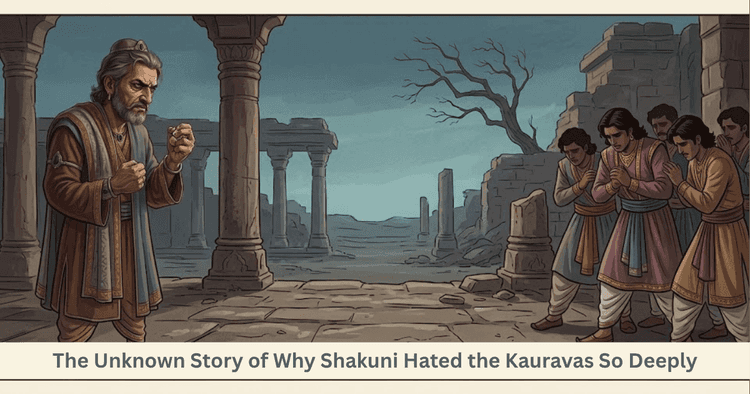
Table of Contents
Dharmo rakshati rakshitah, meaning the one who protects dharma is protected by dharma. The Mahabharata returns to this truth again and again. Yet the same epic also shows what happens when pain, ego, humiliation and revenge become stronger than dharma. Among its many characters, Shakuni represents this inner collapse more clearly than almost anyone else. He was not merely a clever maternal uncle. He was a man whose intelligence had been poisoned by unresolved hurt.
Most people remember Shakuni as the manipulative figure who fed Duryodhana’s mind, created plots against the Pandavas and used the game of dice to open the road toward destruction. But very few pause to ask why such deep hatred grew inside him against the Kuru house. Was he cruel from birth. Was he driven only by ambition. Or was there some old wound within him that slowly turned him into an instrument of revenge.
To understand Shakuni is important because he teaches that intelligence, when cut off from dharma, becomes a weapon of destruction. He also shows that behind every dark character there is not always simple wickedness. Sometimes there is humiliation, a wounded sense of honor and pain flowing in the wrong direction.
Was Shakuni evil from the beginning
If Shakuni is reduced only to trickery and plotting, the depth of the Mahabharata becomes smaller. He was not someone who desired destruction without cause. The hardness within him formed gradually. He was sharp minded, politically aware and deeply perceptive. If the same man had stood on the side of dharma, he might have become a remarkably powerful guide. But the anger and humiliation stored within him led him elsewhere.
Shakuni’s story suggests that human beings are shaped not only by what they do but also by what they carry inside. When inner wounds are not healed, they slowly turn into a worldview. That is what happened with him. He did not turn his pain into tapas, meaning spiritual discipline. He turned it into revenge.
Why did Gandhari’s marriage trouble him so deeply
The first major root of Shakuni’s hatred is believed to be connected with his sister Gandhari. Gandhari was married to Dhritarashtra, the blind prince of Hastinapura. In many retellings, Shakuni felt deeply insulted by this marriage. In his mind, his sister’s life had been sacrificed for political reasons.
His pain increased even further when Gandhari chose to blindfold herself for life. She resolved that if her husband could not see the world, then she too would not enjoy the gift of sight. From Gandhari’s perspective, this was an act of devotion and shared suffering. From Shakuni’s perspective, it was the end of his sister’s visible joy, freedom and ordinary human happiness. He gradually came to believe that the Kuru family had not merely arranged her marriage but had taken away her brightness.
From that moment, a silent bitterness began to grow within him. Outwardly he remained composed but inwardly he started seeing the Kuru family as the cause of his sister’s sorrow.
Feelings that arose in Shakuni through the Gandhari episode
- He felt that justice had not been done to his sister
- He saw the marriage as political compromise rather than dignity
- Gandhari’s blindfold deepened his sense of hurt
- This event slowly hardened into bitterness toward the Kuru house
How does the imprisonment story explain his revenge
There is also a very famous later folk narrative connected with Shakuni’s hatred. According to this tale, his father and brothers were imprisoned by the Kurus. They were given very little food. The family then decided that not all could survive, so the one most capable of carrying their anger forward should remain alive. In this version, all of them gave their food to Shakuni so that he alone might live and avenge the family’s humiliation.
The same folk tradition also says that before dying, his father made him promise that he would destroy the Kuru dynasty. Some retellings even say that Shakuni had dice made from his father’s bones and those dice always obeyed his will. This detail does not clearly appear in the original Mahabharata but it became extremely popular in later folklore because it offered a powerful explanation for the depth of his revenge.
The important point here is that even if this episode belongs more to later tradition than to the earliest text, it reveals a strong psychological truth. When a person witnesses humiliation, hunger, imprisonment or the helpless fall of one’s family, revenge can become very deep. This folk story remains influential because it suggests that behind Shakuni’s intellect there was not only strategy but also burning ancestral pain.
Did Shakuni truly love Duryodhana
From the outside, Shakuni appears to be Duryodhana’s greatest supporter. He stayed close to him, encouraged him, stood by his side and constantly convinced him that the Pandavas were his enemies. But if one watches his conduct more carefully, it becomes clear that he was not Duryodhana’s true guide.
A genuine uncle would have calmed jealousy, restlessness and ego within Duryodhana. He would have taught him balance, kingship and peace. He would have moved him toward dialogue and coexistence with the Pandavas. Shakuni did the opposite. He sharpened every weakness in Duryodhana. He stroked the darkness inside him. He did not teach him wisdom. He turned envy into a force of action.
This is what makes Shakuni more dangerous. Outwardly he was a supporter. Inwardly he was pushing Duryodhana in the very direction where destruction was certain.
Shakuni’s influence on Duryodhana
- He never calmed Duryodhana’s jealousy
- He increased his fear and hatred toward the Pandavas
- He weakened every chance of peace and balance
- He guided Duryodhana not toward strength but toward ruin
Why was the dice game his greatest move
Shakuni’s deadliest act was the game of dice. He knew very well that Yudhishthira, despite being righteous, would not refuse an invitation to gamble. He also knew that if the Pandavas had to be broken before war, their dignity, kingdom and inner balance had to be attacked first. For him, the game of dice was not merely gambling. It was psychological warfare.
In that one game, the Pandavas lost their kingdom, their prosperity, their honor and even Draupadi’s dignity was dragged into humiliation. What happened in that royal assembly did not wound only one woman. It shook the roots of dharma itself. From there emerged the wound that made the great war nearly unavoidable.
This was Shakuni’s true method. Before outer war, he created inner collapse. He did not attack with weapons first. He struck the mind. He was an enemy who did not always strike from the front but rotted relationships from within.
Was Shakuni destroying Hastinapura from inside rather than outside
Yes and that was his most dangerous strategy. He did not attack Hastinapura with an army. He did not launch an open invasion. Instead, he broke the family from within. He turned brothers against brothers, cousins against cousins and the royal court into a chamber of schemes.
Inside Duryodhana’s mind he planted the conviction that the very existence of the Pandavas threatened his right to power. That poison slowly infected every relationship. Where there should have been affection, suspicion appeared. Where there should have been policy, deception entered. Where there should have been protection of the lineage, the preparation for its destruction began.
In this way, Shakuni did not pull down the Kuru house from the outside. He hollowed it from the inside. That is why his role is not seen merely as that of a secondary villain. He stands as one of the chief planners of collapse.
What did revenge finally give him
This is one of the saddest questions in the Mahabharata. If Shakuni hated the Kuru line, if he inflamed Duryodhana, if he used the dice game to twist destiny, then what did he finally gain. The answer is harsh, nothing at all. In the war, Duryodhana died. Gandhari’s sons were destroyed. The Kuru line was shattered. And Shakuni himself was also killed.
His story shows that revenge does not burn enemies alone. It burns relationships, purpose and the one who carries it. If he truly wished to avenge his sister’s suffering, then in the end he led the entire line of that same sister toward destruction. That is the deepest irony of revenge.
Why should Shakuni’s story still be remembered today
Shakuni’s story is not only the tale of one figure from the Mahabharata. It is also a study of the human mind. It shows how dangerous unprocessed pain can become. It teaches that intellect, when separated from compassion, turns poisonous. It also reveals that hatred seated within a family can become more destructive than an enemy outside.
Even today, this story remains relevant because many people do not wage war openly. They break others from within. They offer poison in the language of advice. They inflame in the name of support. They do not open the road of peace but the road of fracture. Shakuni is a symbol of that psychology.
Deep lessons from the story of Shakuni
- Not every clever person is truly wise
- Not every supporter is genuinely a well wisher
- Buried humiliation can destroy entire generations
- The path of revenge ultimately drowns the one who walks it
The greatest life lesson from Shakuni
The greatest message of Shakuni’s story is that pain must be transformed into dharma, not revenge. If his inner fire had turned toward justice, compassion or truth, history might have become very different. But he allowed his wound to become his guide and that was his greatest mistake.
The Mahabharata shows many faces of dharma, yet through Shakuni it also shows that adharma does not always arrive in obvious forms. Sometimes it comes smiling. Sometimes it comes as advice. Sometimes it wears the mask of family and slowly destroys everything from the inside. That is why to understand Shakuni is not only to understand the past. It is also to awaken discernment in the present.
Frequently asked questions
Why did Shakuni hate the Kauravas so deeply
His hatred is often linked to Gandhari’s painful marriage, the sense of family humiliation, later folk stories of imprisonment and the revenge that grew within him.
Is the story of bone dice found in the original Mahabharata
This detail does not clearly appear in the original Mahabharata but it became very popular in later folklore and retellings.
Was Shakuni truly Duryodhana’s well wisher
Outwardly he supported Duryodhana but his actions show that he pushed him toward destruction rather than peace.
Why is Shakuni’s role in the dice game considered so important
Because he understood Yudhishthira’s weakness and turned the dice game into a trap that laid the foundation for the great war.
What is the greatest lesson of Shakuni’s story
The greatest lesson is that revenge never destroys only the enemy. It eventually burns everyone connected to it.
Get your accurate Kundali
Generate KundaliDid you like it?
Author

Pt. Amitabh Sharma (56 Years)
Experience: 20
Consults About: Family Planning, Career
Clients In: Punjab, Haryana, Delhi
Share this article with friends and family
About ZODIAQ
ZODIAQ is an online Vedic Astrology platform. It connects clients seeking astrological advice to experienced astrologers with deep knowledge. Our users also generate kundali and perform kundali milan for free. ZODIAQ also offers services to the Astrologers. Astrologers utilize various offerings by ZODIAQ to serve their clients effectively.
If you are a User
Consult with experienced astrologers and seek their guidance. You can also order handwritten Janm Patrika report with life prediction prepared by experienced astrologers. Generate accurate Kundali, perform Kundali Matching and check horoscope and muhurat. Utilize our online library for all the necessary astrological and spiritual information.
If you are an Astrologer
Create accurate kundali for your clients and perform Kundali Matching for up to 5 people at a time. Write comprehensive Janm Patrika report for your clients with ZODIAQ. Check client details anytime by saving it in client directory. Become more productive by tracking how many clients you guide every day.
WELCOME TO
ZODIAQ
Right Decisions at the right time with ZODIAQ
