How Sharadiya Navratri Began: Sacred Stories of Mahishasura, Shri Rama and Nine Forms of Goddess
By Pt. Nilesh Sharma
Discover the spiritual significance, divine power of Goddess, and the victory of dharma during Navratri
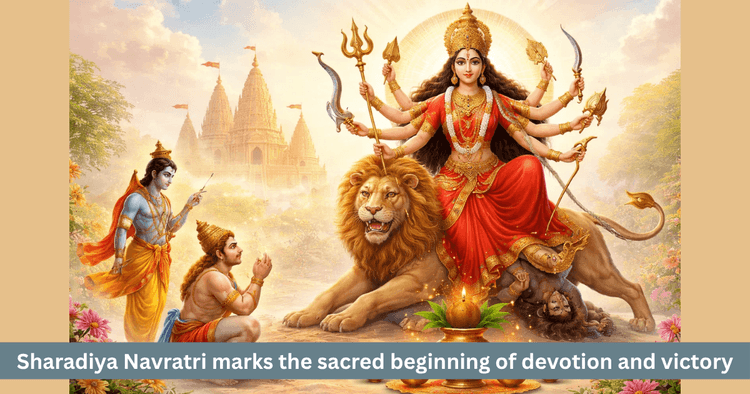
Table of Contents
Sharadiya Navratri is not merely a festival. It is a profoundly sacred period of Shakti, devotion, discipline and the victory of dharma. Every year this holy observance begins after the completion of the ancestral period and opens a path through which devotees experience inner strength, wisdom, compassion and spiritual protection through the worship of Mother Goddess. It is a time when home, temple and mind all become purified together. With the worship of the nine forms of the Goddess, this festival also opens nine inner gateways of the human being, where fear is overcome by faith, weakness by power and darkness by light.
This year Sharadiya Navratri is observed from 17 October, Saturday until 25 October. Usually, this festival begins soon after the ancestral fortnight ends, but due to an extra lunar month this timing was shifted. On the first day, the ritual of Ghatasthapana, the sacred establishment of the kalasha, is considered highly important. From that moment onward, devotees worship the Goddess in her various forms for nine days, and on the tenth day celebrate Vijayadashami as the victory of dharma.
Why is Sharadiya Navratri considered so important
According to sacred texts and Puranic tradition, Sharadiya Navratri is among the most auspicious times for the worship of Mother Durga. During these holy days, a different form of the Goddess is worshipped each day. Each form bestows a distinct blessing upon devotees. One grants strength, another wisdom, another courage, another auspiciousness and another spiritual elevation.
At its heart, Navratri is a festival of Shakti worship. It is not only an outer act of devotion toward the Goddess, but also an inner effort to awaken the sleeping power within. A person who enters into this period sincerely begins to view life’s struggles from a higher and clearer perspective. This is why Navratri is not regarded as a merely religious observance. It is also a period of psychological renewal and spiritual awakening.
The spiritual benefits of Sharadiya Navratri
- Faith and stability increase within the mind
- Fear, laziness and negativity begin to lose their hold
- The various forms of the Goddess reveal different dimensions of life
- Through prayer, discipline and worship, inner power awakens
What is the first Puranic story behind the beginning of Sharadiya Navratri
The first major story associated with the origin of Navratri is the story of Mahishasura. This is not only a tale of battle, but a great narrative of the end of adharma, pride and tyranny. It is said that Mahishasura was a demon who was deeply devoted to Brahma. Through intense austerity he pleased Brahma and obtained a boon that no deva, demon or human being on earth would be able to kill him.
As soon as he received this boon, Mahishasura became cruel, arrogant and destructive. He spread terror across all the three worlds. The devas became distressed. Dharma itself began to tremble. Then the devas, together with Brahma, Vishnu and Mahesha, united their divine radiance. From that combined force emerged Mother Durga, the embodiment of Shakti. Her many arms, many weapons and blazing brilliance symbolized the united force of all divine powers now gathered to destroy adharma.
A fierce battle between Mother Durga and Mahishasura continued for nine days. This battle was not merely physical. It represented truth against falsehood, sacred order against chaos, compassion against brutality. On the tenth day, Mother Durga killed Mahishasura. Since then, the tenth day has been celebrated as the victory of good over evil, and the preceding nine days became established as the period of the Goddess’s worship.
What is the deeper meaning of the Mahishasura story
Outwardly this story speaks of the battle between the Goddess and a demon, but inwardly it mirrors the battle within human life itself. Mahishasura is not only a demon. He represents ego, uncontrolled power, oppression, distorted desire and adharma. Mother Durga is not merely a warrior Goddess. She is the form of awakened consciousness, moral power, protection of dharma and divine balance.
From this story one understands that when chaos rises in life, when inner weaknesses go out of control, the worship of Shakti becomes necessary. Navratri is also a festival of this inner war.
Main insights from this story
- However powerful adharma may seem, its end is certain
- Divine power manifests when the protection of dharma becomes necessary
- Through one pointed spiritual discipline, the inner Mahishasura can also be defeated
- Navratri is a time of awakening inner strength
Why did Maryada Purushottama Shri Rama worship the Goddess during Navratri
The second Puranic story of Sharadiya Navratri is connected with Bhagavan Shri Rama. According to this tradition, before Shri Rama attacked Lanka and before he entered the war against Ravana, he understood that courage alone would not be enough. For victory in a dharmic war, the blessing of Shakti was also necessary.
It is said that Shri Rama worshipped Mother Bhagavati for nine days at Rameshwaram. With full devotion, reverence and resolve, he performed the worship of Navadurga. The Goddess became pleased with his devotion and blessed him with victory in Lanka. On the tenth day, Shri Rama defeated Ravana and established dharma. That day later became known as Vijayadashami.
This story establishes Sharadiya Navratri not only as a festival of the Goddess, but also as a sacred period of Shakti sadhana before a dharma battle. The fact that even Shri Rama, revered as the embodiment of righteousness, turned toward the worship of the Goddess shows that power must be sanctified through devotion.
What does the Shri Rama and Navratri story teach us
The meaning of this story is extremely deep. Shri Rama is honored as an incarnation of Vishnu, yet he too performs the worship of Shakti before victory. This teaches that no matter how capable a person may be, without reverence, humility and divine grace, success remains incomplete.
This story also shows that even one who stands on the side of righteousness must undertake spiritual discipline. It is not enough merely to be on the side of truth. One must also perform worship and austerity for the victory of truth.
Main teachings from the Shri Rama story
- Before victory, humility and spiritual discipline are essential
- The union of power and righteousness alone brings dharmic success
- Through the worship of Mother Bhagavati, both courage and divine protection are received
- Vijayadashami is not only a celebration, but the fruition of sacred practice
Why are the nine forms of the Goddess worshipped during Navratri
During the nine days of Navratri, the nine different forms of Mother Bhagavati are worshipped. This tradition is not simply a sequence of names. It is also a map of spiritual ascent. These nine forms guide the seeker step by step toward stability, austerity, courage, creative force, motherhood, warrior power, destruction of darkness, purification and ultimate fulfillment.
The nine forms worshipped across the nine days are
- Maa Shailaputri
- Maa Brahmacharini
- Maa Chandraghanta
- Maa Kushmanda
- Maa Skandamata
- Maa Katyayani
- Maa Kalaratri
- Maa Mahagauri
- Maa Siddhidatri
The worship of these nine forms reminds the devotee that divine power is one, yet it reveals itself differently in different stages of life. At one time it becomes tapas, at another protection, at another motherhood, at another fierce destruction and at another supreme grace.
What is the significance of Ghatasthapana
On the first day of Navratri, the ritual of Ghatasthapana is performed. The kalasha is not just a ritual vessel. It symbolizes creation, life force, Shakti and the beginning of an inward journey. The vessel filled with sacred water, the barley seeds, the coconut and the leaves together signify fertility, auspiciousness and the arrival of divine presence. Through Ghatasthapana, the spiritual cycle of Navratri begins.
This sacred establishment also reminds the seeker that just as divine presence is invoked into the kalasha, one must also invite awareness and devotion into the inner being. Outer worship becomes meaningful only when the inner altar is also prepared.
Why is Sharadiya Navratri still so meaningful today
Modern life is filled with speed, anxiety, imbalance and inner restlessness. In such a time, Sharadiya Navratri becomes far more than a religious occasion. It becomes a sacred opportunity to restore balance in mind, home and life. Fasting brings discipline. Worship awakens devotion. Sacred stories expand awareness. The worship of the nine forms of the Goddess gives the strength to understand the nine struggles of life.
Even today, many feel that Navratri is not merely a period for asking blessings. It is also a period for self transformation. It teaches the worship of power, but also the joining of that power with humility, dharma, restraint and compassion.
Simple ways to live Sharadiya Navratri meaningfully
- Do not focus only on outer decoration, also give importance to inner purification
- Try to understand the meaning of one form of the Goddess each day
- Turn fasting into mental discipline, not only food restraint
- Carry story, mantra, worship and silent reflection together
The deepest message of Sharadiya Navratri
The two main Puranic narratives behind the beginning of Sharadiya Navratri point toward one common truth. When adharma rises, Shakti is invoked. When a dharmic war stands before life, the worship of Shakti becomes necessary even then. The story of Mahishasura teaches that evil will meet its end. The story of Shri Rama teaches that even dharma must seek the grace of the Goddess before victory. The worship of Navadurga reveals that each stage of life requires a different form of divine strength.
Thus, Sharadiya Navratri is not merely a festival. It is a complete cycle of spiritual discipline. It contains tapas, devotion, battle, compassion, victory and inner awakening. That is why the stories behind its beginning are not merely old narratives. They remain living spiritual truths even now.
Frequently asked questions
Which main Puranic stories are connected with the beginning of Sharadiya Navratri
Two main Puranic stories are connected with the beginning of Sharadiya Navratri, the slaying of Mahishasura and the worship of Mother Bhagavati by Shri Rama.
What is the main message of the Mahishasura story
The main message of this story is that however powerful adharma, cruelty and arrogance may become, divine power ultimately destroys them.
Why did Shri Rama worship Mother Bhagavati during Navratri
Bhagavan Shri Rama worshipped Mother Bhagavati before the battle with Ravana in order to receive victory, protection and the strength needed for the establishment of dharma.
Why are the nine forms of the Goddess worshipped during Navratri
The nine forms of the Goddess connect the devotee with different spiritual and human strengths, so each day of Navratri is dedicated to a different form.
What is the greatest teaching of Sharadiya Navratri
The greatest teaching of this festival is that power becomes truly auspicious only when it is united with dharma, humility, spiritual discipline and truth.
Get your accurate Kundali
Generate KundaliDid you like it?
Author

Pt. Nilesh Sharma (63)
Experience: 20
Consults About: Family Planning, Career
Clients In: Punjab, Haryana, Delhi
Share this article with friends and family
About ZODIAQ
ZODIAQ is an online Vedic Astrology platform. It connects clients seeking astrological advice to experienced astrologers with deep knowledge. Our users also generate kundali and perform kundali milan for free. ZODIAQ also offers services to the Astrologers. Astrologers utilize various offerings by ZODIAQ to serve their clients effectively.
If you are a User
Consult with experienced astrologers and seek their guidance. You can also order handwritten Janm Patrika report with life prediction prepared by experienced astrologers. Generate accurate Kundali, perform Kundali Matching and check horoscope and muhurat. Utilize our online library for all the necessary astrological and spiritual information.
If you are an Astrologer
Create accurate kundali for your clients and perform Kundali Matching for up to 5 people at a time. Write comprehensive Janm Patrika report for your clients with ZODIAQ. Check client details anytime by saving it in client directory. Become more productive by tracking how many clients you guide every day.
WELCOME TO
ZODIAQ
Right Decisions at the right time with ZODIAQ
