Why Does the Gita Say That One Who Dies in Shukla Paksha Does Not Return
By Pt. Nilesh Sharma
Life and Death Paths in Shukla and Krishna Paksha Explained in Gita Chapter 8
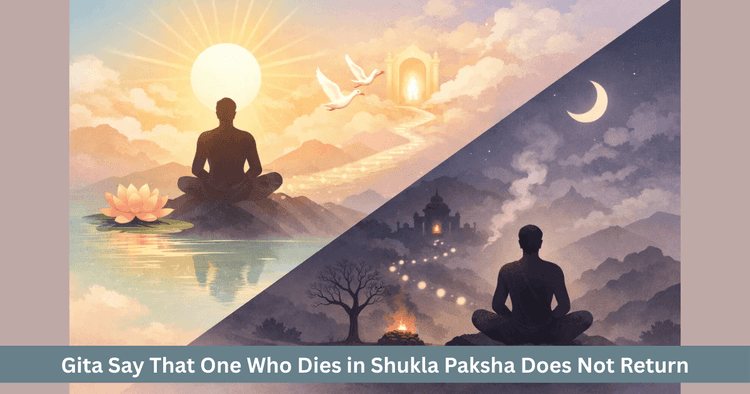
Table of Contents
The Upanishads are called the essence of the four Vedas and Bhagavad Gita is regarded as the essence of the Upanishads. The Gita does not speak only about philosophy but also about the subtle paths between life and death. In the eighth chapter the Gita states that one who leaves the body in the path linked with Shukla Paksha and Uttarayana does not return, while one who departs in the path linked with Krishna Paksha and Dakshinayana returns to birth again.
Brief meaning of Shukla Paksha, Krishna Paksha, Uttarayana and Dakshinayana
Before entering into the verses of the Gita it is useful to clarify these terms so that the teaching does not remain abstract.
Regarding the lunar month.
- A Hindu month has about 30 tithis.
- According to the waxing and waning of the Moon the month is divided into two halves.
- The 15 days in which the Moon increases are called Shukla Paksha, ending with Purnima.
- The 15 days in which the Moon decreases are called Krishna Paksha, ending with Amavasya.
Traditionally Shukla Paksha is regarded as the day of the gods and Krishna Paksha as the day of the ancestors.
Regarding the Sun.
- When the Sun moves northward it is called Uttarayana, understood as the period of the gods.
- When the Sun moves southward it is called Dakshinayana, connected with the realm of the ancestors.
These four states together form the background of the two paths described in the Gita.
What do the relevant verses of the Gita say
Shri Krishna tells Arjuna that there are two paths for those who leave the body. To explain them he first uses the word kala and then describes the two routes clearly.
What is the bright path or Devayana
Krishna says that he will explain the time or path by which those who depart from the body attain a state from which there is no return.
He then mentions the symbols of this way.
- The deity of agni, the bright fire.
- The deity of light.
- The deity of day.
- The deity of Shukla Paksha.
- The deity of the six months of Uttarayana.
Those knowers of Brahman who leave the body under this inner and outer alignment are led step by step by these deities and finally attain Brahman. This is known as the bright path, Devayana or the Shukla gati, from which there is no compulsion to return.
What is the dark path or Pitriyana
The Gita then describes a second route.
- The deity of smoke.
- The deity of night.
- The deity of Krishna Paksha.
- The deity of the six months of Dakshinayana.
A yogi who has performed actions with desire and leaves the body in tune with this route is carried by these deities to the light of the Moon, that is to the realm where the fruits of good actions are enjoyed. After these results are exhausted he returns again. This is called Pitriyana or the Krishna gati, from which there is return.
Two eternal paths
The Gita clearly states that these two ways, Shukla and Krishna, are the eternal paths of the world.
- One who travels by the bright way does not return and attains the supreme state.
- One who travels by the other way returns again to the cycle of birth and death.
It is clear from the context that this teaching is about yogis and seekers, not about every ordinary person.
Does everyone who dies in Shukla Paksha attain liberation
This question arises naturally. Every day, in every phase and season countless people die.
- Many people die during Shukla Paksha.
- Many people die during Krishna Paksha.
Do all those who die in Shukla Paksha attain liberation and do all those who die in Krishna Paksha necessarily return.
In the light of shastra the answer is clear. The statement of the Gita is not a mechanical rule for everyone. It is a teaching meant for a specific class of practitioners.
For whom is this teaching meant
These verses are understood mainly for three kinds of seekers.
- Deep meditators, who have lived their life in sustained dhyana.
- Yogis, who have disciplined prana, senses and mind.
- Single pointed devotees, whose consciousness has become steadily fixed in the Divine.
For such souls death is not merely a physical event. It is also the moment when their lifelong practice determines which path their inner being follows. For them the time of death, inner state, movement of prana and help from deities decide the route.
For an ordinary person who has not lived such a life of yoga or knowledge, mere death in Shukla Paksha does not automatically grant liberation. Such a person moves towards a new birth according to personal karma.
Sinful actions, ghost like states and lower births
Those who are deeply involved in sinful actions, with minds heavily clouded by negative tendencies, do not always find an immediate harmonious birth.
- Such souls may pass through disturbed states after death.
- They can take forms described as ghosts or similar subtle conditions.
- These states are the result of their own karma and inner confusion and continue until that karma is partly exhausted.
After this, birth in lower forms of life is also possible. This is like a demotion from the human condition, which is considered a special opportunity for spiritual growth. Thus the question of liberation or return is linked primarily with karma and inner evolution, not only with lunar or solar phases.
What are Shukla and Krishna Paksha and what do they symbolise
The Shukla and Krishna paths of the Gita become clearer when the ordinary meaning of lunar pakshas is recalled.
- When the Moon waxes from Amavasya to Purnima, the phase is called Shukla Paksha.
- When the Moon wanes from Purnima to Amavasya, the phase is called Krishna Paksha.
The last tithi of Shukla Paksha is Purnima and of Krishna Paksha is Amavasya.
In traditional symbolism.
- Shukla Paksha is called the day of the gods, representing upward movement, light and growth.
- Krishna Paksha is called the day of the ancestors, linked with enjoyment of past karma, introspection and the process of return.
- Similarly Uttarayana is considered the period of the gods and Dakshinayana the period of the ancestors.
The Gita uses these symbols to indicate that when a seeker’s inner direction becomes bright, upward and pure, the final journey also aligns naturally with a path from which there is no compulsion to return.
Practical guidance for a seeker
For a person living an ordinary life the essence of this teaching is simple.
- Liberation does not depend only on date, phase or season.
- The final path after death is shaped above all by practice, intention, devotion and karma.
- Shukla Paksha, Krishna Paksha, Uttarayana and Dakshinayana are indicators but the decisive factor is the state of consciousness at the end.
The Gita therefore invites a person to live in such a way that whenever death comes, the inner direction is towards light. Then, whether the outer calendar shows Shukla Paksha or Krishna Paksha, the inner journey can still move on the path that does not require return.
Frequently asked questions about death in Shukla Paksha and the Gita
Does every person who dies in Shukla Paksha attain moksha
No. The Gita’s teaching here is mainly about accomplished yogis, meditators and knowers of Brahman. For ordinary people rebirth follows according to karmic balance, irrespective of the lunar phase.
Does everyone who dies in Krishna Paksha necessarily return
Krishna Paksha is associated with Pitriyana and with the process of enjoying karmic fruits and returning. Generally it indicates return, yet the exact outcome still depends on the person’s karma and inner state at the time of death.
Why did Bhishma wait for Shukla Paksha and Uttarayana
Bhishma had the boon of ichcha mrityu, the freedom to choose his time of departure. He waited for Uttarayana and the bright half because this period symbolises the Devayana path and upward movement.
What leads to ghost like states or lower births according to this view
When a mind is strongly bound by sin, fear or attachment and is not peaceful at death, the subtle body may remain disturbed. Such souls can pass through ghost like conditions and later take lower births. This is seen as the result of their own actions and mental condition.
What is the most important point for an ordinary practitioner
The key is to live with sincerity, devotion, awareness and some form of steady practice. If inner orientation is towards truth and light, the external phase of the Moon becomes secondary and the journey after death naturally finds a higher direction.
Get your accurate Kundali
Generate KundaliDid you like it?
Author

Pt. Nilesh Sharma (63)
Experience: 20
Consults About: Family Planning, Career
Clients In: Punjab, Haryana, Delhi
Share this article with friends and family
About ZODIAQ
ZODIAQ is an online Vedic Astrology platform. It connects clients seeking astrological advice to experienced astrologers with deep knowledge. Our users also generate kundali and perform kundali milan for free. ZODIAQ also offers services to the Astrologers. Astrologers utilize various offerings by ZODIAQ to serve their clients effectively.
If you are a User
Consult with experienced astrologers and seek their guidance. You can also order handwritten Janm Patrika report with life prediction prepared by experienced astrologers. Generate accurate Kundali, perform Kundali Matching and check horoscope and muhurat. Utilize our online library for all the necessary astrological and spiritual information.
If you are an Astrologer
Create accurate kundali for your clients and perform Kundali Matching for up to 5 people at a time. Write comprehensive Janm Patrika report for your clients with ZODIAQ. Check client details anytime by saving it in client directory. Become more productive by tracking how many clients you guide every day.
WELCOME TO
ZODIAQ
Right Decisions at the right time with ZODIAQ
