Somnath Jyotirlinga: Moon, Consciousness and the First Gateway of Eternal Light
By Pt. Abhishek Sharma
Somnath Jyotirlinga Connects Lunar Energy, Mental Peace and Spiritual Stillness
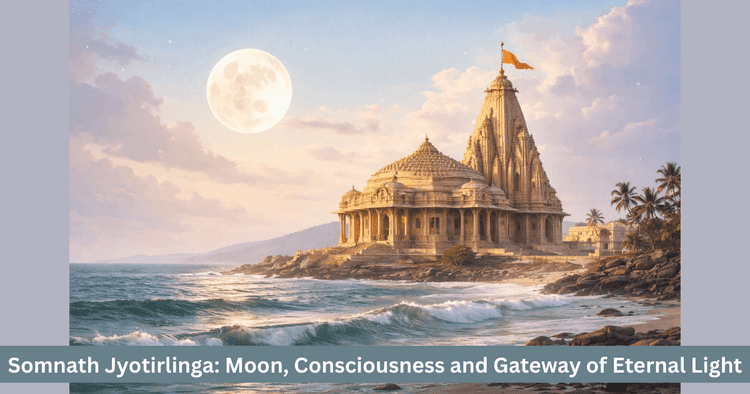
Table of Contents
On the western edge of Bharat, at Prabhas Patan in Gujarat, stands Somnath Jyotirlinga, revered as the first among the twelve jyotirlingas. Facing the vast Arabian Sea, this sacred temple is far more than a structure of stone. It functions as a spiritual axis where the mind naturally becomes quiet, steady and inwardly deep. The continuous sound of waves feels like an echo of ancient mantras and the endless horizon in front of the temple gives a direct sense of expansion and infinity.
In the Hindu calendar and Vedic astrology, Somnath is especially connected with Chandra, the Moon. Chandra presides over the mind, emotions, memory, motherly care and nourishment. therefore when lunar energies are disturbed, pilgrimage to Prabhas Kshetra and worship of Somnath Jyotirlinga are regarded as powerful ways to bring calmness, emotional stability and mental cooling.
Sacred Geography of Prabhas and the Symbol of Baan Stambh
The region of Prabhas Kshetra is praised in the Shiva Purana and other sacred texts. The tapas and worship of deities, sages and great souls in this area have charged the land with subtle spiritual power. The Somnath temple is oriented directly toward the open sea, which symbolises infinitude and unbounded awareness.
Within the temple complex stands the Baan Stambh, an arrow pillar carrying a profound indication. The inscription conveys that from this point southward there is no landmass until the distant south pole. This is not just a geographical statement. It symbolises that when the seeker’s awareness turns towards the Divine, an unobstructed path of light lies ahead. Standing quietly near this pillar, watching the sea and horizon, many find that inner restlessness slows down and a deep stillness begins to descend within.
Story of Chandra and the Origin of Somnath Jyotirlinga
The origin of Somnath Jyotirlinga is linked with the story of Chandra Deva. According to the ancient account, Chandra married the twenty seven daughters of Daksha Prajapati. These daughters personify the twenty seven nakshatras of the sky. Chandra was expected to relate to all of them with equal affection.
Over time, however his love became strongly inclined toward Rohini. Because of this partiality, his other wives felt neglected and distressed. They complained to their father Daksha, who became angry and cursed Chandra so that his radiance would gradually wane and diminish. As the Moon’s light began to fade, imbalance was felt throughout creation, because the Moon is seen as the source of mental stability, rasa and subtle life energy. This was not merely the dimming of a celestial body, it was experienced as a disturbance of emotional and mental harmony.
Chandra’s Austerity, Shiva’s Grace and the Cycle of Phases
Suffering under the curse, Chandra came to Prabhas Kshetra and undertook intense tapasya in devotion to Lord Shiva. With a concentrated mind he meditated, praised Shiva and surrendered his pain and guilt completely at the feet of the Lord. After a long period of penance, Shiva became pleased. He did not entirely remove Daksha’s curse but he changed its form.
Shiva blessed Chandra so that he would not be destroyed but would move through a rhythmic cycle of decrease and increase. The Moon would pass through phases, sometimes losing light, sometimes regaining it. Thus the cycles of Krishna Paksha and Shukla Paksha became established. From new Moon to full Moon and back again, this movement is not only an astronomical event but a living symbol of the rise and fall of energy in human life and mind. At this very place, Shiva manifested as Somnath, Lord of Soma, where soma refers both to the Moon and to the subtle nectar of life. This leela teaches that when pain, guilt and decline are offered into divine refuge, they transform into balance, rhythm and renewal.
Somnath in History: Between Destruction and Reconstruction
The history of Somnath temple includes repeated episodes of destruction and rebuilding. At different periods, invaders attacked the temple, plundered its wealth and attempted to erase its presence. The structure was demolished, the jyotirlinga was insulted and the splendour of the shrine was repeatedly assaulted.
Yet after each fall Somnath rose again. Every reconstruction asserted that dharma and truth can be pushed down for a time but their roots remain strong beneath the surface. After independence, the rebuilding of Somnath took on renewed significance as an affirmation of cultural continuity, resilient faith and the life force of civilisation. Today, Somnath stands with quiet dignity, conveying that truth may be struck, yet it cannot be extinguished.
Architectural Form and Inner Experience of Somnath
The present Somnath temple is built in the Chalukya style. Its tall shikhara rises towards the sky, naturally guiding the devotee’s gaze upward and inward. The overall design balances grandeur with simplicity. The garbhagriha is kept relatively unadorned and calm so that inner attention settles on the jyotirlinga itself.
Devotees often share that, after entering the temple precincts, the scattered flow of thoughts gradually begins to organise itself, as if an unseen rhythm is bringing order to the mind. The temple impresses by its scale and beauty, yet it does not dazzle. Instead it holds a serious, stable and contemplative atmosphere that supports quiet reflection.
Astrological Significance of Somnath and the Moon
In Vedic astrology Somnath is viewed as a principal pilgrimage connected with the Moon. Chandra governs the fields of mind, feeling, maternal emotion, imagination and memory. When the Moon is weak or afflicted in a birth chart, a person may experience anxiety, irritability, disturbed sleep, wavering decisions and emotional imbalance in relationships.
These links between the Moon’s condition and suggested practices can be seen in this table.
| Aspect | Indication |
|---|---|
| Sphere of Chandra | Mind, emotions, motherhood, memory, imagination |
| Signs of weak Moon | Anxiety, irritability, insomnia, unstable decisions, relational tension |
| Suggested practices | Soma related mantras, Monday fasting, abhisheka with water or milk |
| Pilgrimage focus | Darshan and contemplation of Somnath Jyotirlinga at Prabhas Kshetra |
In such periods, it is considered beneficial to undertake a devoted pilgrimage to Somnath, to perform abhisheka of the jyotirlinga with water and milk especially on Mondays and to include lunar mantra japa as part of daily practice. These steps are meant not only for outer results but to help the mind become cool, accepting and peaceful.
Festivals at Somnath and the Dawn Darshan
During Maha Shivratri, Somnath becomes a strong centre of devotion. Throughout the month of Shravan, daily abhishekas, Rudra chanting and offerings create a powerful presence of Shiva’s name in the atmosphere. Mondays in Shravan, Pradosh and other Shiva related dates also see heightened worship and inward focus.
For many seekers, the most memorable experience is the sunrise darshan. When the first rays of the rising Sun strike the sea, touch the temple’s shikhara and gently light up the courtyard, it appears as if light itself is rising from the water to meet Shiva. In that instant the waxing and waning of the Moon, the journey from darkness to light and the cycles of human life all become vividly present.
Living Message of Somnath Jyotirlinga
Somnath is not only an ancient temple. It is a silent teacher of how to understand life. Just as the Moon does not resist its waning but rests in the certainty of full brightness returning, human life too moves through cycles of rise, fall, loss and renewed growth.
When a seeker recognises that phases of lack, defeat or apparent collapse are not final endings but preparations for another stage, inner strength begins to awaken. The jyotirlinga at Somnath reminds us that outer shine may fade, situations may become difficult, yet the inner light cannot be extinguished. Trusting this truth allows sorrow itself to become a form of practice and loss to serve as ground for future light.
For this reason Somnath, besides being the first jyotirlinga, is also seen as a place of learning that gently tells every seeker that if life’s light seems dim for a while, it has not disappeared. It is only changing form and quietly preparing to return.
Common Questions
Where is Somnath Jyotirlinga located and why is it called the first jyotirlinga?
Somnath Jyotirlinga is located at Prabhas Patan in the Saurashtra region of Gujarat. In the listing of twelve jyotirlingas in Shiva Purana, Somnath is named first, which is why it is honoured as the first jyotirlinga.
How is Somnath connected with Chandra, the Moon?
After being cursed by Daksha, Chandra came to Prabhas Kshetra and performed intense penance to Shiva. At this place Shiva granted him the cycle of waxing and waning and manifested as Somnath, Lord of Soma, linking the jyotirlinga with lunar energy.
What benefits are associated with visiting Somnath for those with a weak Moon in the horoscope?
A weak Moon can bring anxiety, emotional instability and disturbed sleep. With sincere devotion, pilgrimage to Somnath, abhisheka with water and milk on Mondays and practice of Chandra related mantras are believed to support mental peace and emotional balance.
What symbolic meaning lies behind the repeated destruction and rebuilding of Somnath temple?
The temple was destroyed many times yet rebuilt again and again. This symbolises that while forms of dharma may be attacked, the roots of truth remain alive within society and rise again when nurtured by faith and courage.
What core life lesson does Somnath Jyotirlinga offer to a spiritual seeker?
Somnath teaches that decline and loss are natural phases of existence. Like the Moon, one can pass through these stages with trust, knowing that the inner light remains unbroken and can return to full expression when the right time arrives.
Get your accurate Kundali
Generate KundaliDid you like it?
Author

Pt. Abhishek Sharma (63)
Experience: 20
Consults About: Family Planning, Career
Clients In: Punjab, Haryana, Delhi
Share this article with friends and family
About ZODIAQ
ZODIAQ is an online Vedic Astrology platform. It connects clients seeking astrological advice to experienced astrologers with deep knowledge. Our users also generate kundali and perform kundali milan for free. ZODIAQ also offers services to the Astrologers. Astrologers utilize various offerings by ZODIAQ to serve their clients effectively.
If you are a User
Consult with experienced astrologers and seek their guidance. You can also order handwritten Janm Patrika report with life prediction prepared by experienced astrologers. Generate accurate Kundali, perform Kundali Matching and check horoscope and muhurat. Utilize our online library for all the necessary astrological and spiritual information.
If you are an Astrologer
Create accurate kundali for your clients and perform Kundali Matching for up to 5 people at a time. Write comprehensive Janm Patrika report for your clients with ZODIAQ. Check client details anytime by saving it in client directory. Become more productive by tracking how many clients you guide every day.
WELCOME TO
ZODIAQ
Right Decisions at the right time with ZODIAQ
