The True Inner Meaning of Sri Vyasa Puja
By Pt. Abhishek Sharma
Complete Surrender at the Guru’s Feet and Inner Experience
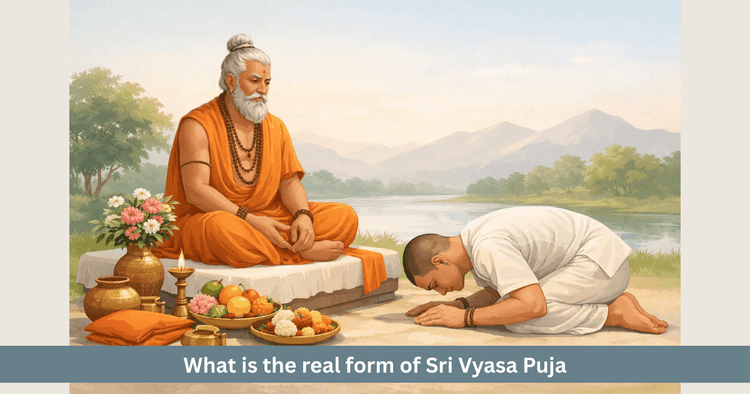
Table of Contents
Sri Vyasa Puja is not merely a ritual, it is a living practice of complete surrender at the lotus feet of the spiritual master. On the full moon of the month of Ashadha, this sacred day is observed as the appearance day of Sage Veda Vyasa. Across Bharat, disciples honour their spiritual guru with deep reverence on this date, which is celebrated as Sri Vyasa Puja or Sri Guru Puja.
Traditionally, garlands, flowers, fruits, sweets and cloth are offered at the lotus feet of Sri Guru. These offerings are auspicious, yet they remain external symbols. Real Sri Vyasa Puja begins only when the disciple offers his or her independent will and ego at the feet of the guru. This is the deepest essence of the entire teaching.
What is the real form of Sri Vyasa Puja
According to the teachings of the saints, simply placing a garland or offering some money, fruits, flowers or cloth at the guru’s feet does not complete true worship. Such acts are symbolic, meant especially for those who need a visible form to express respect.
The inner meaning of Sri Vyasa Puja is that the disciple awakens a firm resolve that life’s direction, important decisions and efforts will now follow the desire and guidance of Sri Guru. When the heart feels that everything which was considered “mine” is now placed at the lotus feet of the guru, then genuine guru worship begins. External flowers and lamps are expressions of this inner surrender.
How is the mood of surrender expressed
Surrender does not exist only in words. It is seen in the way a person gradually reshapes life under the guidance of the guru. When the disciple feels, with clarity, that even personal independence is safe only at the lotus feet of Sri Guru, then the first steps of true Vyasa Puja are taken.
A beautiful example of such surrender appears in the life of Sri Chaitanya Mahaprabhu. At the time of receiving initiation from Sri Ishvara Puri, Mahaprabhu offered His body and everything related to it at the lotus feet of His guru and prayed only for the nectar of Sri Krishna’s lotus feet, to be received through obedience to the guru’s instructions. This prayer is not only His own. It stands as an ideal for every seeker.
Where a disciple rises above selfish plans and emotional demands and places the guru’s wish above personal convenience, there real surrender is visible. Even if such a disciple offers very little externally, his or her Vyasa Puja still becomes meaningful.
Living examples of Vyasa Puja in the lives of saints
The life of Srila Sanatana Gosvami presents a powerful illustration of complete surrender. He gave up his home, family ties, ministerial post, wealth, comfort and royal facilities only to fulfil the desire of Sri Chaitanya Mahaprabhu. He approached Mahaprabhu with empty hands and a full heart, with the feeling that “now everything is Yours.”
This is what has been described as real Vyasa Puja. Without carrying any material gift, he offered his entire life as a garland at the Lord’s feet. His renunciation shows that even a small sacrifice made for the sake of Sri Guru becomes very significant when it is free from selfish motives and filled with pure devotion.
Service to Sri Sri Radha Krishna as the supreme goal
The Vedas, Puranas and words of realised souls again and again point to the highest goal of life, which is the loving service of Sri Sri Radha Krishna. All forms of spiritual practice find their completion in this divine service.
This goal is extremely rare. Yet when a seeker takes shelter at the feet of a genuine guru and follows the discipline, instructions and devotional practices given by that guru, then this difficult goal slowly comes within reach. In this light, Sri Vyasa Puja is also a reminder that through the guru one must find the path leading to the service of Sri Sri Radha Krishna.
The inner oneness of Guru and Bhagavan
Scriptures explain that the origin of devotion is Sri Krishna Himself, yet the same Supreme Lord appears in the form of Sri Guru to guide individual souls. For this reason, it is taught that without sincere service to the guru, all attempts at devotion remain incomplete and fruitless.
Spiritually, there is no conflict between guru and God. The disciple is taught to develop steady and pure bhakti both for the Supreme Lord and for the guru. When such balanced and unwavering faith appears, the deeper meaning of the scriptures starts to shine in the heart. Words from the texts transform into living guidance.
The debt of Bharat to Veda Vyasa
The seekers of Bharat are specially indebted to Sage Veda Vyasa. He arranged the Vedas, presented their essence in the Vedanta Sutra and then manifested the Puranas and the Mahabharata for the benefit of all.
Even after such great work, Veda Vyasa felt a sense of incompleteness. Later, by the grace of Sri Narada Muni, he composed Srimad Bhagavatam, describing the divine pastimes of Sri Krishna and the highest form of devotion. He spoke this Bhagavatam to his son, Sri Sukadeva Gosvami. The reverent service and attentive hearing of Sukadeva towards his father and guru are described as the first true Vyasa Puja.
Thereafter, Srila Suta Gosvami honoured Sukadeva Gosvami and narrated his teachings to the sages of Naimisharanya. This became the second Vyasa Puja in the parampara. Thus, from the time of the Bhagavatam up to the present, the stream of guru and Vyasa worship has continued uninterrupted.
Why is Guru Puja performed before Krishna Puja
In the Vedic tradition, an important principle is taught, that guru puja is performed even before the worship of Sri Krishna. This does not mean that the guru is above God. Rather, it recognises that the path to Krishna opens only through the blessings of the guru.
When the disciple first offers mind, intelligence and ego at the feet of Sri Guru, the heart becomes purified and ready to receive Krishna’s grace. Vyasa Puja therefore reminds the seeker that without the mercy of the guru, one cannot properly understand the mercy of Bhagavan.
Guru parampara and the flow of Radha Krishna service
In the Gaudiya Vaishnava tradition, there is a unique understanding that the highest goal is the service of Sri Sri Radha Krishna, especially in the mood of a maidservant of Srimati Radhika. The guru lineage includes Sri Chaitanya Mahaprabhu, Svarupa Damodara, Ramananda Raya, Rupa Gosvami, Sanatana Gosvami, Krishnadasa Kaviraja, Narottama Thakura, Vishvanatha Chakravarti, Jagannatha Dasa Babaji, Bhaktivinoda Thakura, Srila Prabhupada and later acharyas.
Sri Chaitanya Mahaprabhu is Sri Krishna Himself, appearing with the mood and golden complexion of Sri Radha. He descended to bestow the precious gift of intimate service to Sri Sri Radha Krishna. Mahaprabhu did not widely preach this highest internal mood directly. Instead, He planted it in the heart of Srila Rupa Gosvami and through Rupa Gosvami’s writings the treasure manifested in the world. Without understanding this, the deeper fruit of Vyasa Puja remains hidden.
Vyasa Puja and the inner struggle of a practitioner
Many who step onto the path of sadhana bhajana begin with zeal, yet in due course they become entangled in the attractive power of maya. Attachment to sense pleasure, especially in the form of uncontrolled attraction towards the opposite sex, can pull them away from the path and lead to renewed suffering.
It must therefore be clearly understood that Gaudiya Maths and Vaishnava institutions are not meant to nurture worldly attachments or provide facilities for material arrangements. Their true purpose is to uphold and spread the teachings of Srila Rupa Gosvami. Only those who sincerely seek pure bhajana, guru seva and Vaishnava seva can remain stable in such places and touch the heart of Vyasa Puja.
The disciple, the guru and the foundation of matha life
For one who genuinely desires a life of devotion, the greatest supports are the shelter of Sri Guru and the association of Vaishnavas. Living in a matha or ashram is not always easy. At times the guru or senior Vaishnavas may speak strongly or even chastise the disciple, yet such chastisement is ultimately auspicious.
Just as Narada Muni’s curse led to the upliftment of Nalakuvara and Manigriva, the strong words of guru and Vaishnavas can break the disciple’s pride and cleanse deep rooted tendencies. The one who endures such purification and continues to live in the matha, engaged in service and bhajana, gradually comes to understand the real form of their mercy.
Ashadha Purnima and Srila Sanatana Gosvami
The full moon of Ashadha is not only the day of Vyasa Puja. It also marks the disappearance day of Srila Sanatana Gosvami. In the Gaudiya tradition he is honoured as an associate of Veda Vyasa, because he composed an important commentary on Srimad Bhagavatam and revealed the precious scripture Sri Brhad Bhagavatamrita.
Sri Brhad Bhagavatamrita is regarded as a foundational gem from which the later works of Rupa Gosvami, Raghunatha Dasa Gosvami and others have drawn many insights. In this sense, Sanatana Gosvami is seen as the guru of Rupa Gosvami, while he himself accepted Rupa Gosvami as his guru in certain aspects. Such is the depth of guru tattva, where mutual honour and humility replace any form of pride.
What is the true nature of a guru
If someone begins to feel proud, thinking, “now I have become a guru,” then he or she has already moved away from the essence of guru tattva. A genuine guru does not try to prove greatness. The aim is to guide others so that, in due time, they can also become capable of guiding souls towards bhakti.
The true identity of a guru is seen when the association leads to increased humility, deeper devotion and stronger service mood in the disciple’s heart. Such a guru remains a disciple within the parampara and sees spiritual leadership as responsibility rather than personal privilege.
Duty of those born in Bharat and the practice of Vyasa Puja
The scriptures declare that one who has taken birth as a human being in Bharatvarsha has a special duty. First, to make life successful through suddha bhakti, pure devotion and second, to work for the real welfare of others by encouraging them toward the same path.
One who takes shelter of Sri Guru, sincerely practises devotion and then shares the teachings and principles with others is truly continuing the current of Vyasa Puja. Here both practice and preaching are essential. Preaching without practice becomes empty words and practice without sharing lacks the expansive spirit of compassion.
Highest life goal and the essence of Vyasa Puja
The supreme goal behind the descent of Sri Chaitanya Mahaprabhu was to clearly reveal the highest aspiration of life. That goal is to become a tiny particle of dust at the lotus feet of Srila Rupa Gosvami and through him, to serve Srimati Radhika as a humble maidservant. This has been the cherished ideal of the entire guru varga in this line.
For those who have left their homes for devotional life and for those who practise bhakti while staying at home, the real form of Vyasa Puja is the same. First, to understand these teachings and let them shape the heart. Then, when performing worship of guru, Vyasa and Sri Sri Radha Krishna, the rituals will naturally gain depth and inner meaning. The true purpose of Sri Vyasa Puja is to awaken this transformation.
Common questions about Sri Vyasa Puja
Is Vyasa Puja meant only for worship of the spiritual master
The central focus of Vyasa Puja is the worship of the spiritual master, who represents Veda Vyasa and the entire disciplic succession. Through honouring one’s own guru, all previous acharyas and Veda Vyasa are also respected.
Is it enough to offer garlands and cloth on Vyasa Puja
Offering garlands, cloth, sweets and other items is auspicious. Still, until the mind and behaviour gradually begin to follow the will and instructions of the guru, the worship remains incomplete. Inner surrender is essential.
Can householders also perform Vyasa Puja properly
Yes. Vyasa Puja is not limited to residents of maths or ashrams. Householders who sincerely follow the instructions received from their guru, maintain daily sadhana and honour the teachings in family life are also performing genuine Vyasa Puja.
Is a special mantra compulsory for Vyasa Puja
Different traditions use different mantras and praises, yet the most important aspect is heartfelt prayer and surrender. The mantra that awakens faith and steadiness in the heart is the most effective for that individual.
Is it necessary to perform Vyasa Puja every year
Observing Vyasa Puja each year on Ashadha Purnima is very beneficial, as it offers a chance to review one’s sadhana and renew spiritual vows. If in any year circumstances prevent a full celebration, sincere remembrance and continued obedience to the guru still carry great spiritual value.
Get your accurate Kundali
Generate KundaliDid you like it?
Author

Pt. Abhishek Sharma (63)
Experience: 20
Consults About: Family Planning, Career
Clients In: Punjab, Haryana, Delhi
Share this article with friends and family
About ZODIAQ
ZODIAQ is an online Vedic Astrology platform. It connects clients seeking astrological advice to experienced astrologers with deep knowledge. Our users also generate kundali and perform kundali milan for free. ZODIAQ also offers services to the Astrologers. Astrologers utilize various offerings by ZODIAQ to serve their clients effectively.
If you are a User
Consult with experienced astrologers and seek their guidance. You can also order handwritten Janm Patrika report with life prediction prepared by experienced astrologers. Generate accurate Kundali, perform Kundali Matching and check horoscope and muhurat. Utilize our online library for all the necessary astrological and spiritual information.
If you are an Astrologer
Create accurate kundali for your clients and perform Kundali Matching for up to 5 people at a time. Write comprehensive Janm Patrika report for your clients with ZODIAQ. Check client details anytime by saving it in client directory. Become more productive by tracking how many clients you guide every day.
WELCOME TO
ZODIAQ
Right Decisions at the right time with ZODIAQ
