Puranic Stories of Surya Grahan and the Spiritual Significance of Solar Eclipse
By Pt. Amitabh Sharma
Religious and Spiritual Practices During the Eclipse
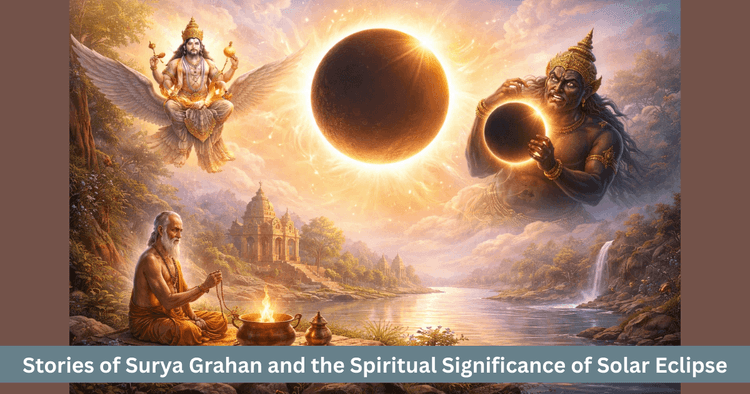
Table of Contents
Surya Grahan has always attracted the human mind. This special alignment in the sky is not seen merely as an astronomical event. In Indian tradition it is connected with planetary positions, flow of energy and spiritual practice. When this combination appears, many religious beliefs, rules and narratives join with it and give it a deeper meaning.
According to Hindu thought Surya Grahan is also viewed in terms of auspicious and inauspicious results. The event takes place when the Moon comes between the Sun and the Earth and for some time covers the light of the Sun. At that time a part of the Sun or sometimes almost the whole disc appears hidden. Along with the formation of the eclipse people naturally turn towards the spiritual impact and towards the stories described in the scriptures.
Why Does a Solar Eclipse Occur
From astronomical and astrological perspectives solar eclipse occurs when the motion of the Moon brings it between the Sun and the Earth so that it blocks the flow of light. This situation is possible only at the new moon when particular alignments are formed.
When the Moon covers only a portion of the Sun a partial solar eclipse appears. When it almost completely covers the Sun, the eclipse looks total or very deep. In Indian tradition Surya Dev is regarded as the source of life, energy and radiance. Therefore this covering of the Sun is not seen as a mere visual change but also as an indication of a subtle shift in energy.
Religious Perspective on the Importance of Surya Grahan
In Indian belief Surya Grahan is considered a period when subtle changes occur in the environment. Scriptures mention that at this time special attention should be paid to the purity of body and mind.
There is an age old tradition of avoiding food during the eclipse and of taking care of children, elderly people and pregnant women. Many people protect food by touching it with tulsi leaves or blades of kusha grass. It is believed that during this period mantra chanting, meditation and charity bear greater fruit than on ordinary days.
After the eclipse it is recommended to bathe, to change clothes, to purify the house and to remember God. The aim is that along with outer cleanliness inner negativity may also reduce and a new positive energy may enter life.
| Topic | Traditional view during the eclipse |
|---|---|
| Food intake | Generally advised to avoid food during the eclipse |
| Mantra and meditation | Considered highly rewarding |
| Charity and merit | Charity during eclipse is regarded as especially meritorious |
| Bath and purification | Bath, change of clothes and house cleaning after eclipse |
Story of Samudra Manthan, Rahu Ketu and Surya Grahan
The best known story linked with Surya Grahan is related to Samudra Manthan, the churning of the ocean. This episode is described in detail in Vishnu Purana and Bhagavata Purana. According to the story, gods and demons churned the ocean of milk to obtain amrita, the nectar of immortality. During the churning many jewels and divine objects appeared and finally Lord Dhanvantari emerged holding a pot filled with nectar.
A fierce struggle broke out between gods and demons to gain the nectar. Seeing the gods becoming weak Lord Vishnu assumed the enchanting form of Mohini. In this form He assured both sides that He would distribute the nectar equally, yet inwardly resolved that amrita would be given only to the gods.
At that time an intelligent demon named Svarbhanu disguised himself as a god and sat in their row. When Mohini was serving the nectar he too drank amrita along with the gods.
Then Surya Dev and Chandra Dev recognised him. They immediately informed Lord Vishnu that a demon in disguise had joined the gods and had drunk the nectar. Hearing this Lord Vishnu manifested His Sudarshana Chakra and cut off Svarbhanu’s head from his torso.
Because Svarbhanu had already drunk amrita his existence did not end. His head became known as Rahu and his body as Ketu. According to Puranic belief from that time Rahu and Ketu became enemies of the Sun and the Moon. Out of a desire for revenge they from time to time seize the Sun and the Moon.
This event is regarded as the Puranic cause of solar and lunar eclipses. When Rahu is said to swallow the Sun, the phenomenon is called Surya Grahan. When Rahu or Ketu swallow the Moon, it is known as Chandra Grahan.
Is Solar Eclipse Mentioned in the Ramayan
References to Surya Grahan are not confined only to the Puranas. The great epic Ramayan also contains a description of an eclipse. According to the story during the fierce battle between Lord Rama and Ravana, the power of Ravana was at its peak and the war between righteousness and unrighteousness had reached a decisive stage.
At that time a terrible solar eclipse occurred and darkness seemed to spread in all directions. The gods became concerned about how victory of righteousness would finally be achieved.
Then the great sage Agastya appeared on the battlefield. He taught Lord Rama the powerful hymn dedicated to the Sun known as "Aditya Hridaya Stotra". In Roman script it is written as Aditya Hridaya Stotra and its meaning is "Hymn of the heart of the Sun".
According to the narrative Lord Rama stood firm on the battlefield and recited Aditya Hridaya Stotra with deep devotion. He gained special strength and confidence from Surya Dev. Fear and doubt left his mind and he re entered the battle with renewed courage. After this turning point the course of war moved towards the side of dharma and finally Ravana was defeated.
Recommended Conduct During Surya Grahan
On the basis of Puranic stories and religious customs several practices are suggested for the time of Surya Grahan. Their aim is to maintain purity of body, mind and surroundings.
- Avoid unnecessary travel during the period of eclipse
- Advise pregnant women not to view the eclipse directly
- According to tradition food is not taken for some time before and during the eclipse
- During the eclipse mantra chanting, meditation, recitation of hymns and remembrance of God are considered very auspicious
- After the eclipse it is recommended to take bath, change clothes and clean the house
The central purpose behind these rules is to use this special time not for routine activities but for spiritual practice, prayer and self reflection so that along with the subtle effect of planets inner negativity may also decline.
Spiritual Lessons from Surya Grahan Narratives
The story of Rahu Ketu indicates that greed, deceit and attempts to gain benefit by disguise finally produce restlessness and conflict. Svarbhanu received amrita yet he did not gain lasting peace. His existence divided into two forms, Rahu and Ketu, who are forever in a state of struggle.
The episode of Aditya Hridaya Stotra in the Ramayan teaches that when circumstances appear dark and difficult, if a person remembers divine power, keeps patience and strengthens inner courage, situations that seem impossible can also turn in favour of dharma.
Through these narratives Surya Grahan may be understood not only as a sign of fear or misfortune but also as an opportunity for sadhana, prayer, discipline and firm faith.
Common Questions Related to Surya Grahan
Why is Surya Grahan regarded as so important in Hinduism?
The Sun is considered the source of life, energy and radiance. When the Sun is covered during an eclipse it is taken as a sign of special change in the flow of energy. Therefore separate rules are given in the scriptures for the eclipse period.
Is Surya Grahan only an astronomical event or also a spiritual one?
In reality it is an astronomical event, yet in Hindu tradition it is also viewed in a spiritual way. During this time mantra chanting, meditation and charity are regarded as especially fruitful.
Why are Rahu and Ketu associated with eclipses?
According to the Samudra Manthan story the head and torso of the demon Svarbhanu became Rahu and Ketu. They are believed to seize the Sun and Moon, hence they are considered the Puranic cause of eclipses.
Is it necessary to recite Aditya Hridaya Stotra during every solar eclipse?
There is no compulsion, yet reciting Aditya Hridaya Stotra or other hymns of the Sun with devotion strengthens mental strength, concentration and confidence which benefits everyone.
What is considered proper to do after the eclipse ends?
After the eclipse it is considered good to take a bath, wear clean clothes, purify the house and pray to God. Many people also resolve to give charity at this time to gain merit.
Get your accurate Kundali
Generate KundaliDid you like it?
Author
Pt. Amitabh Sharma (56 Years)
Experience: 20
Consults About: Family Planning, Career
Clients In: Punjab, Haryana, Delhi
Share this article with friends and family
About ZODIAQ
ZODIAQ is an online Vedic Astrology platform. It connects clients seeking astrological advice to experienced astrologers with deep knowledge. Our users also generate kundali and perform kundali milan for free. ZODIAQ also offers services to the Astrologers. Astrologers utilize various offerings by ZODIAQ to serve their clients effectively.
If you are a User
Consult with experienced astrologers and seek their guidance. You can also order handwritten Janm Patrika report with life prediction prepared by experienced astrologers. Generate accurate Kundali, perform Kundali Matching and check horoscope and muhurat. Utilize our online library for all the necessary astrological and spiritual information.
If you are an Astrologer
Create accurate kundali for your clients and perform Kundali Matching for up to 5 people at a time. Write comprehensive Janm Patrika report for your clients with ZODIAQ. Check client details anytime by saving it in client directory. Become more productive by tracking how many clients you guide every day.
WELCOME TO
ZODIAQ
Right Decisions at the right time with ZODIAQ
