Trimbakeshwar Jyotirlinga: Source of Godavari and Unity of the Trinity
By Pt. Abhishek Sharma
Sacred Site of Shiva at Brahmagiri Parvat, Nashik
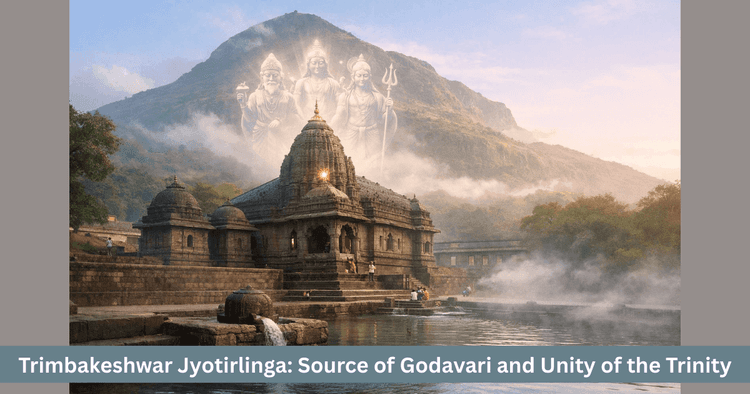
Table of Contents
At the foothills of Brahmagiri Parvat near Nashik in Maharashtra stands Trimbakeshwar Jyotirlinga, a shrine where river origin, the unity of the Trinity and deep karmic purification converge. Hills stretching around the shrine, morning mist, clear air and the subtle presence of ancient mantras together make this land feel like a living Vedic altar. Trimbakeshwar is not only a temple of Shiva. It is the place from where the sacred Godavari River begins to flow and where the subtle oneness of Brahma, Vishnu and Shiva is indicated within the jyotirlinga itself.
This tirtha holds special value for seekers who long for cleansing, balance and inner clarity in their life, family and karmic patterns. The land, the water and the mantras here together create a field of practice where both outer and inner purification are honoured.
Sacred Geography of Brahmagiri and Trimbakeshwar
The heart of Trimbakeshwar Dham is the Brahmagiri mountain and the origin of the Godavari River. Water flowing down the slopes of Brahmagiri, the streams moving across stone and the sanctity near the temple together give this area the character of a natural pilgrimage field.
Key geographical aspects of Trimbakeshwar are summarised in this table.
| Aspect | Description |
|---|---|
| State | Maharashtra |
| Location | Near Nashik, at the base of Brahmagiri Parvat |
| River source | Sacred origin region of Godavari |
| Presiding deity | Trimbakeshwar Jyotirlinga |
| Special spiritual identity | Unity of the Trinity, Godavari source, ancestral rites and karmic cleansing |
The climb towards Brahmagiri, the visit to the source of Godavari and then darshan at Trimbakeshwar Jyotirlinga together form not a mere tour but a complete spiritual sequence for a seeker.
Story of Gautama Rishi and the Compassion of Trimbakeshwar
The origin of Trimbakeshwar Jyotirlinga is connected with Gautama Rishi. He was known for virtue, discipline and compassion. He lived an austere life in his ashram and ensured food, water and shelter for guests, seekers and creatures that came to his dwelling.
According to the traditional account, due to a series of events and misunderstandings, an inauspicious incident took place whose blame fell upon Gautama Rishi, although he did not intend to commit that sin. Instead of denying responsibility, the rishi accepted the situation as karma and chose the path of purificatory sadhana.
He undertook intense penance and prayed to Lord Shiva to bring a Ganga like sacred flow into this region so that both the land and the associated karmas could be purified. Pleased with his devotion, Shiva manifested here and released the holy river Godavari. Many lineages revere Godavari as the Southern Ganga.
Lord Shiva decided to remain at this place as Trimbakeshwar, granting the land a blessing that sincere practice here would support true repentance, peace for ancestors and karmic cleansing.
Meaning of Trimbakeshwar and the Unity of the Trinity
The word Trimbaka refers both to the three eyed form of Shiva and to the threefold aspect. The name Trimbakeshwar expresses the speciality of this shrine where the presence of Brahma, Vishnu and Shiva is experienced as a single thread.
In contrast with most jyotirlingas, the form at Trimbakeshwar is unique. In the sanctum, the linga holds a small inner hollow, within which three subtle representations are understood to embody
- Brahma
- Vishnu
- and Shiva.
This rare form indicates that creation, preservation and dissolution are not separate powers but different directions of one consciousness. For a seeker this understanding is profound, as it reveals that behind the changing movements of life there is a single central source that holds them all.
Unique Form of the Jyotirlinga at Trimbakeshwar
Many jyotirlingas appear as a single stone form. At Trimbakeshwar, the jyotirlinga within the sanctum is hollowed and multi symbolic. In the small depression, along with sacred water, the three symbolic forms quietly remind the seeker that
- surface differences may appear
- but at depth all rest in one consciousness.
This image is especially meaningful for seekers of holistic balance. It encourages the alignment of devotion, knowledge and action, rather than favouring only one aspect of life.
Temple Architecture and Atmosphere around Trimbakeshwar
The Trimbakeshwar temple is built of black basalt stone and reflects the traditional Hemadpanthi style. The dark stone, strong walls, fine carvings and balanced layout give the temple a dignified and timeless quality.
As one moves near the garbhagriha, the atmosphere becomes more still, dense and meditative. Because of the Godavari’s origin nearby, there is a special interplay here of water and stone. Many pilgrims first climb Brahmagiri to visit the source of Godavari and then descend to have darshan of Trimbakeshwar Jyotirlinga. This sequence symbolises
- the ascent towards purification
- followed by receiving Shiva’s grace in the temple.
In this way, both the climb and the darshan become parts of a single inner journey.
Why Is Trimbakeshwar Important for Astrology and Karma Related Practice
A central feature of Trimbakeshwar Dham is its connection with ancestral rites and karmic purification. In Vedic astrology and dharmic tradition, it is counted among the major centres where
- Narayan Nagbali
- other rites for peace of ancestors
- and remedies for lineage related afflictions
are performed.
Families who experience
- Pitru Dosha
- difficulties in having children
- obstacles in lineage growth
- or persistent stagnation without clear cause
often turn to Trimbakeshwar with the intention of performing specific rituals.
Astrologically, Trimbakeshwar is also associated with the energy of Jupiter, which governs wisdom, guidance, dharma and clarity of understanding. When practice here is undertaken with genuine repentance and discipline, it can support greater mental clarity, decision making ability and a renewed sense of direction in life.
These themes can be seen in this table.
| Aspect | Indication |
|---|---|
| Main spiritual focus | Peace for ancestors, karmic cleansing, lineage and progeny matters |
| Astrological tone | Jupiter’s guidance, dharma, family and lineage related yogas |
| Recommended rites | Narayan Nagbali, Pitru Tarpana, bathing in Godavari, Shiva worship |
| Spiritual aim | Inner and outer purification, greater balance in life flow |
The rituals performed here are not only formal acts. They can become the basis for a lasting transformation in how one looks at life and responsibility.
Festivals, Kumbh Mela and Godavari Bathing
The Kumbh Mela held in the Nashik region further elevates the spiritual importance of Trimbakeshwar Dham. During this period, large numbers of sadhus, devotees and seekers gather near the Godavari to engage in practice, sacred bathing and mantra chanting.
At Trimbakeshwar, Maha Shivratri and the month of Shravan are marked by continuous worship, Rudrabhisheka and chanting of Shiva’s name. During these times the temple complex and surrounding area feel especially suffused with Shiva’s presence.
Bathing in the Godavari during auspicious periods, particularly when done with the intention of repentance or a fresh beginning, becomes more than a physical act. It turns into a sign of inner renewal.
Inner Guidance Offered by Trimbakeshwar Jyotirlinga
Trimbakeshwar Jyotirlinga teaches that the three great functions of existence
creation, preservation and dissolution
are three flows of a single divine awareness. Just as the Godavari rises from a small source and then travels across many regions and settlements, life too arises from one origin and moves into countless forms and experiences.
The shrine also reminds us that purification is not only about outward rites and bathing. When a person
- accepts responsibility for personal actions
- holds gratitude and peace toward ancestors
- and seeks to understand the unity of the Trinity in every aspect of life
then inner clarity and calm begin to arise.
Sitting between the quiet garbhagriha of Trimbakeshwar, the flowing water of Godavari and the heights of Brahmagiri, a seeker can slowly sense that when balance is found within, the outer flow of life also becomes smoother, more harmonious and grace filled. This is the subtle blessing held by this jyotirlinga.
Common Questions
Where is Trimbakeshwar Jyotirlinga located and what is its main geographical feature.
Trimbakeshwar Jyotirlinga is located near Nashik in Maharashtra, at the base of Brahmagiri Parvat. Its key geographical feature is that this region is revered as the sacred source area of the Godavari River.
How is Gautama Rishi’s story linked with Trimbakeshwar.
According to the traditional account, Gautama Rishi was blamed for a sin he did not intend. Seeking purification, he performed intense penance and prayed to Shiva for a sacred river. Shiva, pleased with his devotion, manifested Godavari and remained there as Trimbakeshwar, blessing the land with his presence.
What makes the Trimbakeshwar Jyotirlinga different from other jyotirlingas.
Within the sanctum at Trimbakeshwar, the jyotirlinga contains a small depression that holds three symbolic forms representing Brahma, Vishnu and Shiva. This rare representation of the Trinity’s unity distinguishes this shrine from other jyotirlingas.
Which rituals at Trimbakeshwar are important from an astrological and karmic perspective.
Rituals such as Narayan Nagbali and other ancestral peace ceremonies hold special place at Trimbakeshwar. They are performed to address Pitru Dosha, lineage difficulties and unexplained life obstacles and are seen as practices that also strengthen Jupiter related spiritual understanding.
What central life direction does Trimbakeshwar offer to a seeker.
This shrine teaches that creation, preservation and dissolution are expressions of one divine consciousness. Like the Godavari’s rise and expansion, life flows from a single source into many forms. When a seeker accepts responsibility, honours lineage and seeks purification both within and without, the flow of life becomes more coherent and peaceful.
Get your accurate Kundali
Generate KundaliDid you like it?
Author

Pt. Abhishek Sharma (63)
Experience: 20
Consults About: Family Planning, Career
Clients In: Punjab, Haryana, Delhi
Share this article with friends and family
About ZODIAQ
ZODIAQ is an online Vedic Astrology platform. It connects clients seeking astrological advice to experienced astrologers with deep knowledge. Our users also generate kundali and perform kundali milan for free. ZODIAQ also offers services to the Astrologers. Astrologers utilize various offerings by ZODIAQ to serve their clients effectively.
If you are a User
Consult with experienced astrologers and seek their guidance. You can also order handwritten Janm Patrika report with life prediction prepared by experienced astrologers. Generate accurate Kundali, perform Kundali Matching and check horoscope and muhurat. Utilize our online library for all the necessary astrological and spiritual information.
If you are an Astrologer
Create accurate kundali for your clients and perform Kundali Matching for up to 5 people at a time. Write comprehensive Janm Patrika report for your clients with ZODIAQ. Check client details anytime by saving it in client directory. Become more productive by tracking how many clients you guide every day.
WELCOME TO
ZODIAQ
Right Decisions at the right time with ZODIAQ
