Why No Deity Can Escape This Hidden Universal Law
By Pt. Sanjeev Sharma
How Brahma’s Story Reflects the Universal Law of Dharma and Truth
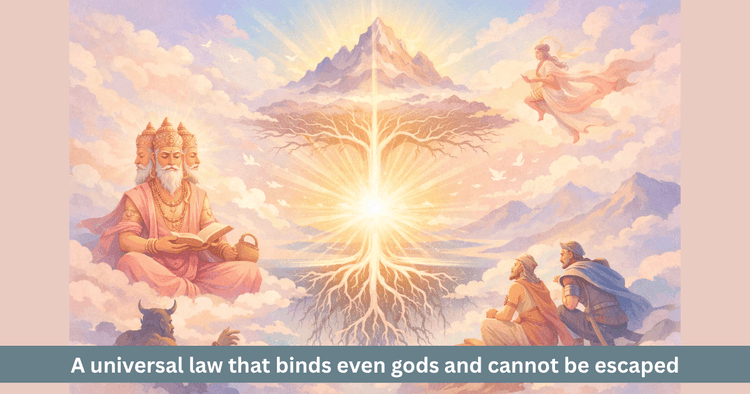
Table of Contents
At times, sacred narratives do not merely describe events of the past. They awaken questions hidden deep within the human mind. One such question arises from the story of Brahma. If Brahma is the creator of the universe, if the Vedas give him an exalted place, if the origin of living existence is linked with his name, then why are his temples so few. This is not merely a religious curiosity. It points toward a subtle truth that the Sanatana tradition teaches again and again, that there is a principle greater than position, a dharmic order greater than power and a reality greater than divinity itself and that reality is truth.
This narrative compels a person to pause and reflect. Common thinking would suggest that the creator should naturally be the most widely worshiped. Yet tradition offers a different teaching. It says that even deities are bound by laws. At first, this thought feels surprising, yet here lies the depth of the story. In Sanatana Dharma, divinity does not mean freedom from consequence. Rather, the higher the station, the deeper the responsibility. That is why the story of Brahma is not only about the rarity of temples. It reveals the universal order before which gods, sages, celestial beings and human beings all remain bound.
Brahma’s Limited Worship Is Not Mere Coincidence
Many people assume that the small number of temples dedicated to Brahma is only a simple matter of tradition. Yet the Puranic view approaches this subject with much greater seriousness. It suggests that public devotion does not remain steady merely because of creative power, divine status or cosmic importance. Worship remains rooted where truth, humility and conduct aligned with dharma remain steady. Brahma’s greatness never disappears, yet his limited worship becomes a silent teaching.
It is also important to understand that the Sanatana tradition does not reduce one deity in order to glorify another. Every deity has an essential role. Brahma is the creator, Vishnu the sustainer and Shiva the force of dissolution and transformation. Yet when the question turns toward enduring worship, power alone is not enough. Conduct and truthfulness become decisive. For this reason, the rarity of Brahma’s temples is not a denial of his greatness. It is a profound spiritual warning.
This warning matters even more for human life. If a person seeks respect only through status, seeks trust only through authority or assumes that success alone guarantees lasting honor, that person has not understood the central message of this story. Enduring reverence does not arise from outer achievement alone. It arises from inner moral steadiness.
The Curse That Changed the Direction of Worship
A Puranic episode presents this teaching with striking force. A sacred yajna, meaning a consecrated fire ritual, was to be completed. A yajna is not simply a matter of offerings, mantra and flame. It depends upon timing, purity, participation and sacred discipline. During this ritual, circumstances arose in such a way that Savitri did not arrive on time. That delay created a turning point whose effect remained alive in religious memory.
When Savitri arrived, she saw Gayatri beside Brahma in that ritual setting. That sight awakened deep anger within her. This moment should not be read merely as a personal emotional reaction. It symbolizes a condition in which time, sacred order, commitment and ritual propriety fall out of balance. The result of that imbalance was not only emotional. It left a permanent mark upon the stream of devotion.
Within this setting, the line becomes deeply meaningful: Yadi satya ka tyag kiya jaye, to puja na hogi, meaning if truth is abandoned, worship will not remain. This does not only suggest a curse. Its deeper teaching is that the worthiness of worship is not secured by position alone. When the core balance of dharma is disturbed, the form of reverence itself may change. This is a serious teaching because it shows that cosmic order is not impressed by outward prestige.
Brahma’s role as the creator remains valid today just as it was in ancient times. His place in the Vedas, the Puranas and philosophical thought remains secure. Yet his limited worship in public religious life shows that honor and ongoing devotion function at different levels. Respect may remain because of wisdom and role but worship endures where reverence is supported by truth.
When Ego Covered Truth
The episode involving Brahma and Vishnu in the question of supremacy is also connected with this wider teaching. This story is not simply a description of divine rivalry. It shows how ego can blur truth the moment it enters the field of awareness. It is said that when Bhagavan Shiva appeared as an endless column of radiance, no one could know its beginning or its end. That infinite form represented the boundless principle of truth itself.
In such a situation, to claim that one had found its end was not merely a statement. It reflected a deeper tendency in which a being tries to protect position by compromising with truth. Here the story becomes profoundly human as well, because falsehood does not appear only in divine narratives. Human beings too often distort truth in order to protect prestige, status, fear or ambition.
Shiva recognized that falsehood. Then emerged the essence of the declaration: Jisne satya ko tyaga, uska naam prithvi par vandaniya nahin hoga, meaning the one who abandoned truth will not remain worthy of reverence on earth. If this is understood only as a curse, only half the meaning is received. In reality, it is a statement of cosmic justice. It says that reverence does not arise merely from a high station. It is earned through truthfulness and it can diminish through falsehood.
This episode teaches another deep principle. The higher the position, the greater the expectation of transparency. The mistake of an ordinary person may remain within a small circle but the deviation of one placed high spreads much farther. That is why this story teaches that even a divine position cannot cancel the universal law. The one who stands higher must remain more vigilant.
What Does It Really Mean That No Deity Is Greater Than Truth
In the Sanatana tradition, the sentiment appears again and again that no deity is greater than truth. Some may treat this as a simple moral saying, yet it is actually one of the deepest principles of dharmic thought. It does not reduce the importance of the deities. It means that even divinity itself stands established within the order of satya, meaning truth, dharma, meaning righteous order and rita, meaning the sacred cosmic rhythm of truth and balance. This is the very structure that sustains creation.
If this rule did not exist, power itself would become the final truth. Then dharma would lose its meaning. But the Sanatana vision does not permit that. It teaches that authority is also tested, divinity also has its sacred restraint and worship also stands on a foundation. That foundation is truth. therefore the story of Brahma is not merely an explanation for the scarcity of temples. It reveals the spine of sacred consciousness itself.
When a human being begins to understand that truth is not only something to be spoken but a law of existence, life begins to change. Relationships become clearer. Actions become more responsible. Speech becomes more accountable. Slowly one realizes that falsehood may bring immediate advantage but it does not generate lasting reverence.
For this reason, Brahma’s story is not limited to theology. It applies equally to life management, social trust, family balance and spiritual discipline. Where truth exists, there is steadiness. Where steadiness exists, reverence endures.
The Spiritual Signal Hidden in Brahma’s Absence
It is deeply thought provoking that Brahma is present in the Vedas, in streams of knowledge and in philosophical reflection on creation and yet his direct worship remains limited. Outwardly this seems to be a question about temples but inwardly it becomes a question of self examination. Tradition appears to say that creation alone is not enough. To preserve sacredness, one must also sustain the continuous practice of truth.
Thus Brahma’s limited worship becomes a symbolic teaching. It tells us that greatness and worship worthiness do not always operate at the same level. A being may be great, necessary and exalted, yet if the memory associated with that being carries a sense of imbalance, ego or falsehood, the current of collective devotion may change. This is why Brahma’s honor remains, yet daily worship of him appears limited.
There is a subtle spiritual point here. Sanatana Dharma does not teach only whom to worship. It also teaches what allows one to remain worthy of worship. This applies to deities symbolically and to human beings directly. If life lacks humility, truthfulness and dharmic awareness, then even outer success cannot fill the inner void.
In this context, the sentence becomes deeply meaningful: Satya ka palan hi sacche jeevan ka marg hai, meaning the practice of truth alone is the path of a real life. This is not merely a lesson in courtesy. It is the foundation of sadhana, meaning sacred disciplined inner practice. A person who lives by truth becomes less scattered within. Consciousness becomes clearer. Personality becomes more trustworthy. Eventually, life itself begins to take the form of worship.
If Even the Gods Are Bound by Law, Why Should Human Beings Not Learn
If this story is treated only as a sacred legend, its most necessary teaching will be missed. This narrative addresses human life directly. If even the highest divine station is shown as bound by law, timeliness, sacred restraint and dharma, then the teaching becomes even more urgent for human beings. That is why the line carries such force: Ishvar bhi niyamon se bandhe hain, hamein bhi palan karna chahiye, meaning even the divine is bound by laws, we too should follow them.
Modern life often creates the illusion that power guarantees safety. A person gains rank, wealth or fame and begins to believe that consequences will no longer matter in the same way. Yet life repeatedly proves otherwise. Without character, achievement remains unstable. Disrespect toward time, ego, falsehood or lack of responsibility slowly hollows out reputation from within.
The story of Brahma symbolizes this truth. The lapse here is not merely a practical mistake. It represents a deviation from principle. And when principle breaks, the effect does not remain limited to one event. It enters memory, tradition, collective consciousness and even the way future generations understand a name.
This is why the story remains so powerful even today. It does not merely say do not lie. It says something much deeper. It says that the one who turns away from truth slowly diminishes the glow of spiritual radiance within. It is this radiance that gives rise to reverence. It is this radiance that preserves true stature.
Why This Story Matters So Deeply in the Present Age
The present age is full of speed. Decisions are rapid, reactions are immediate, competition is sharp and outer achievement often appears extremely attractive. Yet in such a time, inner steadiness, commitment to truth and self restraint become even more necessary. That is why the story of Brahma remains relevant. It reminds us of the invisible moral structure without which no success remains secure.
If a person honors a promise, remains faithful to time, tries to keep ego from governing decisions and refuses to use falsehood as a convenient tool, life slowly becomes more balanced. That balance is not only social. It is mental and spiritual as well. Such a person may appear ordinary from the outside, yet inwardly there is steadiness. Over time, that steadiness gives birth to trust and reverence.
Ancient stories did not survive merely because they spoke of gods. They endured because they hold a mirror before human life. They reveal that responsibility matters more than authority, humility matters more than fame and fidelity to truth matters more than visible success. The episode of Brahma expresses this principle with rare sharpness.
It also teaches that great decline does not always come from great events. Sometimes a small imbalance, an unguarded statement, an improper claim or a brief moment of ego can shape consequences for a very long time. That is why the story is not only religious. It is intensely practical.
Where Truth Lives, Reverence Endures
If the entire story must be gathered into one essence, it can be said that its center is not Brahma’s absence but the inescapable presence of truth. Once this is understood, the story rises beyond punishment and becomes a teaching of awakening. It does not seek to create fear. It seeks to help a human being look clearly at the direction of one’s own life.
Ego is temporary. Position changes. Fame rises and falls. But truth remains steady. That steadiness is the root of reverence. Where truth exists, trust is born. Where trust is born, devotion remains. And where devotion remains, life deepens in meaning.
When a person honors truth, the inner self begins to stand with that person. Inner conflict decreases. Speech becomes clearer. Action becomes more restrained and aligned. Worship then no longer remains limited to the temple. Keeping one’s word, respecting time, humility, pure conduct and faithfulness to dharma also become forms of devotion.
This is the greatest teaching of the story. The universe is not sustained by power alone. It is sustained by principle. And the name of that principle is truth. The one who understands this realizes that before becoming great, one must become truthful. In the end, the person who becomes worthy of lasting reverence is not the one who shines by position alone but the one who shines through character.
Frequently Asked Questions
Why is Brahma worshiped less in temples
According to Puranic tradition, Brahma’s limited worship conveys a deeper teaching that truth, humility and the practice of dharma are greater than status and power. His honor remains but his lesser worship becomes a reminder of this principle.
Does Brahma become less important because his temples are few
No, not at all. Brahma remains deeply revered in the Vedas, the Puranas and in philosophical understanding as the creator. The rarity of temples does not deny his greatness. It serves as a symbolic sacred lesson.
What is the greatest teaching human beings should learn from this story
The central lesson is that no deity is greater than truth. If one preserves integrity in speech, timing, conduct and humility, then life itself becomes a path of sacred discipline.
Are there still temples of Brahma today
Yes, there are still a few temples dedicated to Brahma. Among them, the Brahma Temple at Pushkar is especially well known and is regarded with deep reverence.
How can this teaching be applied in life today
By speaking truth, respecting time, keeping one’s promises, avoiding ego, remaining responsible toward one’s duties and living with humility, this teaching can be brought meaningfully into everyday life.
Get your accurate Kundali
Generate KundaliDid you like it?
Author

Pt. Sanjeev Sharma (63)
Experience: 20
Consults About: Family Planning, Career
Clients In: Punjab, Haryana, Delhi
Share this article with friends and family
About ZODIAQ
ZODIAQ is an online Vedic Astrology platform. It connects clients seeking astrological advice to experienced astrologers with deep knowledge. Our users also generate kundali and perform kundali milan for free. ZODIAQ also offers services to the Astrologers. Astrologers utilize various offerings by ZODIAQ to serve their clients effectively.
If you are a User
Consult with experienced astrologers and seek their guidance. You can also order handwritten Janm Patrika report with life prediction prepared by experienced astrologers. Generate accurate Kundali, perform Kundali Matching and check horoscope and muhurat. Utilize our online library for all the necessary astrological and spiritual information.
If you are an Astrologer
Create accurate kundali for your clients and perform Kundali Matching for up to 5 people at a time. Write comprehensive Janm Patrika report for your clients with ZODIAQ. Check client details anytime by saving it in client directory. Become more productive by tracking how many clients you guide every day.
WELCOME TO
ZODIAQ
Right Decisions at the right time with ZODIAQ
