Yogini Ekadashi Vrat Katha and Significance
By Aparna Patni
Complete Story and Auspicious Benefits of This Fast
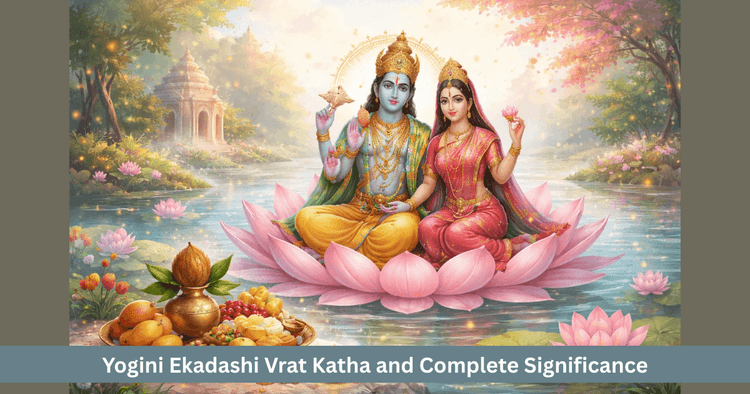
Table of Contents
The very name of Ekadashi naturally brings Lord Vishnu to mind. Among the twenty four Ekadashis observed in a year, Yogini Ekadashi is regarded as especially powerful and purifying. It is believed that those who observe this fast with sincerity, worship with devotion and listen to or read the Yogini Ekadashi Katha begin to see their heartfelt wishes slowly fulfilled and many obstacles soften over time.
Yogini Ekadashi falls in the Krishna Paksha of the month of Ashadha. On this day devotees worship Lord Vishnu and also honour Goddess Lakshmi, seeking blessings of prosperity, harmony and protection. The real fruit of this fast does not come from fasting alone. It arises from a combination of worship, story listening and a pure intent in the heart, which is why it is said that the Yogini Ekadashi Vrat remains incomplete without its Katha.
What is the importance of Yogini Ekadashi
Yogini Ekadashi is not seen as an ordinary fast. It is understood as a practice that works on mind, body and karma together.
- Worship of Lord Vishnu and Goddess Lakshmi on this day is believed to bring destruction of sins, relief from sorrows and the blessing of contentment and abundance.
- The special strength of this Ekadashi is said to lie in reducing the burden of long standing wrongs that keep troubling the mind, where one feels regret but does not know how to heal.
- Yogini Ekadashi is also associated with relief from suffering caused by serious diseases such as leprosy, when the fast is kept with full devotion and proper method.
The events in the Katha are not just a tale. They show how deep acceptance of mistakes, genuine repentance and sincere spiritual effort can transform even a very heavy destiny.
What is the Yogini Ekadashi Vrat Katha
The traditional story of Yogini Ekadashi is moving and thought provoking. It shows how negligence and uncontrolled desire can disrupt life and also how Vrata and faith can lift a person again.
The story of Alakapuri, Kuber and Hem Mali
Long ago, in the divine city of Alakapuri, the treasurer of the gods, Kuber, lived in great splendour. He was a devoted worshipper of Lord Shiva and performed daily worship with great reverence. For this worship, a gardener named Hem had the responsibility of bringing fresh flowers from the sacred lake Mansarovar every day.
Hem Mali would regularly collect flowers on time and fill the place of worship with fragrance and colour. Life was harmonious, Kuber was pleased and Hem enjoyed the fortune of serving the Lord. Then one day things changed. That day Hem became deeply absorbed in pleasure with his wife and forgot the importance of his duty.
Time slipped away. The auspicious hour for worship passed and he reached Kuber’s court with flowers much too late. When Kuber realised that Lord Shiva’s worship had been delayed only because of Hem’s negligence and indulgence, he became very angry. In anger he cursed Hem to fall into the mortal world and wander as a leper.
Under the force of the curse Hem lost his divine appearance and was struck with leprosy. His family, comfort and honour vanished. Alone and in great pain he began to wander through forests with a wounded body and a heavy mind.
Shelter with Markandeya Rishi and the path of the fast
While wandering in this miserable state, Hem one day reached a dense forest where the great sage Markandeya Rishi was absorbed in penance. Exhausted and full of suffering, Hem fell at the feet of the sage. Seeing his pitiable condition, the compassionate Rishi asked who he was, how this had happened and which actions had brought such misery.
With eyes full of remorse Hem narrated his entire story. He spoke of serving Kuber, bringing flowers for Shiva’s worship and then forgetting his duty due to desire, reaching late and receiving Kuber’s curse. The sage recognised his honesty and repentance and showed him a way to redemption.
Markandeya Rishi told him that if he would observe the fast of Yogini Ekadashi in the Krishna Paksha of Ashadha with full discipline, his sins would be destroyed and his disease would go. Hearing this, a new hope arose in Hem’s heart. He bowed to the sage with deep respect and resolved to follow the instructions exactly.
Observing the fast and the transformation that followed
When the time came, Hem observed the Yogini Ekadashi Vrat as taught by the Rishi. With discipline, restraint and devotion he kept the fast, performed worship, listened to the Katha and sought forgiveness in his heart for his past faults.
Through the power of this Vrata his leprosy slowly disappeared. His body regained a luminous and healthy form. The life that had been crushed under guilt and illness became light, strong and joyful. In the end he attained the heavenly realms and lived in a state far higher than before.
The message is clear. When one accepts responsibility, seeks the right guidance and follows Vrata with sincerity, even the heaviest karmic load can gradually become lighter.
Yogini Ekadashi Vrat and Puja Vidhi
The Yogini Ekadashi Vrat is not merely about avoiding food. It is a complete day of focused practice. On this Krishna Paksha Ekadashi of Ashadha, the traditional routine is as follows.
Main rules of the fast
- The Vrat begins at dawn with a bath and a clear sankalpa for the day.
- Throughout the day one maintains restraint in thought, speech and action as far as possible.
- Food is taken according to one’s capacity and tradition, such as fruit only, light fasting or water based fasting. The aim is purity, not torture.
Puja steps and worship
- On this day an image or murti of Narayana is bathed and adorned with flowers, sandal paste and sacred offerings.
- Lord Vishnu is worshipped together with Goddess Lakshmi so that both prosperity and righteousness stay balanced in life.
- After offering food, devotees perform aarti with incense and lamp and conclude the ritual with prayer.
Charity, Katha and special beliefs
On Yogini Ekadashi, along with worship, charity and listening to the Katha are considered very important.
- Sacred texts say that giving food, clothes or other help to poor Brahmins or the needy on this day is highly meritorious.
- The Vrat is regarded as complete only when the Katha of Yogini Ekadashi is attentively heard or read. The story brings the inner meaning of the Vrat into the heart and deepens understanding beyond outer rules.
- There is also a belief that the sin of cutting a peepal tree, which is considered very serious, can be cleansed through this fast if it is observed with genuine repentance and devotion.
The essence of these beliefs is that humans must live responsibly toward nature, trees, living beings and society. When a mistake occurs, one should sincerely seek to transform oneself through repentance and spiritual effort.
Inner message of the Yogini Ekadashi Vrat
The Yogini Ekadashi Vrat Katha carries more than a list of rewards and punishments. It offers a deep reflection on daily life.
- The story of Hem Mali shows how easily life can change direction when one ignores duty and is driven only by desire.
- Kuber’s curse reminds that neglecting a responsibility is not only a personal lapse. It is also a failure in relation to the divine and to the order we serve.
- The guidance of Markandeya Rishi shows that when a person honestly accepts his or her mistake, the divine sends a way towards correction and healing.
The core teaching of this Ekadashi is that a fast must be of the heart as much as of the body. When sankalpa, self correction and reflection join ritual, Yogini Ekadashi truly becomes a day of union and inner balance.
Common questions about Yogini Ekadashi
Does simply reading the Katha give the full fruit of the Vrat?
Listening to or reading the Katha is essential, yet the complete fruit arises when fasting, worship, self restraint and Katha all come together in a sincere way.
Can one observe Yogini Ekadashi without a full fast due to health reasons?
Yes. One may follow a lighter fast with fruits or simple food according to health. What matters most is a pure intention, discipline and devotion to the Lord.
Should only Lord Vishnu be worshipped on this day?
Lord Vishnu is the central deity of this Ekadashi. Alongside him, Goddess Lakshmi is also honoured so that both material well being and inner virtues stay in harmony.
Is Yogini Ekadashi important only for relief from diseases?
It is known for relief from diseases, yet it is equally important for destruction of sins, mental peace, prosperity and creating a sense of new beginning in life.
What if someone cannot listen to the Katha on the same day?
If circumstances prevent listening on that day, one should pray for forgiveness and read or hear the Katha as soon as possible. Still, it is best to plan so that the Katha can be heard on the Vrat day itself.
Get your accurate Kundali
Generate KundaliDid you like it?
Author

Aparna Patni (63)
Experience: 20
Consults About: Family Planning, Career
Clients In: Punjab, Haryana, Delhi
Share this article with friends and family
About ZODIAQ
ZODIAQ is an online Vedic Astrology platform. It connects clients seeking astrological advice to experienced astrologers with deep knowledge. Our users also generate kundali and perform kundali milan for free. ZODIAQ also offers services to the Astrologers. Astrologers utilize various offerings by ZODIAQ to serve their clients effectively.
If you are a User
Consult with experienced astrologers and seek their guidance. You can also order handwritten Janm Patrika report with life prediction prepared by experienced astrologers. Generate accurate Kundali, perform Kundali Matching and check horoscope and muhurat. Utilize our online library for all the necessary astrological and spiritual information.
If you are an Astrologer
Create accurate kundali for your clients and perform Kundali Matching for up to 5 people at a time. Write comprehensive Janm Patrika report for your clients with ZODIAQ. Check client details anytime by saving it in client directory. Become more productive by tracking how many clients you guide every day.
WELCOME TO
ZODIAQ
Right Decisions at the right time with ZODIAQ
