What Does Apasmara Beneath Dakshinamurti Signify
By Pt. Nilesh Sharma
How Apasmara symbolizes ignorance and instability, revealing the deeper meaning of the Guru principle in Dakshinamurti
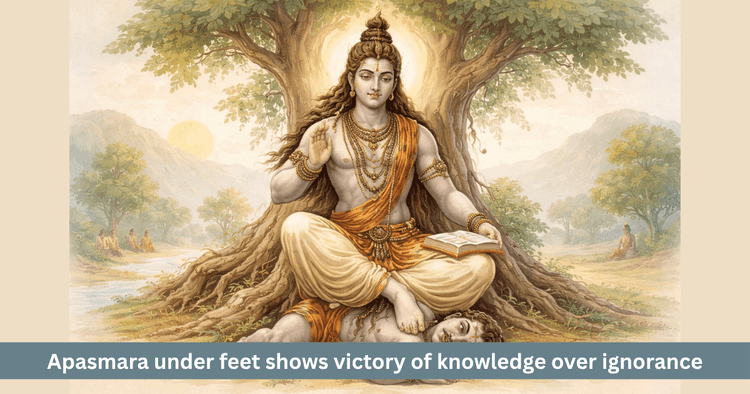
Table of Contents
The form of Lord Dakshinamurti in Indian spirituality is not merely a divine image but a subtle symbol of the Guru principle, Self knowledge and teaching through silence. Every feature of this form, every gesture and every symbol is linked with a deep philosophical meaning. Among these, one of the most important elements is the dwarf demon seen beneath his feet, known as Apasmara Purusha. At first glance this may appear to be only an artistic detail, yet in truth it becomes a key to understanding the entire meaning of Dakshinamurti.
Apasmara should not be understood merely as a demon. It is regarded as a symbol of ignorance, confusion, instability of awareness and the condition of forgetting truth. When Dakshinamurti is shown pressing it beneath his feet, this is not merely an image of divine power. It is the vision of that Guru truth which quiets the darkness within the disciple and grants the light of knowledge. That is why this episode belongs not only to iconography but also to inner awakening.
Who is Apasmara Purusha
Apasmara Purusha is the dwarf demon shown beneath the feet of Dakshinamurti in sacred imagery. In Shaiva tradition and Agamic interpretation, this figure carries a very deep meaning. It is not the representation of an outer enemy. It symbolizes that condition within the human being in which one becomes removed from truth, disconnected from inner remembrance and deprived of Self awareness.
Here the word Apasmara is not limited only to a literal indication of illness. It is also understood as a symbol of forgetfulness, decline of awareness, distance from knowledge and spiritual instability. That is why the demon beneath the feet of Dakshinamurti represents that state of the human mind which wanders in ignorance after losing touch with its real nature.
Why is it called the demon of ignorance
In Indian spirituality, ignorance is not merely the lack of information. Ignorance means not knowing one’s true Self, forgetting truth and mistaking the temporary for the eternal. When this condition deepens, the human being may appear clever outwardly, yet inwardly remains unstable, fearful and confused. Apasmara is a symbol of this inner darkness.
The word demon here does not refer to an imaginary frightening creature. It refers to that force which draws the human being away from inner peace. Ignorance is such a force. It slowly covers memory, discernment and inner steadiness. That is why Apasmara is called the demon of ignorance. It does not live outside. It lives within and until the grace of the Guru arises, the seeker may not even recognize it.
Symbolic meanings of Apasmara
• Ignorance that covers truth
• The state of forgetfulness in which one loses awareness of the true Self
• An unsteady and restless mind unable to hold real knowledge
• A confused awareness that keeps wandering despite having direction
Why does Dakshinamurti press him beneath his feet
The form of Dakshinamurti is that supreme form of the Guru who does not merely teach but presses down the ignorance living within the disciple. The fact that Apasmara lies beneath his feet signifies that the revelation of knowledge becomes possible only when ignorance comes under control. As long as confusion remains active within, the light of Self knowledge cannot remain steady.
The pressing down here does not mean destruction through anger. It means rendering its power ineffective. The Guru does not fear the darkness within the disciple. He recognizes it, has mastery over it and finally quiets it. The foot of Dakshinamurti is therefore important because it symbolizes not mere suppression but spiritual victory. This is not the victory of an outward battle. It is the victory of transformation within consciousness.
Is Apasmara only a symbol of disease
The word Apasmara is traditionally linked with forgetfulness, instability of awareness and forms of mental disorder. Yet in the image of Dakshinamurti, its meaning becomes much wider. Here it is not merely a sign of illness. It becomes a symbol of that deep spiritual disease in which the human being falls into forgetfulness of one’s true nature.
Forgetting one’s true nature means that one becomes trapped in outer identity, fear, desire and temporary achievement while losing connection with the real Self. In this sense, Apasmara can exist in some form within every seeker. This makes the symbol extremely alive. It teaches us that in spiritual life the greatest enemy is not an outer opponent but the inner condition of forgetting.
How does the Guru crush ignorance and grant knowledge
This question lies at the heart of the Dakshinamurti form. The Guru does not fill knowledge from outside. He reveals it from within. He does not give the disciple something entirely new. He uncovers the truth already present within. But this cannot happen while the disciple’s mind remains covered by confusion, doubt, instability and ignorance. The Guru first removes that covering. That is the deeper meaning of placing the foot upon Apasmara.
When the Guru crushes ignorance, he does not take away the freedom of the disciple. He liberates the disciple’s awareness. He reminds the seeker that one is not merely a creature of fear, forgetfulness, doubt and darkness. The light of knowledge already exists within. The work of the Guru is to reveal it. That is why the silence of Dakshinamurti, his foot and the subdued Apasmara together reveal the full process of Guru grace.
Teachings from the episode of the Guru and Apasmara
• The Guru first quiets ignorance, then reveals knowledge
• A mind full of confusion cannot hold truth steadily
• Knowledge is not an outer object but an inner remembrance
• The foot of the Guru symbolizes both protection and awakening
What is the relation between the silence of Dakshinamurti and Apasmara
The silence of Dakshinamurti is well known. He is revered as the Adi Guru who removes the doubts of the disciple without speech. This silence becomes effective only when Apasmara lies subdued beneath him. As long as ignorance remains active, silence may seem only empty. But when ignorance becomes quiet, that same silence becomes a presence filled with knowledge.
From this perspective, Apasmara and silence are not opposites. They are two stages in the process of Guru revelation. First the restlessness of ignorance is subdued, then the wisdom of silence becomes available. This form of Dakshinamurti teaches the seeker that true silence begins when the inner noise decreases. And inner noise decreases only when Apasmara, the ignorance within, loses its hold.
How does Shaiva Siddhanta read this symbol
In Shaiva Siddhanta, the Guru, knowledge, grace and release from bondage are of great importance. From this perspective, Apasmara becomes a symbol of the binding condition in which the soul remains unable to experience truth due to ignorance. Dakshinamurti stands above that condition. This means that the Guru principle is not subject to ignorance but transcends it and triumphs over it.
In this tradition, knowledge is not merely intellectual information. Knowledge is the light that leads the soul back to its deepest identity. Therefore Apasmara beneath the feet is not only an artistic posture. It is a visible teaching of the path to liberation. It declares that where Guru grace is present, ignorance no longer remains the final authority.
What is the dignity of this form in Agama Shastra
Agama Shastra does not interpret temple image and sacred form merely through aesthetics. Every element is understood to carry a spiritual purpose. The presence of Apasmara beneath Dakshinamurti is one such element. It shows that the image is not only an object of worship but also a school of spiritual vision.
From the Agamic point of view, when the seeker sees this image, one should not only have darshan of the Lord. One should also ask inwardly, what is my Apasmara. What is my confusion. What do I keep forgetting. What is disordered within me. Then one understands that only by taking refuge in the Guru can this inner demon be overcome.
In what forms does Apasmara appear in the life of a seeker
Within every seeker, Apasmara may appear in a different form. For one it may be ego. For another, restlessness. For another, fear. For another, spiritual laziness. For another, hearing truth yet failing to live it. This is why the symbol of Apasmara remains just as relevant today as it must have been in earlier times.
When a seeker begins to identify these tendencies within, the image of Dakshinamurti becomes inwardly alive. Then one understands that this dwarf demon does not lie only beneath the icon. It is also present somewhere within one’s own consciousness. This understanding is the beginning of sadhana and turning toward the Guru is the next step.
Possible forms of Apasmara within the seeker
• Self doubt
• Forgetting the true aim of life
• Hearing knowledge yet failing to embody it
• Ego and instability
A simple table to understand this symbol
| Element | Deeper meaning |
|---|---|
| Apasmara Purusha | Symbol of ignorance, forgetfulness and unstable awareness |
| Foot of Dakshinamurti | Guru grace and victory over ignorance |
| Dwarf demon | The limited and distorted inner mind |
| Silent teaching | Transmission of knowledge beyond words |
| Granting knowledge | Awakening inner remembrance and removing confusion |
Why is this symbol important in the present age
The human being of today knows much, yet forgetfulness, distraction and mental fragmentation have increased more than ever. Information is abundant but inner remembrance is weak. This is the modern form of Apasmara. In such a time, the demon beneath the feet of Dakshinamurti becomes a deeply important reminder. It teaches that knowledge will not arise through information alone. It requires the recognition of inner ignorance and its quieting through Guru grace.
For this reason, the symbol is not merely part of ancient iconography. It is also a need of modern spiritual practice. The person who recognizes the inner Apasmara has already walked half the path. The one who takes refuge at the feet of Dakshinamurti can receive direction for the rest.
Darkness beneath the feet, light awakening above
This episode of Dakshinamurti and Apasmara gives us a profoundly beautiful spiritual teaching. The rise of knowledge does not happen by ignoring ignorance. First darkness is recognized, then it is quieted and only then does inner light become steady. The Apasmara beneath the feet of Dakshinamurti is the visible form of this truth.
That is the enduring power of this symbol. It does not frighten the seeker. It makes the seeker both alert and assured. Alert because ignorance is hidden within. Assured because Guru grace is greater than it. Once this truth enters the heart, the image of Dakshinamurti no longer remains only a sacred form for worship. It becomes an invitation to inner awakening.
Frequently asked questions
Who is Apasmara Purusha
Apasmara Purusha is the dwarf demon beneath the feet of Dakshinamurti and is regarded as a symbol of ignorance, forgetfulness and unstable awareness.
Why is he called the demon of ignorance
Because he represents the inner darkness that takes the human being away from truth, Self knowledge and steady discernment.
Why does Dakshinamurti press him under his feet
This shows that the Guru gains victory over ignorance and then grants knowledge to the disciple.
Is Apasmara related to forgetfulness as an illness
Yes but here the meaning also extends to spiritual forgetfulness and the disorder of consciousness.
With which traditions is this symbol generally associated
It is generally associated with Agama Shastra and Shaiva Siddhanta.
Get your accurate Kundali
Generate KundaliDid you like it?
Author

Pt. Nilesh Sharma (63)
Experience: 20
Consults About: Family Planning, Career
Clients In: Punjab, Haryana, Delhi
Share this article with friends and family
About ZODIAQ
ZODIAQ is an online Vedic Astrology platform. It connects clients seeking astrological advice to experienced astrologers with deep knowledge. Our users also generate kundali and perform kundali milan for free. ZODIAQ also offers services to the Astrologers. Astrologers utilize various offerings by ZODIAQ to serve their clients effectively.
If you are a User
Consult with experienced astrologers and seek their guidance. You can also order handwritten Janm Patrika report with life prediction prepared by experienced astrologers. Generate accurate Kundali, perform Kundali Matching and check horoscope and muhurat. Utilize our online library for all the necessary astrological and spiritual information.
If you are an Astrologer
Create accurate kundali for your clients and perform Kundali Matching for up to 5 people at a time. Write comprehensive Janm Patrika report for your clients with ZODIAQ. Check client details anytime by saving it in client directory. Become more productive by tracking how many clients you guide every day.
WELCOME TO
ZODIAQ
Right Decisions at the right time with ZODIAQ
