The Science of Chinmaya Mudra: The Silent Symbol of the Union of the Individual Self and the Supreme
By Pt. Sanjeev Sharma
How Chinmaya Mudra expresses the deep spiritual relationship between the self, Supreme, ego, karma and maya
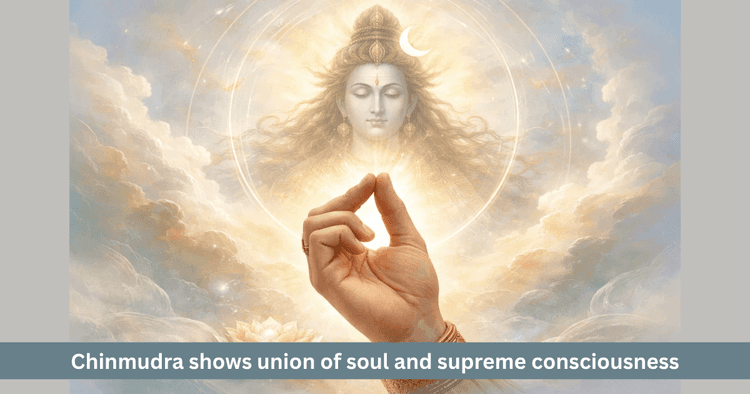
Table of Contents
In the Indian spiritual tradition, sacred gestures, hand positions, postures and iconographic details are never treated as mere ornamentation. Every mudra contains philosophical depth, spiritual instruction and the direction of inner realization. The Chinmaya Mudra seen in the hand of Bhagavan Dakshinamurti is one such profoundly meaningful gesture. At first glance, it may appear to be only a particular arrangement of the fingers. Yet inwardly it becomes a complete spiritual teaching in which the relationship between the individual soul, the Supreme, ego, karma and maya is all expressed in a single silent symbol.
In the traditions of Yoga Shastra and Tantra Sara, this mudra is explained not merely as a gesture of instruction but as a direct expression of realized knowledge. In it, the index finger touches the thumb. The index finger is regarded as the symbol of the jivatma, the individual self, while the thumb is regarded as the symbol of the Paramatma, the Supreme Self. Their meeting signifies that the final journey of the soul finds completion only in union with its highest source. At the same time, the remaining three fingers remain apart, representing ego, karma and maya. In this way, a single hand gesture becomes a map of the entire spiritual path.
Why Is Chinmaya Mudra Considered So Important
The center of Dakshinamurti’s teaching is not speech but silent knowledge. therefore any mudra in his hand cannot be accidental. Chinmaya Mudra teaches that the highest truth is not merely a matter of hearing or reading. It is a matter of union, recognition and the rediscovery of one’s own true source. For this reason, it is not merely symbolic. It is living philosophy.
This mudra is especially important because it shows two things at once. First, the union of the individual self with the Supreme. Second, the factors that create the illusion of separation. That is why it is linked to knowledge, meditation, guru principle and self realization.
Key points for understanding the importance of Chinmaya Mudra
- It transforms knowledge from verbal teaching into sacred symbol
- It teaches that the final destiny of the individual self is union with the Supreme
- It shows that ego, karma and maya remain as coverings while the soul lives in bondage
- It is the visual expression of the guru’s teaching that truth must be both seen and realized
Why Is the Index Finger Regarded as the Individual Self
The index finger is the finger most commonly used to point outward. It indicates objects, directions, identities and distinctions. For this reason, in spiritual symbolism it becomes associated with that individual sense of self which experiences itself as separate, acts in the world and identifies with limited existence. This is the individualized self sense.
The essential nature of the jivatma is pure consciousness. Yet when it identifies with body, mind, intellect and ego, it begins to feel bound and separate. The index finger represents this limited self experience. It stands somewhat apart, as though declaring its own distinct identity. But when that same finger joins the thumb, its seeming separation begins to dissolve.
Why Is the Thumb a Symbol of the Supreme
The thumb is the most stable, foundational and powerful finger of the hand. Without the thumb, grasp weakens, balance is reduced and the hand’s full potential cannot express itself. For this reason, the thumb is taken as the symbol of the Supreme Self. It stands by itself, depends on nothing else and silently supports the activity of all the other fingers.
The Supreme is understood in exactly this way. It is the basis of all, yet itself dependent on none. It pervades all, yet remains unbound. Therefore when the thumb joins the index finger, it visually expresses the great truth that the individual self too ultimately rests in the Supreme.
How Does the Union of the Index Finger and Thumb Become Supreme Knowledge
The central teaching of Chinmaya Mudra is that the union of the individual self and the Supreme is not a new external event. It is a transformation of recognition. When the index finger touches the thumb, it gives up its apparent separateness and returns to its source. This is the root of supreme knowledge. Knowledge does not mean merely knowing that the Supreme exists. It means realizing that the true nature of the individual self is grounded in that very Supreme reality.
This union does not imply that two truly separate things come together for the first time. It means that what only appeared separate comes to know its essential oneness. This is the heart of Advaita Vedanta. That is why Chinmaya Mudra may be understood not merely as a yogic hand gesture but as a visual interpretation of self realization.
Why Do the Other Three Fingers Remain Separate
The second important dimension of Chinmaya Mudra is that the remaining three fingers stay apart. Traditionally, they are understood as symbols of ego, karma and maya. This carries a very deep meaning. The real relationship between the individual self and the Supreme always exists, yet the individual forgets this truth because these three coverings remain operative. These are the forces that make worldly experience appear final and binding.
The fact that the three fingers remain apart suggests the following:
- Ego makes the individual feel like a separate doer
- Karma binds one into action and consequence
- Maya casts a veil over reality
Thus the mudra teaches at once that union is possible but that certain coverings stand between the soul and realization.
The spiritual symbolism of the three fingers
| Symbolic finger meaning | Deeper significance |
|---|---|
| Ego | The limited sense of I and mine |
| Karma | The chain of cause and consequence |
| Maya | The veil over the real nature of truth |
Should These Three Be Seen as Enemies
A subtle point must be understood here. Ego, karma and maya should not be treated only as enemies. They are also part of the field through which the soul experiences the world. The problem is not their existence but complete identification with them. When the soul forgets that it is deeper than these coverings, bondage begins. Therefore Chinmaya Mudra does not destroy them. It reveals their limited place.
Ego gives the early structure of individuality. Karma gives movement to life. Maya creates the field of experience. But without true knowledge, these same principles become the causes of bondage. The mudra therefore teaches that the soul may rise above them by returning to its source.
Why Is the Relationship Between Dakshinamurti and Chinmaya Mudra So Deep
Dakshinamurti is the silent guru. He teaches more through presence than through speech. For such a guru to hold Chinmaya Mudra is deeply meaningful, because the mudra itself silently says what his silence conveys. The final question within the disciple is who am I. Chinmaya Mudra becomes the visual answer. You are not merely limited. Your true nature rests in the Supreme. Your bondage is temporary. Your essence is consciousness.
The connection between Dakshinamurti and this mudra is deep for another reason as well. Together they teach:
- Truth is not merely heard but recognized
- The task of the guru is not to create something new but to awaken the truth already within
- The apparent difference between individual self and Brahman is not ultimate
- The aim of spiritual practice is not to gain something external but to remove the coverings
Is This Mudra Only Philosophical or Also Practical for Spiritual Practice
It is not only symbolic. It is also a deeply effective aid in spiritual practice. In meditative traditions, hand gestures are linked to states of mind and energy. When a seeker sits in Chinmaya Mudra, one is not merely arranging the fingers. One is activating an inner remembrance. It becomes a reminder that the final goal is not outward wandering but inward return.
In practice, this mudra is considered helpful in several ways:
- It assists the seeker in turning inward
- It keeps alive the memory of non dual truth
- It symbolically settles the mind into steadiness and surrender
- It unites meditation and knowledge at one inner point
Why Does It Hold a Place in Both Yoga and Tantra
In both Yoga Shastra and Tantra Sara, the body is not viewed as a mere physical shell. It is seen as a medium of energy, awareness, memory and realization. That is why hands, breath, gaze, posture, mudra and meditation all interconnect. Chinmaya Mudra is important in both traditions because it changes the direction of awareness. It turns the mind inward.
For yoga, this mudra is related to prana, concentration and meditative memory. For tantra, it symbolizes the union of individual consciousness and Shiva consciousness, as well as the awakening of inner recognition. Thus it is not only a philosophical sign but also a part of practical spiritual science.
What Does Chinmaya Mudra Teach Modern Life
Modern life is full of outward identity, achievement, reaction, comparison and instability. The index finger of human attention is constantly turned outward. It keeps pointing toward objects, targets, people and problems. In such a time, Chinmaya Mudra offers a profound reminder that the outer world matters but the final answer will not be found only outside. One must reconnect with the source within.
This mudra gives several deep teachings for modern life:
- Do not build identity only upon ego
- Perform action but do not lose yourself entirely in action
- Do not deny maya but do not take it as the ultimate truth
- Seek the point within where the individual touches the Supreme
What Is the Deepest Spiritual Message of This Mudra
The final message of Chinmaya Mudra is simple, yet profoundly deep. The individual self is not truly separate. Its apparent separation is part of the journey. Its reunion is realization. Ego, karma and maya are the field of that journey. In this one mudra, the beginning, middle and culmination of spiritual life all appear together.
This mudra declares:
- You are not lost, you are only forgetful of your source
- You are not truly small, you have only mistaken yourself to be limited
- Your destination is not outside but within
- Supreme knowledge is not new construction but original recognition
Final Reflection
The science of Chinmaya Mudra is evidence of the astonishing subtlety of the Indian spiritual tradition, which can make even the simple position of fingers into a map of self realization. The traditions of Yoga Shastra and Tantra Sara show through this mudra that the relation between the individual soul and the Supreme is not a distant theory but a living truth of practice. The joining of the index finger with the thumb and the remaining apart of the other three fingers, is not merely a visual arrangement. It is a compact yet powerful expression of Vedanta, yoga and inner realization.
therefore it may be said that Chinmaya Mudra is not merely a hand gesture. It is a gesture of knowledge. Where ordinary perception sees only fingers joined together, awakened vision sees the union of the individual with the Supreme, the causes of bondage and the direction of liberation, all at once. That is the most beautiful and deepest truth of this sacred mudra.
Frequently Asked Questions
What does Chinmaya Mudra represent
It is understood as the symbol of the union of the individual soul with the Supreme.
Why is the index finger said to represent the individual self
Because it symbolizes limited identity and the sense of separateness.
Why is the thumb taken as the symbol of the Supreme
Because it represents the foundational, complete and self existent divine principle.
What do the other three fingers represent
They symbolize the coverings of ego, karma and maya.
What is the main teaching of this mudra
It teaches that the path of self knowledge lies in recognizing one’s true nature and rising beyond bondage.
Get your accurate Kundali
Generate KundaliDid you like it?
Author

Pt. Sanjeev Sharma (63)
Experience: 20
Consults About: Family Planning, Career
Clients In: Punjab, Haryana, Delhi
Share this article with friends and family
About ZODIAQ
ZODIAQ is an online Vedic Astrology platform. It connects clients seeking astrological advice to experienced astrologers with deep knowledge. Our users also generate kundali and perform kundali milan for free. ZODIAQ also offers services to the Astrologers. Astrologers utilize various offerings by ZODIAQ to serve their clients effectively.
If you are a User
Consult with experienced astrologers and seek their guidance. You can also order handwritten Janm Patrika report with life prediction prepared by experienced astrologers. Generate accurate Kundali, perform Kundali Matching and check horoscope and muhurat. Utilize our online library for all the necessary astrological and spiritual information.
If you are an Astrologer
Create accurate kundali for your clients and perform Kundali Matching for up to 5 people at a time. Write comprehensive Janm Patrika report for your clients with ZODIAQ. Check client details anytime by saving it in client directory. Become more productive by tracking how many clients you guide every day.
WELCOME TO
ZODIAQ
Right Decisions at the right time with ZODIAQ
