Dakshinamurti Beneath the Banyan Tree: The Silent Secret of Liberation Amid the Roots of the World
By Pt. Suvrat Sharma
How Dakshinamurti beneath the banyan tree reveals liberation within worldly existence, maya and karmic entanglement
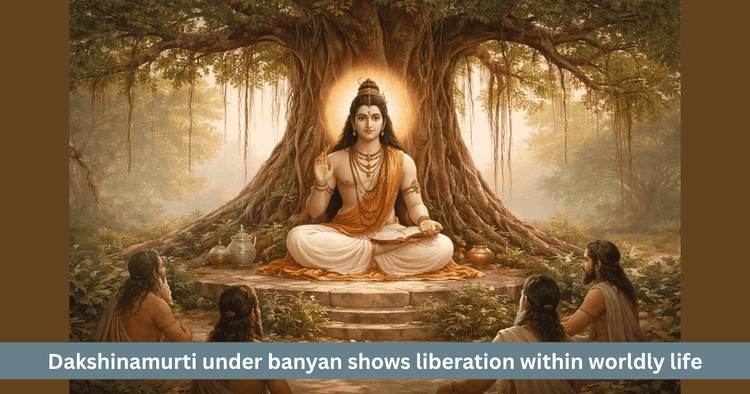
Table of Contents
In Indian spiritual tradition, the form of the guru is never merely that of a teacher who gives instruction. The guru becomes a living symbol. The form of Dakshinamurti, the guru aspect of Lord Shiva, is one of the deepest and most profound examples of this truth. In this form, Shiva is not only a deity of wisdom. He is revered as the silent guru, the giver of self knowledge and the guide who reveals liberation in the midst of bondage. One of the most significant aspects of Dakshinamurti’s iconography is that he is often shown seated beneath a banyan tree, known in Sanskrit as vata vriksha. This is not a decorative choice. It carries an immensely deep spiritual indication.
The banyan tree in Indian culture symbolizes stability, expansion, longevity, lineage and the complex spread of worldly existence. Its branches stretch outward and from them descend roots that sink again into the earth and form new supports. In this way, the tree does not grow only upward. It keeps binding itself to the ground through its own expansion. This is why it is often understood as a symbol of worldly existence, maya, karmic entanglement and the endless cycle of life. When the guru is shown seated beneath such a tree, the meaning becomes profound. It means that the guru does not teach liberation by escaping the world but by sitting directly in the midst of its very structure.
In the tradition of the Shiva Purana, this indication is regarded as highly meaningful. The banyan is not merely a place where the guru sits. It is itself part of the teaching. The guru sits beneath the very tree whose roots spread like the world and from there teaches that however far the roots of bondage extend, awakened consciousness can still rise beyond them. This is the most beautiful and enduring meaning of the entire episode.
Why is the banyan tree specifically chosen
In Indian tradition, every symbol has a purpose. If Dakshinamurti had been shown seated beneath an ordinary tree, the meaning would not have become so deep. The banyan is significant because it represents both the expansion of life and the expansion of bondage at the same time. Its branches spread outward and from them new roots descend downward and create new points of attachment.
Several features of the banyan make it especially suitable for this spiritual symbolism
- it is vast and long lived
- its branches and roots remain continuously interconnected
- it can spread in such a way that one tree seems like many
- its structure resembles the complexity of worldly entanglement
For this reason, the banyan ceases to be merely a tree. It becomes a symbol of that state in which human beings become caught in countless strands of relationship, desire, memory, karma and identity.
How do the roots of the banyan symbolize the world
The most extraordinary feature of the banyan tree is its roots. In ordinary trees, roots remain hidden below the earth. In the banyan, however new roots descend from the branches themselves. These roots then enter the earth and become fresh supports. This process continues again and again. That is why the banyan can eventually take on the form of a small forest.
Spiritually, this structure beautifully expresses the nature of worldly life. The world works in the same way. One desire gives rise to another. One relationship creates another connection. One action creates another consequence. One identity leads to another expectation. Thus human life becomes bound through its own expansion.
This may be understood more clearly in the following way
| Aspect of the banyan tree | Symbolic meaning of the world |
|---|---|
| Main trunk | The primary structure of life and ego identity |
| Expanding branches | Desires, relationships, roles and extensions |
| Descending roots | New karmic ties, new attachments, new dependencies |
| Vast spread | The endless web of birth, death and experience |
This table shows that seeing the banyan as a symbol of the world is not merely poetic imagination. It is a deep philosophical insight.
Why does the guru sit beneath that very tree
Here we arrive at the central beauty of the symbol. If the banyan represents the world, then the guru seated beneath it teaches that liberation is not attained by denying the world but by understanding it. Dakshinamurti is not sitting far away in some empty region outside existence. He is seated directly beneath the roots and branches of worldly life itself. This image is itself a teaching.
From beneath this tree, the guru teaches three great truths
- the world exists and cannot simply be denied
- the world contains bondage but bondage is not the final truth
- the knowledge of the guru can reveal freedom even in the midst of worldly entanglement
This is an extremely important lesson. The ordinary mind often thinks that if the world is complex, then spirituality must mean running away from it. But Dakshinamurti seated beneath the banyan shows that the true guru reveals liberation from within the world itself.
The relationship between the banyan and maya
In Indian philosophy, maya does not merely mean illusion. It also refers to the power by which the world appears as a compelling reality even though everything within it is transient. The structure of the banyan resembles this principle beautifully. It appears vast, enduring and complete, while at the same time its very structure keeps generating fresh bonds of continuity. Human beings experience worldly life in a similar way. They feel that this is final, permanent and fully real, even when it constantly changes.
Dakshinamurti does not cut down this maya with an axe. He sits beneath it and changes the seeker’s vision through knowledge. This means that bondage does not first break outwardly. It first loosens inwardly through right understanding. When vision changes, the very world that once appeared as a trap may begin to reveal itself as a field of learning.
Is the banyan only a symbol of bondage
No. This is what makes the symbolism so rich. The banyan is not only a symbol of the world’s entanglement. It is also a symbol of stability, shelter, continuity and living tradition. therefore Dakshinamurti beneath the banyan teaches that the world cannot be understood only as a problem. It contains bondage but it also contains the possibility of spiritual ripening.
The guru beneath the banyan teaches balance. He does not say that the world is only suffering. He does not say that the world is the final reality. He teaches that the world is a field of practice but final freedom lies in the realization of the Self beyond all attachment.
The silence of Dakshinamurti and the shade of the banyan
One of the greatest features of Dakshinamurti is his silent instruction. He teaches more through presence than through words. If this silence is understood together with the shade of the banyan, the symbolism becomes even deeper. The banyan casts vast shade. It covers, shelters and compels one to pause. Within that great shade, Dakshinamurti sits in stillness. This image naturally turns the seeker inward.
The shade of the banyan may be read in several ways
- the vast presence of the world
- the covering power of maya over the mind
- the place of stillness for practice amidst worldly complexity
- the shelter in which the guru purifies one’s vision
The silence of Dakshinamurti transforms the whole atmosphere. The very tree that symbolized bondage becomes, in the presence of the guru, the place of awakening.
The importance of this symbol in the Shiva Purana tradition
In the tradition of the Shiva Purana, this symbol is not regarded as a visual arrangement alone. Every form of Shiva carries profound metaphysical significance. Dakshinamurti beneath the banyan shows that Shiva is not merely the deity of dissolution but also the guru who cuts bondage. He understands the roots of worldly existence because he himself abides beyond them.
If this is seen more deeply, one realizes that the guru’s role is not to destroy the world but to reveal its true nature. Only when the seeker recognizes the endlessly spreading roots of attachment can the movement toward liberation begin. The tradition of the Shiva Purana thus indicates that the guru is never unaware of worldly complexity. He sits in the midst of it and reveals the secret of freedom.
What does this mean in the life of a seeker
If this episode is left only at the level of sacred story, then its practical value remains incomplete. In truth, every seeker carries a banyan tree within. It may be formed of habits, relationships, ego, karmic patterns, memory, fear, desire or unfinished longing. These become the branches and roots that continue to bind life.
In such a condition, Dakshinamurti beneath the banyan teaches the seeker
- recognize your bonds
- do not run away from them
- look at them through the vision of the guru
- awaken inwardly and rise beyond them
This is not a spirituality of escape. It is a spirituality of maturity. It is not about abandoning life but about placing life in its right perspective.
Main teachings for understanding the banyan and worldly bondage
To understand this symbol more clearly, a few central points may be remembered
- the spreading banyan shows that the world is not a straight line but a complex web
- the descending roots show that bondage keeps renewing itself in fresh forms
- the presence of the guru shows that bondage is not ultimate
- the instruction beneath the tree shows that knowledge is possible even amidst worldly life
- the sign of liberation shows that the outer web loosens only when inner attachment loosens
These points make it clear that the symbol is extremely alive and directly connected with the life of the seeker.
Why is this episode relevant in the modern age
Modern human beings may not live in forests, yet the banyan of worldly life has become even more widespread. Its roots are no longer limited to family and social structure. They now spread into digital identity, achievement, public image, financial anxiety, comparison, insecurity and constant mental restlessness. In such a time, Dakshinamurti seated beneath the banyan becomes even more relevant.
This episode teaches the modern seeker that
- the web of the world has changed its form but not its nature
- bondage still spreads, only in new ways
- liberation is still possible, if one’s vision changes through wisdom
- silence, steadiness and self knowledge remain as necessary as ever
In this way, the symbol of the banyan is not ancient only in form. It can still function as a powerful spiritual map for life today.
The final light of this episode
Dakshinamurti seated beneath the banyan tree is one of the most subtle and profound images in Indian spirituality. The tradition of the Shiva Purana teaches that the banyan is not merely a symbol of greatness but also of the spreading roots of worldly existence. And precisely beneath that tree, the guru is seated. This declares that however vast and complex the world may seem, wisdom is greater.
Dakshinamurti teaches that liberation is not found by running away from the world but by understanding bondage and rising beyond it. He sits beneath the roots and reveals the sky beyond all roots. This is the deepest beauty of the symbol. The guru does not deny the world. He lights the lamp of self knowledge within it and that lamp alone can finally free the seeker from bondage.
Frequently Asked Questions
Why is Dakshinamurti shown seated beneath the banyan tree
Because the banyan symbolizes the expanding bonds of worldly life and the guru teaches liberation from beneath that very symbol.
How do the roots of the banyan symbolize the world
The descending roots represent the ever spreading web of desires, karmas, attachments and relationships.
Is the banyan only a symbol of bondage
No. It also symbolizes stability, shelter, continuity and living tradition.
What is considered the main source of this interpretation
The principal source associated with this symbolism is the tradition of the Shiva Purana.
What can a seeker learn from this symbol
A seeker learns that even while living amidst the world, one can understand bondage through the guru’s wisdom and rise beyond it.
Get your accurate Kundali
Generate KundaliDid you like it?
Author

Pt. Suvrat Sharma (63)
Experience: 20
Consults About: Family Planning, Career
Clients In: Punjab, Haryana, Delhi
Share this article with friends and family
About ZODIAQ
ZODIAQ is an online Vedic Astrology platform. It connects clients seeking astrological advice to experienced astrologers with deep knowledge. Our users also generate kundali and perform kundali milan for free. ZODIAQ also offers services to the Astrologers. Astrologers utilize various offerings by ZODIAQ to serve their clients effectively.
If you are a User
Consult with experienced astrologers and seek their guidance. You can also order handwritten Janm Patrika report with life prediction prepared by experienced astrologers. Generate accurate Kundali, perform Kundali Matching and check horoscope and muhurat. Utilize our online library for all the necessary astrological and spiritual information.
If you are an Astrologer
Create accurate kundali for your clients and perform Kundali Matching for up to 5 people at a time. Write comprehensive Janm Patrika report for your clients with ZODIAQ. Check client details anytime by saving it in client directory. Become more productive by tracking how many clients you guide every day.
WELCOME TO
ZODIAQ
Right Decisions at the right time with ZODIAQ
