Dakshinamurti and Brahma’s Sons: The Power of Silent Teaching
By Pt. Sanjeev Sharma
When silence reveals the highest truth beyond words
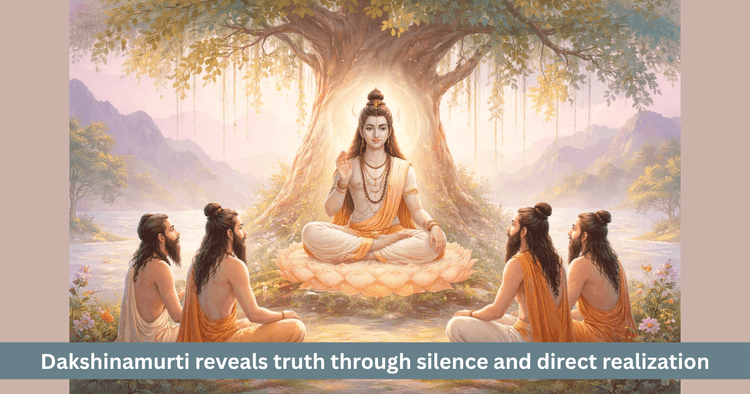
Table of Contents
In Indian spiritual tradition, certain episodes do not remain mere stories. They reveal the limits of conceptual knowledge, the greatness of direct experience and the supreme place of the guru principle. The episode associated with Dakshinamurti is one such profound revelation. When the great mind born sons of Brahma, Sanaka, Sanandana, Sanatana and Sanatkumara, asked Brahma himself about the highest truth, even the creator of the universe could not fully answer them in words. At that point, Lord Shiva manifested as Dakshinamurti and granted them the direct experience of that truth which cannot merely be heard but must be inwardly realized.
This episode is especially deep because the question here was not an ordinary question. It concerned existence, the Self, maya and ultimate reality. Brahma is indeed the creator of the universe, the knower of the Vedas and the lord associated with cosmic manifestation. Yet when the matter of final truth arose, the knowledge of creation was no longer sufficient. At that point, a guru was needed who could do more than explain. A guru was needed who could bring about direct realization. This is the very point at which the form of Dakshinamurti becomes unique in Indian philosophy.
The tradition associated with the Shrimad Bhagavata Purana teaches through this episode that knowing truth and becoming established in truth are two different things. Scripture may guide the intellect but final fulfillment comes only when inner ignorance becomes quiet. Dakshinamurti is the primordial guru of that silence.
Who were the Kumaras and why was their question so great
Sanaka, Sanandana, Sanatana and Sanatkumara are collectively known as the Kumaras. They are not regarded as ordinary sages. They symbolize innate renunciation, wisdom and the deepest spiritual inquiry. Their consciousness did not become trapped in the attractions of the world. From the beginning, they turned directly toward that truth which, once known, leaves no further hunger for outer attainment.
Their significance may be understood through a few important points
- they are regarded as the mind born sons of Brahma
- they turned toward Brahmavidya, the knowledge of ultimate reality, instead of worldly expansion
- their inquiry was not limited to ritual or religious formalities
- they wanted direct knowledge of the final truth
When such sages ask a question, it does not remain an intellectual query. It becomes the question of consciousness itself. That is why their inquiry before Brahma becomes so important.
Why did Brahma become silent and unable to answer
This is a very subtle question. Brahma is the creator and not lacking in knowledge. Why then did he become unable to answer. This does not mean that Brahma was ignorant. It means that the knowledge of creation and the direct experience of the supreme reality are two different levels. Brahma is associated with manifestation, names, forms and the structured universe. But the question of the Kumaras concerned that truth which lies beyond all name and form.
A very beautiful philosophical suggestion is hidden here. The consciousness through which the universe is created is still not the final and complete expression of the absolute. Creation is an expression but the truth itself is beyond that expression. therefore Brahma’s silence does not reveal inadequacy. It reveals the fact that certain questions can only be answered through realization, not through description alone.
That is why this episode turns toward the guru principle. When words reach their limit, Dakshinamurti appears.
Why was the form of Dakshinamurti needed
Dakshinamurti is the form of Shiva in which he appears as the primordial guru. He is not simply a deity who responds with blessings. He is the guru who dissolves the root of confusion. When the sons of Brahma sought final truth, they needed not merely a thinker but one who could establish their consciousness directly in reality itself.
The need for Dakshinamurti arose because
| Level of inquiry | Type of response needed |
|---|---|
| Scriptural question | Words and reasoning |
| Philosophical question | Reflection and analysis |
| Question of the Self | Silent realization |
| Inquiry into ultimate truth | Grace of the guru and direct awakening |
This table makes clear that when the question concerns the unity of the Self and the Absolute, language can only go so far. Beyond that point, the very presence of the guru becomes the answer.
What did Shiva as Dakshinamurti actually do
The most important aspect of this episode is that Dakshinamurti did not merely give an answer. He brought about the experience of truth. This distinction is essential. Knowledge obtained through words remains in memory. Knowledge obtained through direct realization enters one’s very being. The mode of teaching of Dakshinamurti belongs to this second category.
In many traditions, his teaching is called silent instruction. This does not mean that he simply said nothing and therefore knowledge arose magically. It means that his presence, his consciousness, his stillness and his grace awakened within the seekers that truth which they had been searching for outside themselves.
The work of the guru here was
- to quiet the question at its root
- to transform inquiry into fulfillment
- to convert knowledge into realization
- to establish the seeker in the truth of the Self
That is why Dakshinamurti is regarded not merely as a great knower but as the liberating guru.
Can silence truly become instruction
In ordinary life, we assume that teaching happens through speech. But Indian spirituality also affirms that the highest truth is often communicated most deeply through silence. This is because words create distinctions, while silence opens the possibility of unity. Words keep the mind active. Silence allows one to move beyond the mind.
The silent instruction of Dakshinamurti teaches that
- the final form of truth may lie beyond thought
- words give direction but silence gives inner steadiness
- the guru influences not only through speech but through conscious presence
- realization of the Self arises more naturally in inward stillness
This silence is not empty. It is living silence. The answer is fully present within it.
What was the real problem of the sons of Brahma
If this story is read inwardly, the problem of the Kumaras was not simply that they did not get an answer. Their problem was the problem of every serious seeker. One may know much, yet still lack the final certainty that only realization provides. Scripture may be present, reasoning may be present, meditation may be present, renunciation may be present but the heart is not fully at peace until truth becomes direct.
Every seeker can see oneself reflected in the Kumaras
- much has been heard but what has truly been known
- much has been understood but what has been lived
- much has been studied but what has been seen
- many questions have been asked but where is peace
The appearance of Dakshinamurti is the answer to this inner problem. He teaches that final truth is not poured into the seeker from outside. It is awakened from within.
How does this episode reveal the greatness of the guru
In Indian tradition, the guru is given the highest place because the guru does not merely provide information. The guru transforms consciousness. Even sages as elevated as the sons of Brahma required a guru when they reached the threshold of final truth. This clearly shows that there comes a point in spiritual life where personal effort must be met by the grace of the guru.
The episode reveals several essential qualities of the guru principle
- the guru does not merely give learned knowledge
- the guru reaches the root of the seeker’s question
- the guru leads the disciple from outer answers to inward realization
- the guru’s presence itself brings practice toward completion
That is why Dakshinamurti is not merely one form of Shiva. He is the eternal embodiment of the guru principle itself.
Is direct realization regarded as higher than scripture
In Indian philosophy, scripture holds a very exalted place. It guides, illumines and gives authority. Yet scripture is not meant only for intellectual accumulation. Its final purpose is realization. If even after studying sacred teaching the seeker remains unchanged inwardly, then knowledge remains incomplete. The episode of Dakshinamurti clarifies this beautifully.
This may be understood as follows
| Level of knowing | Result |
|---|---|
| Hearing | Listening |
| Reflection | Understanding |
| Deep contemplation | Assimilating inwardly |
| Realization | Becoming one with truth |
Dakshinamurti takes the disciple to the fourth level. That is what makes his form unique.
What is the psychological meaning of this episode
If read in a modern psychological light, this episode feels surprisingly relevant. Even today human beings possess much information, yet little peace. They search for answers, yet clarity remains distant. They try to understand everything through intellect, while existential balance belongs to a deeper level than intellect alone. The silence of Dakshinamurti teaches that what the inner being requires is not always more information but often deep stillness.
This episode also teaches the modern mind that
- not every question finds its true resolution in words
- some truths must descend into life, not remain in thought
- the right guru quiets the noise within
- the purpose of knowledge is not to burden the mind but to free it
What can a seeker learn from this story
This episode is not only a Puranic narrative. It is also a spiritual path in symbolic form. A seeker can receive many deep insights from it.
Main teachings of this episode
- the search for truth is the highest of all inquiries
- knowledge of creation alone is not the final truth
- the guru is the one who turns truth into experience
- silence too can be true instruction
- self realization is not an intellectual achievement but an existential transformation
To bring these teachings into life is the real fruit of this story.
Why does this episode remain so powerful even today
Because the essential question of the human being remains unchanged. One still wants to know who one is, what life means and what the lasting truth is amidst death, change, instability and maya. Science order and achievement may all be valuable but final fulfillment comes only when the inner restlessness is quieted. This is exactly the message of Dakshinamurti and it is as necessary now as it was in the time of the Kumaras.
The final radiance of this episode
When the sons of Brahma, Sanaka, Sanandana, Sanatana and Sanatkumara, approached their father in search of final truth and found that their inquiry still remained unsatisfied, Lord Shiva appeared as Dakshinamurti and granted them that realization which cannot be confined within language. This tradition of the Shrimad Bhagavata Purana reveals one of the highest truths of Indian spirituality, namely that knowledge of creation is great but direct realization of one’s true nature is greater. And it is the guru who opens the doorway to that realization.
That is why Dakshinamurti is not merely a teacher. He is the living presence of truth itself. He teaches that when intellect reaches its end, grace begins its work. When words fall silent, true silence speaks. When inquiry ripens fully, the guru transforms it not into an answer but into direct experience. This is the deepest and most enduring meaning of the story.
Frequently Asked Questions
Who were Sanaka, Sanandana, Sanatana and Sanatkumara
They are regarded as the mind born sons of Brahma and symbols of high wisdom and renunciation.
Why could Brahma not answer fully
Because the direct realization of ultimate truth lies beyond the level of creation knowledge and cannot be fully expressed in words alone.
What did Dakshinamurti do
He appeared in the form of the guru and granted the sons of Brahma direct realization of truth through silence and self awakening.
Can silence also be teaching
Yes. In Indian spirituality, silence is often regarded as a teaching greater than speech because it directly touches consciousness.
What is considered the main source of this episode
The principal source of this narrative is the tradition associated with the Shrimad Bhagavata Purana.
Get your accurate Kundali
Generate KundaliDid you like it?
Author

Pt. Sanjeev Sharma (63)
Experience: 20
Consults About: Family Planning, Career
Clients In: Punjab, Haryana, Delhi
Share this article with friends and family
About ZODIAQ
ZODIAQ is an online Vedic Astrology platform. It connects clients seeking astrological advice to experienced astrologers with deep knowledge. Our users also generate kundali and perform kundali milan for free. ZODIAQ also offers services to the Astrologers. Astrologers utilize various offerings by ZODIAQ to serve their clients effectively.
If you are a User
Consult with experienced astrologers and seek their guidance. You can also order handwritten Janm Patrika report with life prediction prepared by experienced astrologers. Generate accurate Kundali, perform Kundali Matching and check horoscope and muhurat. Utilize our online library for all the necessary astrological and spiritual information.
If you are an Astrologer
Create accurate kundali for your clients and perform Kundali Matching for up to 5 people at a time. Write comprehensive Janm Patrika report for your clients with ZODIAQ. Check client details anytime by saving it in client directory. Become more productive by tracking how many clients you guide every day.
WELCOME TO
ZODIAQ
Right Decisions at the right time with ZODIAQ
