Flame in Dakshinamurti’s Hand: Symbol of Inner Illumination
By Pt. Amitabh Sharma
Understanding the fire that burns ignorance and reveals self knowledge
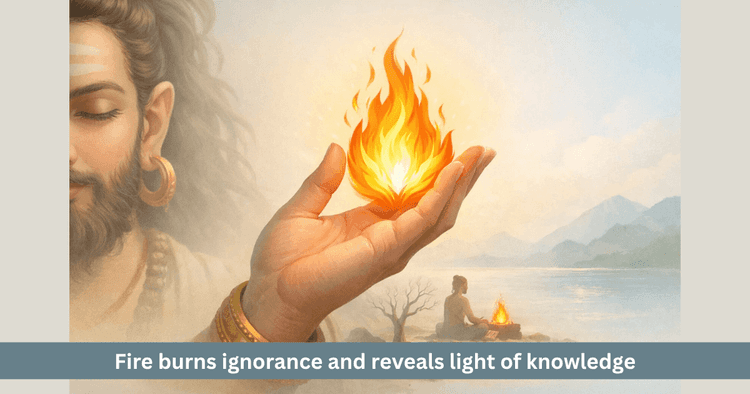
Table of Contents
In Indian spirituality, Lord Dakshinamurti is not understood merely as a gentle form of Shiva but as the divine embodiment of the Guru principle, Self knowledge and silent revelation. Every symbol in his form directs the seeker inward. Among these, one of the most powerful is the flame held in his hand. This flame is not regarded as an ordinary fire. It symbolizes that divine power which burns away the darkness of ignorance and spreads the light of knowledge.
This form of Dakshinamurti offers a very clear teaching. Knowledge does not arise through pleasant words alone. At times, inner inertia, confusion, attachment and darkness must be burned away. The flame is the symbol of this inner transformation. It destroys, yet not for destruction alone. It purifies, illuminates and brings the seeker closer to true being. This is why the flame in the hand of Dakshinamurti carries such depth of meaning.
Why is the flame so important in the form of Dakshinamurti
Dakshinamurti is commonly revered as the silent Guru. He teaches the disciple not only through speech but through presence itself. The book, the rudraksha, the gesture of wisdom and the flame in his hands all show that the work of the Guru is many sided. He does not merely offer scripture, nor only guide practice. He also removes the ignorance hidden within the disciple. In this process, the flame becomes indispensable.
The flame here is not the fire of anger. It is the fire of discernment. It is the power that burns the false so that the true may become visible. The presence of flame in the hand of Dakshinamurti means that the Guru possesses not only compassion but also the radiant force of transformation. He does not merely console. He changes the seeker.
Why is the flame called the symbol that burns the darkness of ignorance
In Indian philosophy, ignorance does not mean merely having little information. Ignorance means not knowing one’s real nature, mistaking the temporary for the eternal, clinging to confusion as if it were truth and drifting away from the deeper purpose of life. This darkness is inward, not outward. That is why an outer light is not enough to remove it. An inner fire is needed.
The flame in the hand of Dakshinamurti symbolizes that inward light. It does not push darkness away. It burns it. Where there is flame, inertia cannot remain. Where knowledge becomes fire, confusion slowly loses its force. This is why the flame of Dakshinamurti is not only a sign of brightness but also of the destruction of ignorance through wisdom.
Main spiritual indications of the flame
- Burning away ignorance
- Inner purification
- Awakening discernment
- Spreading the light of knowledge
Is this flame only a symbol of destruction
No. It is very important to understand that the flame of Dakshinamurti does not destroy alone. In Indian tradition, fire always has a double meaning. It burns, yet it also purifies. It reduces to ash, yet it also sanctifies. In sacrifice, fire carries offerings upward. In austerity, fire refines the seeker. In wisdom, fire removes confusion and gives clarity.
Seen in this way, the flame in the hand of Dakshinamurti is the power of transformation. It can burn away what is false, lazy, confused and fear bound within the seeker. Yet in the same movement, it also makes the mind pure, the intellect alert and consciousness radiant. Therefore the flame symbolizes both destruction and illumination together.
Why is the relationship between the Guru and fire so deep
The work of the Guru is not merely to give information. A true Guru begins a process within the disciple in which old false assumptions break and new clarity is born. This process can be gentle, yet at times it can also be intense. Ignorance does not leave easily, because the mind clings to its old structures. In this sense, the knowledge of the Guru often works like fire.
This is why Dakshinamurti is revered as the supreme Guru. His flame is not meant to break the disciple but to awaken the disciple. It takes light into the dark corners of the mind. It brings hidden confusion into view. It shakes inertia and then creates a place where knowledge may become steady. This is the real meaning of Guru fire.
How the Guru flame works
- It first recognizes confusion
- Then it burns ignorance
- After that it awakens discernment
- Finally it stabilizes knowledge
How does Shilpa Shastra deepen this symbol
In Shilpa Shastra, every limb, gesture and attribute of a sacred image is determined with deep intention. The flame in the hand of Dakshinamurti also reflects this seriousness of tradition. It is not a decorative feature. It is an effort to make philosophy visible through form. This shows that the image is not only a center of worship but also a lesson in contemplation.
When Shilpa Shastra places fire in the hand of a deity, it signals to the seeker that some inner heaviness must be removed through the contemplation of that divine form. In the case of Dakshinamurti, that heaviness is ignorance. That is why the flame makes the image living. It declares that here knowledge is not only silent. It is also radiant awakening.
Is this flame also connected with austerity
Yes. The flame in the hand of Dakshinamurti may also be linked with tapas, meaning austerity or inner heat of discipline. Tapas does not mean suffering for its own sake. It means refining oneself to such a degree that inner impurities begin to burn away. The flame may be seen as an outer symbol of that tapas. The seeker who desires truth must eventually place laziness, uncontrolled desire, intellectual ego and spiritual carelessness into the fire of discipline.
This is why the form of Dakshinamurti is not merely a teaching of Guru grace. It is also a call to practice. It says that the wish for knowledge is not enough. Worthiness is also needed. And worthiness is shaped by fire. That fire may appear outwardly but more deeply it is the fire of discipline, alertness and inner sincerity.
In what forms does the darkness of ignorance appear within the seeker
This question is essential, because unless the seeker recognizes inner darkness, the symbol of the flame remains only an outer image. Ignorance can appear in many forms. Sometimes it comes as ego. Sometimes as the idea I already know. Sometimes as spiritual laziness. Sometimes as the weakness of hearing truth yet failing to live it. Sometimes as confused decisions and an unstable mind.
The flame of Dakshinamurti gives the courage to look at these states. It says that whatever within is meant to burn should not be protected. What is false must be left behind. What is confused must be recognized. Only then can the light of knowledge truly spread.
Possible forms of ignorance within the seeker
- Ego
- Laziness
- Spiritual instability
- Hearing truth yet not living it
- Lack of discernment
What does it mean that the flame spreads the light of knowledge
When it is said that this flame spreads the light of knowledge, the meaning is not merely intellectual understanding. Here knowledge means an awakened vision of life. It is the light by which the seeker begins to see the Self, actions, fears, purpose and the relation to ultimate reality with greater clarity. This light is not imposed from outside. It unfolds from within.
The flame of Dakshinamurti first removes the covering and then reveals the light. Therefore the spreading of knowledge here is not the spreading of information. It is the expansion of consciousness. Where earlier there was darkness, now seeing becomes possible. Where earlier there was confusion, now direction emerges. Where earlier there was fear, now peace begins to arise.
How can the seeker bring this flame into life
To bring the flame of Dakshinamurti into life means to awaken the fire of discernment within. For this, the seeker may cultivate a few simple yet deep practices. Regular study, silent reflection, contemplation upon the words of the Guru, japa, meditation, truthful self examination and a refusal to compromise with what is false, these are ways to keep that inner flame alive.
This fire should not burn like anger. It should burn like awareness. It should not burn others. It should refine the self. When the seeker awakens such a flame within, the symbol of Dakshinamurti ceases to be only an image for reverence. It becomes a way of living.
Practical directions for the seeker
- Daily silent reflection
- Study together with self examination
- Not clinging to false assumptions
- Bringing the Guru’s word into life
- Learning to burn inwardly for truth
A simple table to understand this theme
| Element | Deeper meaning |
|---|---|
| Flame | Burning ignorance and spreading knowledge |
| Dakshinamurti | Divine Guru of silence and awakening |
| Darkness | Confusion, ego and forgetfulness of the Self |
| Light | Discernment, clarity and Self realization |
| Shilpa Shastra | Tradition that turns symbols into philosophy |
Why is this symbol even more relevant today
The modern age is full of information but not full of inner clarity. People know much but know themselves very little. Decisions are quick but direction is weak. Words are many but light is little. In such a time, the flame in the hand of Dakshinamurti becomes especially relevant. It reminds us that the real problem is not outer darkness but inner confusion. And the real solution is not external brightness but inner wisdom.
For this reason, the symbol speaks deeply to the present age. It says do not merely collect knowledge. Turn it into fire. Let it become powerful enough to burn the false foundations within and reveal the true one. This is one of the most necessary spiritual disciplines of the present time.
The Guru light hidden in the flame
The flame in the hand of Dakshinamurti finally leads us toward a beautiful truth. The Guru is not only the one who comforts. The Guru also leads the disciple out of darkness. By recognizing inner error, attachment and confusion, the Guru burns them away so that wisdom may become steady. This is the real meaning of the flame.
When the seeker understands this symbol deeply, it becomes clear that in spiritual life gentleness alone is not enough. At times, intensity is also needed. But that intensity must not be destructive. It must be awakening. The flame of Dakshinamurti is such intensity. It burns but in order to free. It shines but in order to awaken inner light. This is the most lasting and luminous teaching of the symbol.
Frequently asked questions
What does the flame in the hand of Dakshinamurti symbolize
It is generally understood as a symbol of burning ignorance and spreading the light of knowledge.
Is this flame only a sign of destruction
No. It also symbolizes purification, transformation and the awakening of discernment.
What is meant by the darkness of ignorance
Ignorance means not knowing one’s real nature, living in confusion and remaining far from truth.
What is the importance of this flame in Shilpa Shastra
Shilpa Shastra sees it as an important symbol of the philosophical teaching hidden within the form of Dakshinamurti.
What message does this symbol offer the seeker
It teaches that only by burning away inner confusion, ego and darkness can the true light of knowledge arise.
Get your accurate Kundali
Generate KundaliDid you like it?
Author
Pt. Amitabh Sharma (56 Years)
Experience: 20
Consults About: Family Planning, Career
Clients In: Punjab, Haryana, Delhi
Share this article with friends and family
About ZODIAQ
ZODIAQ is an online Vedic Astrology platform. It connects clients seeking astrological advice to experienced astrologers with deep knowledge. Our users also generate kundali and perform kundali milan for free. ZODIAQ also offers services to the Astrologers. Astrologers utilize various offerings by ZODIAQ to serve their clients effectively.
If you are a User
Consult with experienced astrologers and seek their guidance. You can also order handwritten Janm Patrika report with life prediction prepared by experienced astrologers. Generate accurate Kundali, perform Kundali Matching and check horoscope and muhurat. Utilize our online library for all the necessary astrological and spiritual information.
If you are an Astrologer
Create accurate kundali for your clients and perform Kundali Matching for up to 5 people at a time. Write comprehensive Janm Patrika report for your clients with ZODIAQ. Check client details anytime by saving it in client directory. Become more productive by tracking how many clients you guide every day.
WELCOME TO
ZODIAQ
Right Decisions at the right time with ZODIAQ
