Dakshinamurti and Gayatri Mantra: Silent Guru and Vedic Light
By Pt. Sanjeev Sharma
Understanding the unity of mantra, silence, and divine consciousness
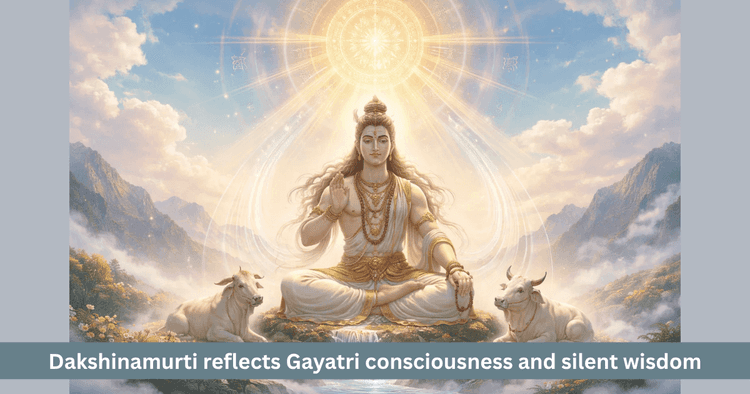
Table of Contents
In Indian spiritual tradition, there are certain symbols that seem different at first glance, yet inwardly they are expressions of the same truth. The relationship between Dakshinamurti and the Gayatri Mantra belongs to this profound category. Dakshinamurti is generally known as the primordial guru, the silent teacher and the giver of self knowledge, while the Gayatri Mantra is revered as the essence of the Vedas, the great mantra of illumination and the highest form of divine prayer. Yet in some hidden Tantric traditions there is a suggestion that Dakshinamurti is the masculine embodiment of the Gayatri Mantra. This idea is not merely poetic imagination. It is a subtle and deeply spiritual insight.
In the tradition associated with the Rudrayamala Tantra, this understanding appears in a suggestive form. A mantra is not merely sound and a deity is not merely an image. A mantra may be the verbal form of a deity and a deity may be the embodied consciousness of a mantra. If viewed in this way, the Gayatri Mantra ceases to be only a recitable sacred formula. It becomes a luminous stream of consciousness. In the same way, Dakshinamurti ceases to be only a divine image or a form of the guru. He appears as the living and awakened masculine embodiment of that same stream.
This idea becomes especially fascinating because the Gayatri Mantra is generally associated with light, intelligence, prayer and sacred inspiration, while Dakshinamurti is associated with silence, self knowledge, inner vision and realization of truth. When the two are brought together, it begins to become clear that light and silence, mantra and guru, sound and experience, are not opposites. They are two directions of the same ultimate reality. This is the heart of the entire episode.
Why has the Gayatri Mantra been given such an exalted place
In the Vedic tradition, the Gayatri Mantra is regarded as one of the most sacred and transformative mantras. It is not merely a prayer. It is understood as a means of purifying, centering and illuminating consciousness. Its repetition is not just the repetition of words. It is a call for the awakening of divine intelligence. It is a movement from inner darkness toward light.
A few important points help explain its greatness
- it is associated with light and awakening of intelligence
- it is a prayer for the strengthening of discernment
- it is more concerned with inner inspiration than outer achievement
- it is regarded as a means of linking the human being with divine consciousness
When a tradition says that Dakshinamurti is the masculine embodiment of the Gayatri Mantra, it means that the same power which flows in the mantra as sound appears in Dakshinamurti as the living presence of the guru.
How does the guru form of Dakshinamurti deepen this relationship
The form of Dakshinamurti in Indian philosophy is not merely a symbol of scholarship. He is the guru of self realization. He does not give knowledge that remains only in memory. He grants an experience that changes the way the seeker sees. therefore if the Gayatri Mantra leads the intellect toward divine illumination, Dakshinamurti appears as the guru who stabilizes that illumination in living realization.
Three features of Dakshinamurti especially deepen this relationship
- he teaches through silence
- he awakens inner insight
- he leads the seeker from outer knowledge to inner truth
The Gayatri Mantra is the prayer that the intellect may be illumined. Dakshinamurti is the guru of that illumined intelligence who can finally guide it toward self knowledge. In this way, the relationship between mantra and guru becomes vividly alive.
What does “masculine embodiment” actually mean here
The phrase “masculine embodiment” must be understood carefully. It does not refer merely to social gender. In Indian Tantric and philosophical language, the word “purusha” may signify consciousness, witness being, the unmoving Self or the awakened principle. On the other hand, mantra or Shakti may signify the dynamic, flowing, expressive aspect of that same reality.
In that light, the statement may be understood as follows
- the Gayatri Mantra is the power of divine consciousness in sound form
- Dakshinamurti is the witness and guru form of that same consciousness
- the mantra is a flow, the guru is its awakened center
- the mantra is sound, the guru is the lived meaning of that sound
Thus to call Dakshinamurti the masculine embodiment of the Gayatri Mantra means that he is the stable, witnessing, guru form of the consciousness hidden within the mantra.
Can mantra and deity be forms of the same truth
The answer of Indian Tantra and mantra tradition is clearly yes. In that tradition, mantra is not merely sound. It is structured consciousness in vibrational form. In the same way, a deity is not merely an icon but the embodied and experiential center of that same power. That is why deities are linked with seed mantras, root mantras, heart mantras and Gayatri mantras.
This relationship can be understood in a simple way
| Element | Mantra form | Deity form |
|---|---|---|
| word | vibration and utterance | living presence |
| power | flowing consciousness | concentrated consciousness |
| practice | repetition and meditation | vision and surrender |
| fruit | awakening within | realization and grace |
This table makes clear that mantra and deity are not two separate entities. They can be two modes of one truth. The relationship between Dakshinamurti and the Gayatri Mantra can be understood on this basis.
How does the Rudrayamala Tantra tradition deepen this vision
Tantric texts often speak in symbolic and suggestive language. They do not always explain everything directly. In the tradition associated with the Rudrayamala Tantra, to regard Dakshinamurti as the masculine embodiment of the Gayatri Mantra is not to create a merely new image of divinity. It means that the guru principle of Shiva is linked with that Vedic stream of light which illumines the intellect and consciousness of the seeker.
From this angle, the episode opens three deep dimensions
- there is no opposition between Vedic mantra and Tantric realization
- the guru principle gives living depth to the meaning of mantra
- light and silence together lead the seeker toward wholeness
This is why the idea is so elevated and worthy of contemplation.
What is the inner relationship between Dakshinamurti and Gayatri
If this episode is not treated merely as a textual statement but felt inwardly, an extraordinary relationship begins to appear between the two.
Some subtle points of correspondence
- the Gayatri Mantra is a prayer for the illumination of intelligence
- Dakshinamurti is the guru who quiets ignorance
- the Gayatri Mantra turns the seeker toward inner light
- Dakshinamurti teaches how to become steady in that light
- the Gayatri Mantra is awakening in sound
- Dakshinamurti is awakening in silence
From these points it becomes clear that although their modes differ, their purpose is one and that purpose is to lead the seeker to inner radiance.
Is this relationship only Tantric or also philosophical
This relationship is certainly Tantric but it is not only Tantric. It also contains a deep philosophical meaning. If the essence of the Gayatri Mantra is to direct the intellect toward the divine and the essence of Dakshinamurti is to direct the seeker toward self realization, then a natural sequence becomes visible. First the intellect is purified, then discernment deepens and then through the grace of the guru the ground is prepared for realization.
This may be understood through the following movement
- the mantra changes the direction of the mind
- the guru changes the state of being
- the mantra prepares inwardly
- the guru transforms that preparation into realization
Thus the relationship is not only one of worship. It is also a map of spiritual unfolding.
How do the sound of Gayatri and the silence of Dakshinamurti work together
This is a beautiful question. At first it may seem that the Gayatri Mantra is sound while Dakshinamurti is silence and therefore the two stand in contrast. But in Indian spirituality, mantra and silence are not opposites. Mantra can gradually carry the seeker to that point where sound dissolves into silence. Silence, in turn, may be the state in which the meaning of the mantra becomes fully realized.
Thus
- Gayatri may begin the inward journey
- Dakshinamurti may bring it toward self realization
- mantra purifies the mind
- the guru leads the seeker beyond the mind
This is the deepest beauty of the relationship. Sound and silence become two stages of one spiritual path.
What does this episode mean in the life of a seeker
If a seeker applies this insight inwardly, it becomes clear that spiritual progress is not achieved by isolating scripture, mantra, guru and meditation from one another. They can all become stages of one unified journey. If the seeker repeats the Gayatri Mantra, purifies the intellect, sharpens discernment and then surrenders before the guru principle of Dakshinamurti, the path may become more complete.
Main indications for the seeker
- do not treat mantra as mere recitation but as a means of transforming consciousness
- do not treat the guru as merely a lecturer but as the awakener of realization
- recognize the journey from sound into silence
- connect outer worship with inner light
- understand the need for both knowledge and grace
These indications turn the episode into a living path of practice.
Why is this idea relevant in the modern world
Modern human beings possess much information, yet little inward illumination. They may repeat mantras, yet remain inwardly restless. They may study knowledge, yet fail to awaken inner light. In such a time, the relationship between Dakshinamurti and Gayatri becomes deeply relevant. It teaches that sound alone is not enough, thought alone is not enough and ritual alone is not enough. All of these must be carried toward the maturity of consciousness through the guru principle.
The final light of this episode
The idea that Dakshinamurti is the masculine embodiment of the Gayatri Mantra in certain hidden Tantric traditions is one of the profound insights of Indian spirituality. The tradition associated with the Rudrayamala Tantra suggests that mantra and deity, sound and silence, illumination and realization, are not separate islands. They are interconnected streams of one reality. The Gayatri Mantra turns consciousness toward light and Dakshinamurti becomes the guru who establishes that light in self realization.
That is why this episode is not only a Tantric secret. It is also a beautiful map of spiritual practice. First let the mantra purify the intellect. Then let the grace of the guru transform vision. Finally let the seeker recognize the silent radiance within. This is the deepest meaning of the relationship between Dakshinamurti and the Gayatri Mantra.
Frequently Asked Questions
Why is Dakshinamurti called the masculine embodiment of the Gayatri Mantra
Because in some Tantric traditions he is regarded as the awakened guru form of the divine consciousness contained within the Gayatri Mantra.
What does masculine embodiment mean here
It is not used in a merely social sense. It points instead to witness consciousness, stable principle and the awakened guru form.
Can mantra and deity be forms of the same truth
Yes. In Indian mantra and Tantra tradition, the mantra may be understood as the sound form of divine power and the deity as its embodied consciousness.
What is regarded as the main source of this idea
The principal source associated with this view is the Tantric tradition linked with the Rudrayamala Tantra.
What can a seeker learn from this episode
A seeker may learn that mantra, guru, silence and inner light can together form a complete path toward self realization.
Get your accurate Kundali
Generate KundaliDid you like it?
Author

Pt. Sanjeev Sharma (63)
Experience: 20
Consults About: Family Planning, Career
Clients In: Punjab, Haryana, Delhi
Share this article with friends and family
About ZODIAQ
ZODIAQ is an online Vedic Astrology platform. It connects clients seeking astrological advice to experienced astrologers with deep knowledge. Our users also generate kundali and perform kundali milan for free. ZODIAQ also offers services to the Astrologers. Astrologers utilize various offerings by ZODIAQ to serve their clients effectively.
If you are a User
Consult with experienced astrologers and seek their guidance. You can also order handwritten Janm Patrika report with life prediction prepared by experienced astrologers. Generate accurate Kundali, perform Kundali Matching and check horoscope and muhurat. Utilize our online library for all the necessary astrological and spiritual information.
If you are an Astrologer
Create accurate kundali for your clients and perform Kundali Matching for up to 5 people at a time. Write comprehensive Janm Patrika report for your clients with ZODIAQ. Check client details anytime by saving it in client directory. Become more productive by tracking how many clients you guide every day.
WELCOME TO
ZODIAQ
Right Decisions at the right time with ZODIAQ
